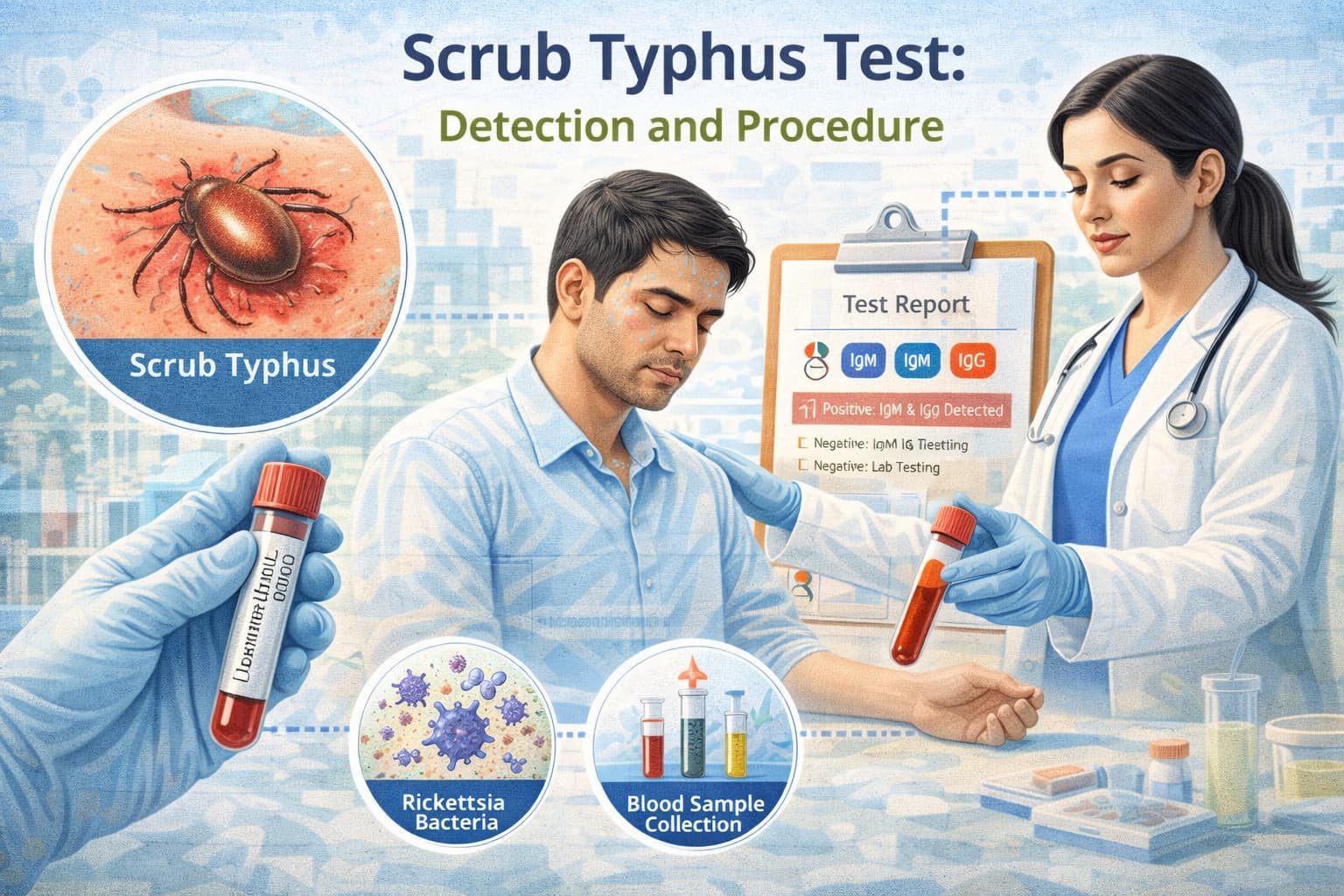
Scrub typhus is caused by Orientia tsutsugamushi, transmitted through the bite of infected chiggers. The condition progresses rapidly and may lead to multi-organ involvement, creating diagnostic challenges for pathology labs in India and clinicians. Early identification through a scrub typhus test strengthens and supports timely therapy.
Among available diagnostics, the Scrub Typhus IgM ELISA is a priority due to its sensitivity in the early immune phase, when IgM antibodies begin to appear within the first week of infection.
For pathology labs modernising their workflows, clarity on test methodology, interpretation, and structured reporting is essential.
Understanding the Scrub Typhus Test in Clinical Diagnostics
A scrub typhus test identifies the presence of IgM antibodies directed against O. tsutsugamushi. As IgM rises early, the test supports rapid detection during the acute phase. The assay quantifies antigen–antibody interactions through an ELISA format, reducing subjectivity compared with legacy tests.
Laboratories rely on the test for cases presenting with undifferentiated febrile illness, eschar presence, thrombocytopenia, or elevated transaminases. Early positivity accelerates antimicrobial initiation and reduces the risk of complications.
Detection Principles
The Scrub Typhus IgM ELISA uses coated antigens that bind to IgM antibodies in patient serum. After conjugation and substrate addition, optical density values indicate reactive or non-reactive status. Compared with lateral flow assays, ELISA delivers higher accuracy with validated kits and QC processes.
Advantages of the Test
- Detects early-phase antibodies.
- High analytical sensitivity.
- Standardised quantification.
- Compatibility with automated microplate systems.
- Supports structured result reporting in LIS environments.
Scrub Typhus Test Procedure
The scrub typhus test procedure varies slightly by kit. But core steps are consistent across validated assays.
Sample collection
- 2–3 mL of venous blood collected in a plain tube.
- Serum separated after clotting.
- Avoid hemolysis to prevent assay interference.
Reagent preparation
- Bring reagents to room temperature.
- Dilute wash buffers to manufacturer specifications.
Sample dilution: Serum diluted as required before plate inoculation.
Microplate inoculation: Add diluted samples, positive control, and negative control into designated wells.
Incubation: Follow kit-specific temperature and duration settings.
Washing cycle: Complete required washes to remove unbound components.
Conjugate addition: Introduce enzyme-linked antibodies.
Substrate addition: Allow colour development under controlled time and light exposure.
Reaction termination: Add stop solution.
Optical density reading: Measure absorbance at specified wavelength.
Operational Requirements for an Accurate Test
| Parameter | Requirement | Notes |
|---|---|---|
| Sample type | Serum | Avoid lipemic or hemolysed samples |
| Minimum volume | 50–100 µL | Varies by kit |
| Temperature control | Stable incubation conditions | Impacts IgM binding |
| Plate reader | 450 nm ± reference filter | Essential for ELISA workflow |
| Internal QC | Positive & negative controls | Validates each run |
Interpretation
In a test report, a scrub typhus test positive means IgM antibodies have been detected, confirming active or recent infection. Interpretation of the test should consider the below.
- Day of illness.
- Antibody kinetics.
- Cross-reactivity with other rickettsial diseases.
- Clinical correlation and symptom onset.
Negative results early in illness may require repeat testing due to delayed seroconversion in some cases.
Scrub Typhus Test Normal Range and Cutoffs
| Result Type | Index/OD Value | Interpretation |
|---|---|---|
| Non-reactive | Below cutoff | No IgM detected |
| Borderline | Around cutoff | Recommend repeat testing |
| Reactive | Above cutoff | IgM antibodies detected |
Turnaround Time: Lab Efficiencies
The scrub typhus test time depends on reagent incubation cycles, plate washing efficiency, and batch size. Most ELISA workflows deliver results within 3–5 hours after sample processing. Labs focused on operational excellence emphasise,
- Batch optimisation.
- Reduced idle time between incubations.
- Automated calculation and reporting.
- Real-time tracking of plate status.
The turnaround time of the test directly impacts clinical response during peak monsoon seasons when case volumes increase.
Reporting Standards and Structure
A well-structured scrub typhus test report format ensures clarity for clinicians, surveillance teams, and internal audits. Hence, the reporting must include the following.
- Test name.
- Methodology (IgM ELISA).
- Observed OD/index value.
- Qualitative interpretation.
- Reference ranges.
- Comments on clinical correlation.
Modern LIS platforms enable customised formatting with dynamic fields, automated interpretations, digital signatures, and QR codes for instant access.
Elements in a Test Report Format
| Section | Required Fields |
|---|---|
| Patient Information | Name, age, sex, ID, referring clinician |
| Sample Details | Sample type, collection time, accession number |
| Analytical Details | Method, kit details, QC validity |
| Results | Quantitative value + qualitative status |
| Interpretation | IgM reactivity statement |
| Additional Notes | Recommendation for repeat testing or correlation |
| Authentication | Digital signatures, date & time |
LIS Integration: Strengthening Lab Operations
A powerful LIS is now integral to operational excellence in infectious disease diagnostics. Flabs, an AI-driven LIS, improves the full lifecycle of the scrub typhus test from registration to reporting.
Core Capabilities
- AI Interpretation for preliminary result generation aligned with lab rules.
- AI Test Suggestion for fever panels based on patient history.
- AI Flagger to instantly highlight abnormal values.
- AI Smart Report to structure the scrub typhus IgM report with precision.
- TAT Management to track each sample in real time and ensure on-schedule release.
- Bulk Registration & Bulk Approval during seasonal surge testing.
- Dynamic QR Code for secure report verification.
- Bar Code support for reliable sample tracking.
- Quality Control automation to validate each ELISA batch.
- AI Voice Reporting for rapid dictation of interpretive notes.
- Multiple Referral Management for transparent financial workflows.
- Finance automation to manage billing for standalone or panel tests.
These capabilities elevate diagnostic confidence and reduce administrative load. It.supports smooth coordination between lab teams and clinicians.
Bringing It Together
The scrub typhus test is central to laboratory evaluation of acute febrile illness in endemic regions. IgM ELISA remains at the forefront of detection, thanks to its early-phase sensitivity and structured analytical workflow. Clear procedures, validated kits, reliable QC, and standardised reporting frameworks safeguard diagnostic accuracy.
As case loads fluctuate seasonally, AI-powered platforms such as Flabs provide operational resilience, viz., real-time monitoring, automated interpretations, intelligent reporting, and traceable QC.
These capabilities give laboratories a stable backbone for infectious disease diagnostics and strengthen clinical outcomes through timely, reliable reports.
Also CHECK - Rheumatoid Factor Test: Purpose and Interpretation
Get Started at ₹1!
Try Flabs for a full month for just ₹1.
Follow us on