
The Triple Sugar Iron Test (TSI) stands as a cornerstone in microbiological diagnostics, particularly for identifying Gram-negative enteric bacteria. Beyond its ability to differentiate sugar fermentation and gas production, the TSI test also highlights critical environmental influences on bacterial metabolism. Factors such as oxygen availability, incubation conditions, and medium composition can impact test outcomes, providing deeper awareness into microbial behavior.
While we focuse on principles and procedures of the Triple Sugar Iron AGAR test, it’s essential to recognise the TSI test’s adaptability in detecting atypical bacterial patterns. It adds value in both diagnostic accuracy and bacterial taxonomy.
What is Triple Sugar Iron Test
The Triple Sugar Iron (TSI) test is a biochemical method used to differentiate bacteria based on their sugar fermentation patterns and gas production. It helps identify Gram-negative enteric bacilli by assessing their ability to utilise specific carbohydrates and produce hydrogen sulfide.
The test relies on changes in pH and gas production to indicate bacterial metabolic activity. By observing color changes and other reactions in the medium, the triple sugar iron test aids in distinguishing between different bacterial groups, supporting microbiological diagnostics and research. For example, to diagnose gastrointestinal infections.
Triple Sugar Iron AGAR Test Principle
The Triple Sugar Iron (TSI) Agar test differentiates bacteria based on their carbohydrate fermentation patterns and hydrogen sulfide production. Imagine a tube filled with a specialised agar containing three sugars—lactose, sucrose, and glucose—and an indicator, phenol red, which changes colour depending on pH.
When bacteria ferment sugars, they produce acid, turning the medium yellow (acidic). When there’s only glucose fermentation in triple sugar iron test, the limited acid quickly oxidises at the slant, reverting it to red (alkaline), while the butt stays yellow due to low oxygen. Fermentation of lactose or sucrose produces enough acid to keep the entire tube yellow.
Hydrogen sulfide production adds another layer of differentiation, forming a black precipitate in the butt. The tube’s loosely closed cap ensures proper airflow, influencing reactions. triple sugar iron test brings these complex bacterial behaviors into a colourful display, helping identify various organisms effectively.
Triple Sugar Iron Test Procedure
The triple sugar iron test procedure involves inoculating TSI agar with bacteria and incubating it. After sufficient incubation, sugar fermentation, gas production, and hydrogen sulfide (H₂S) formation are observed through color changes and precipitates.
Requirements
Culture Media: Use Triple Sugar Iron Agar (TSIA).
Triple sugar iron test composition (per 1000 mL): Peptone (20 g), Glucose (1 g), Lactose (10 g), Sucrose (10 g), Yeast Extract (3 g), Meat Extract (3 g), Sodium Chloride (5 g), Ferric Citrate (0.3 g), Sodium Thiosulfate (0.3 g), Phenol Red (0.024 g), Agar (12 g).
Final pH: 7.4 ± 0.2 at 25°C.
Preparation: Dissolve 64.62 g of TSIA powder in 1000 mL water. Boil to dissolve completely. Dispense 5–7 mL into test tubes, loosely cap, and autoclave at 121°C for 15 minutes. Cool at a 30° incline to form slants with a 2.5–5 cm butt.
Reagents: None required for triple sugar iron test.
Equipment: Test tubes, incubator, weighing machine, autoclave, Bunsen burner, inoculating loop, PPE, and general lab materials.
Control Organisms: Examples include Escherichia coli (ATCC 25922), Salmonella Typhimurium (ATCC 14028), and others.
Test Procedure
- Use a sterile inoculating loop or wire to pick a well-isolated colony from an 18–24-hour-old fresh bacterial culture.
- Stab the butt of the TSIA slant up to 3–5 mm from the base using the inoculating wire.
- While withdrawing, streak the surface of the slant in a zigzag motion to inoculate properly.
- Loosen the tube cap slightly to allow sufficient aeration during incubation.
- Incubate the test tube at 35 ± 2°C for 18–24 hours.
- Examine the tube for sugar fermentation by noting colour changes in the slant and butt (yellow indicates acid production, and red indicates no fermentation).
- Observe for gas production by checking for bubbles, cracks, or agar lifting.
- Check for hydrogen sulfide (H₂S) production by identifying black precipitate formation in the butt.
- If required, extend incubation for another 24–48 hours to confirm H₂S production. It also increases the duration of triple sugar iron test procedure.
- Record observations systematically, noting slant/butt colour, gas production, and H₂S results.
- Discard used test tubes following laboratory safety protocols.
- Verify triple sugar iron test results with additional tests, such as biochemical or molecular methods, if needed.
Triple Sugar Iron Agar Test Results
| Reaction | Observation | Result |
|---|---|---|
| Red slant, yellow butt | Dextrose fermented only | Glucose fermentation |
| Yellow slant, yellow butt | Entire medium yellow | Fermentation of multiple sugars |
| Red slant, red butt | No Colour change | No sugar fermentation |
| Blackbutt | Black precipitate forms | Hydrogen sulfide (H₂S) produced |
| Bubbles or cracks | Gas in the agar | Gas production (CO₂, H₂) |
What are triple sugar iron agar positive and negative results?
Positive results show fermentation of sugars (yellow color), gas production (bubbles or cracks), or hydrogen sulfide production (black precipitate). Negative results show no fermentation, indicated by a red or unchanged color in the medium.
Observation
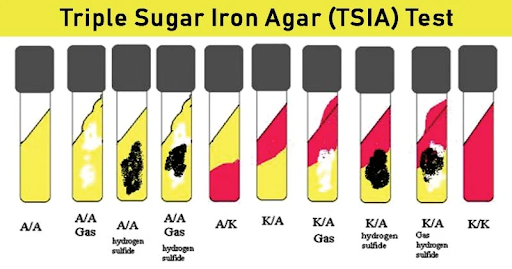
TSIA Profiles for Common Enteric Pathogens
| Bacteria | Slant/Butt Color (pH) | H₂S Production | Gas Production |
|---|---|---|---|
| E. coli | Yellow/Yellow (Acidic/Acidic) | –ve | +ve |
| Shigella spp. | Red/Yellow (Alkaline/Acidic) | –ve | –ve |
| Salmonella Typhi | Red/Yellow (Alkaline/Acidic) | –ve | +ve |
| K. pneumoniae | Yellow/Yellow (Acidic/Acidic) | –ve | +ve |
| Salmonella Paratyphi B and C | Red/Yellow (Alkaline/Acidic) | +ve | +ve |
Points to Remember
- Always stab the butt of the medium carefully in the triple sugar iron test; improper stabbing invalidates the test.
- Loosen the caps during incubation to ensure proper airflow and avoid incorrect results.
- Read the triple sugar iron test results within the recommended 18-24 hours to prevent false positives (if read too early) or false negatives (if read too late).
- Use a fresh culture to inoculate the medium, as older cultures may produce unreliable results.
- Avoid contaminating the triple sugar iron test medium, as mixed colonies can lead to inaccurate interpretations.
- Hydrogen sulfide production may mask acid in the butt, but its presence confirms an acidic environment.
- TSI Agar is less sensitive to hydrogen sulfide detection compared to SIM medium.
- Ensure proper incubation temperature (35–37°C), as deviations can impact bacterial growth and metabolism.
- Some organisms may show delayed or atypical carbohydrate fermentation.
- Use pure culture colonies for additional biochemical, immunological, or molecular tests to confirm identification.
In the End
While the Triple Sugar Iron test is invaluable for identifying enteric pathogens, its true potential lies in its role as a preliminary diagnostic tool. Combining TSI results with advanced methods like molecular diagnostics or MALDI-TOF mass spectrometry ensures more precise identification. Moreover, maintaining high-quality culture conditions and standardising protocols across laboratories supports test reliability.
Get Started at ₹1!
Try Flabs for a full month for just ₹1.
Follow us on