![Bilirubin Report Format - Download Free PDF Sample [2026]](/_next/image?url=https%3A%2F%2Fcdn.flabs.in%2Fwebassets%2F331cc21cd60cb7d45a00.jpg&w=3840&q=80&dpl=dpl_2j2bJXxv8956DCXPMaSvmX4oQLUc)
Pathology laboratory reports serve as a crucial link of communication between healthcare professionals. They are the basis for accurate diagnosis and treatment of a patient's health condition. In this connection, bilirubin test reports have a huge responsibility in diagnosing and treating diseases related to the liver, typically Jaundice (Pilia). Bilirubin reports must follow the bilirubin report format to ensure transferability and traceability.
It is set by global and local medical regulatory bodies, and all laboratories administering the test must follow their guidelines for designing and disseminating test reports. Let's learn the specifics of the bilirubin report format to understand its significance in medical diagnosis.
Standard Guidelines for Bilirubin Report Format
Header: Title of the report, "Bilirubin Test Report," along with a header section containing patient details, unique identification number, logo, and referral.
Patient Identification: Name, age, gender, and other demographic details, along with a unique identification number.
Referring Physician: In the header section, include details of the referring physician for official communication. If none exist, mark "Self-referral" in the bilirubin report format.
Specimen details: Name, volume, date of collection, along with encrypted details like specimen codes, collection tube numbers, etc. Mention any special instructions for bilirubin specimen handling.
Test Methodology: A brief explanation of the test procedure and possible variations in the methodology under testing conditions increases the reliability of the bilirubin reports.
Results: This is the heart of the bilirubin test report. Present clear test results along with units of measurement. Use numerical values and graphical representations if necessary.
Reference Values: Present the total bilirubin normal range values for reference and highlight the deviations along with reasons.
Interpretation: Present the interpretation of the bilirubin test results and the clinical implications of the observed deviations. Ensure standard language for universal bilirubin report formatting.
Instrumentation: Mention the instrumentation used in the testing along with calibration and maintenance standards. Include details about the bilirubin sample collection tubes used. It is also a good practice to specify the factors affecting the accuracy of the test in the jaundice test report.
Attestation: Include the signatures of the laboratory personnel and other relevant authorities for standardisation of the bilirubin report format. It also promises reliability and traceability of the test results.
Data Encryption: The bilirubin report format must have data encryption to safeguard patient data and privacy. When presenting lab contact details, patient contact details, etc., include QR codes, barcodes, and other methods.
Lab Info: Provide contact details of the diagnostic laboratory to encourage open communication between patients and healthcare professionals.
Formatting Consistency: Use a consistent font size, style, and colour throughout the bilirubin report. Ensure all headings are bolded and aligned with clear section dividers.
Accessibility: Make sure the bilirubin report format is accessible, with options for translation or larger print for those with visual impairments or language barriers.
Cross-references: If applicable, reference previous or related test reports in the bilirubin report to provide a comprehensive view of the patient's history.
Confidentiality Statement: Include a statement about the confidentiality of the report to reassure the patient about privacy.
Glossary: Provide a glossary of medical terms used in the report for clarity and to aid understanding for non-medical readers.
Ethical Considerations: Bilirubin report formats shall note any ethical considerations or compliance with local/national regulatory requirements.
Download Bilirubin Test Report Sample
The ICMR (Indian Council of Medical Research) sets the standard guidelines for bilirubin report formatting in India. However, different diagnostic laboratories may adopt a slightly different format. Download the bilirubin test report sample below for reference.
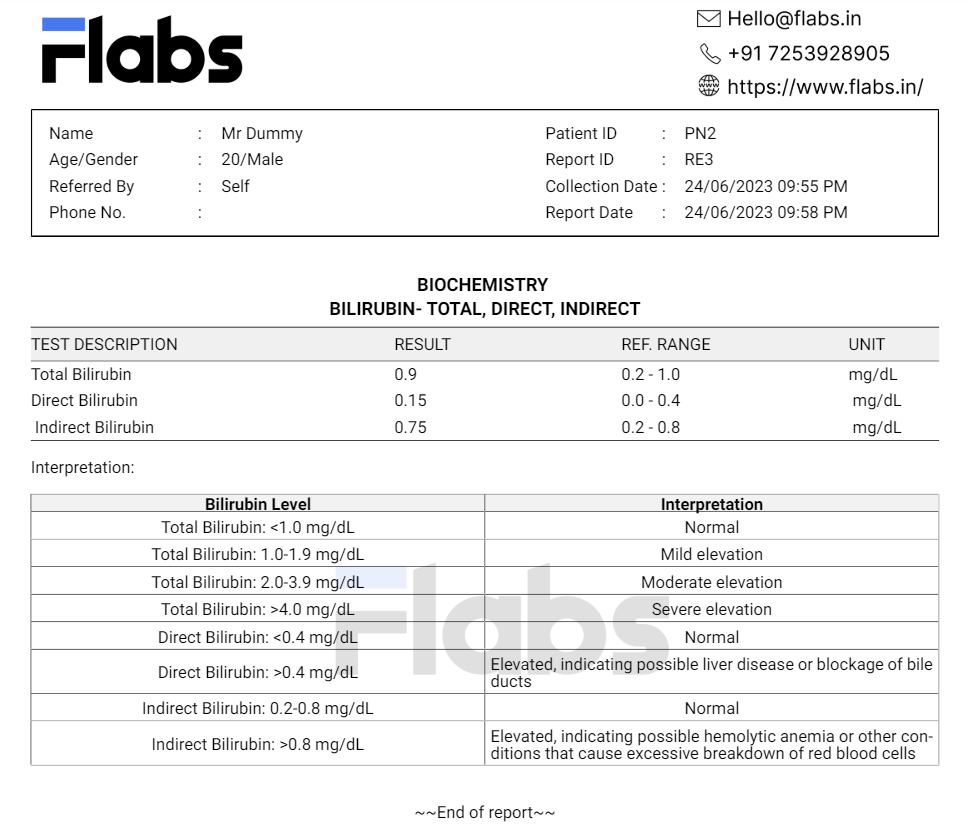
Bilirubin Test Report Sample PDF

Total Bilirubin Normal Range
| Total Bilirubin (mg/dL) | Total Bilirubin (μmol/L) | Indirect Bilirubin (mg/dL) | Indirect Bilirubin (μmol/L) | Direct Bilirubin (mg/dL) | Direct Bilirubin (μmol/L) | Direct Bilirubin (μmol/L) |
|---|---|---|---|---|---|---|
| Adult/Elderly/Child | 0.3-1.0 | 5.1-17 | 0.2-0.8 | 3.4-12.0 | 0.1-0.3 | 1.7-5.1 |
| Newborn | 1.0-12.0 | 17.1-205 | - | - | - | - |
Possible Critical Values
- Adult: >12 mg/dL
- Newborn: >15 mg/dL
Conclusion
Bilirubin report formats are crucial links between a patient's health condition and diagnosis. Every pathology laboratory looking to advance in quality healthcare must prioritise following necessary guidelines in structuring the bilirubin test reports.
The NABL (National Accreditation Board for Laboratories) conducts regular reviews to ensure that medical labs are following quality standards. So, it is paramount to not just adopt formats but also ensure regular updates and keep abreast of the latest changes.
Also check - Conjugated vs Unconjugated Bilirubin
Get Started at ₹1!
Try Flabs for a full month for just ₹1.
Follow us on