Blood cancer remains a major concern across clinical practice– a new case is reported every 5 minutes in India. Early diagnosis and timely intervention rely on proper reporting in pathology labs. That is where the importance of a blood cancer report emerges.
Many pathologists and haematologists encounter variations in how a blood cancer report format is presented. Such differences can create inconsistencies in interpretation.
For instance, a well-organised blood cancer test report ensures oncologists receive clear data on morphology, immunophenotype, and cytogenetic status. A unified approach to report design aligns diagnostic clarity with treatment and collaboration across departments.
The Blood Cancer Report Format
A blood cancer report format functions as the backbone of communication in medical labs. It integrates laboratory findings, morphological evaluations, and molecular data into a complete summary. The document translates complex analyses into a structured format.
Every blood cancer report of a patient must include identifiable sections: patient demographics, sample details, test methodology, results, and interpretation.
The objective of formatting is consistency. A standardised presentation supports reproducibility and traceability. Quite often, it is multidisciplinary teams that manage haematological malignancies, where unambiguous communication is imperative.
Main Sections of the Report
Each report component serves a specific purpose. When these elements are systematically arranged, the outcome improves lab practices as a whole.
1. Patient Information and Clinical Summary
The initial part records patient identifiers such as name, age, sex, and medical record number. A brief clinical summary provides context about presenting blood cancer symptoms, viz., fatigue, unexplained bruising, lymphadenopathy, or recurrent infections.
Example
| Parameter | Details |
|---|---|
| Name | John Doe |
| Age/Sex | 45/M |
| Clinical Indication | Persistent anaemia, leukocytosis |
| Referring Physician | Dr A. Sharma (Dummy) |
A concise description of prior investigations or therapy may be there. The report also captures family history and occupational exposure when relevant.
2. Sample Type and Collection Details
Accurate reporting starts with specimen documentation. Each blood cancer test report must specify the sample type: peripheral blood, bone marrow aspirate, or biopsy. The date and time of collection, transport conditions, and fixative used influence the interpretation.
A line mentioning sample integrity ensures traceability.
Example: “Peripheral blood sample received in EDTA anticoagulant, adequate volume, no visible clot formation.”
3. Complete Blood Count (CBC) Findings
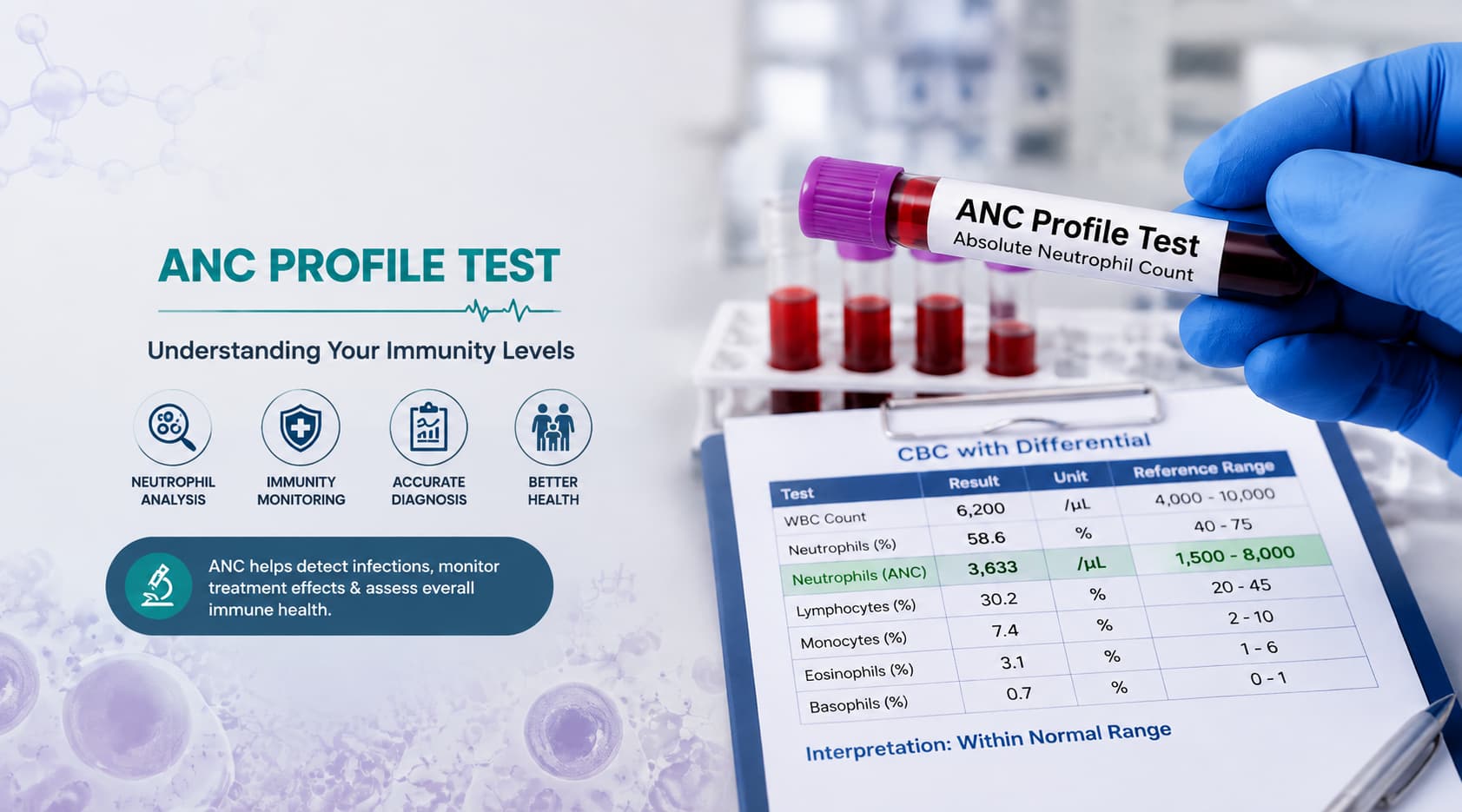
The blood cancer patient's CBC report outlines numerical parameters central to haematologic assessment. Haemoglobin concentration, total leukocyte count, platelet count, and differential percentages provide a baseline for diagnostic correlation.
| Test | Result | Reference Range | Interpretation |
|---|---|---|---|
| Haemoglobin | 8.2 g/dL | 13–17 g/dL (Males) & 11.5–15.5 g/dL (Females) | Anaemia |
| Total Leukocyte Count | 35,000 /µL | 4,000–10,000 /µL | Leukocytosis |
| Platelet Count | 90,000 /µL | 150,000–400,000 /µL | Thrombocytopenia |
Deviations from reference intervals suggest marrow dysfunction or neoplastic proliferation.
4. Peripheral Smear Evaluation
Microscopic morphology remains foundational. The report documents red cell morphology, white cell distribution, and platelet adequacy. Description must include the presence of blast cells, atypical lymphocytes, or myeloid precursors.
Example: “Peripheral smear reveals 60% blasts with prominent nucleoli and scant cytoplasm; background neutropenia present.”
This section differentiates between reactive and malignant changes. These changes are also used for bone marrow examination.
5. Bone Marrow Findings
A blood cancer report sample from bone marrow should describe both aspirate smears and trephine biopsy features. Parameters include cellularity, myeloid-erythroid ratio, megakaryocyte status, and infiltration pattern.
The description should end with a diagnostic impression.
Example: “Findings consistent with acute myeloid leukaemia (AML) with myelomonocytic differentiation.”
Incorporating digital images or photomicrographs improves visual correlation for multidisciplinary reviews.
6. Cytochemistry and Immunophenotyping
Cytochemical stains (e.g., MPO, PAS) assist in lineage identification. Immunophenotyping using flow cytometry further defines blast characteristics. This segment lists CD marker profiles with percentage expression.
Example: “Flow cytometry indicates blasts expressing CD13, CD33, CD34, and HLA-DR, consistent with myeloid lineage.”
This data distinguishes between AML, ALL, and mixed-phenotype leukaemias. Inclusion of reference clones and control standards adds credibility to the result.
7. Cytogenetic and Molecular Analysis
Chromosomal studies and molecular assays refine classification and prognosis. The report must mention karyotype, fluorescence in situ hybridisation (FISH) results, and molecular mutation panels.
Examples
Karyotype: 46,XY,t(9;22)(q34;q11.2)
Molecular test: BCR-ABL fusion transcript detected (p210 type)
Such findings directly influence therapy selection and risk stratification, e.g., in chronic myeloid leukaemia or acute lymphoblastic leukaemia.
8. Interpretation and Summary
A blood cancer positive report includes a concise diagnostic statement supported by data. It links morphological, immunophenotypic, and molecular findings. Each term must align with the WHO hematologic neoplasm classification.
Example: “Acute promyelocytic leukaemia (APL) with PML-RARA fusion detected by RT-PCR.”
Conversely, a blood cancer negative report clearly indicates the absence of malignant features, specifying whether reactive or benign hematologic patterns were noted.
9. Stage and Prognostic Indicators
A blood cancer last-stage report should mention disease extent and prognostic scoring systems (e.g., IPSS-R for myelodysplastic syndromes).
Parameters such as blast percentage, cytogenetic complexity, and transfusion dependency determine prognosis. Reporting measurable residual disease (MRD) where applicable adds value to patient monitoring.
10. Correlation with Data
Interpretation gains significance when correlated with symptoms and prior results. Linking the blood cancer report of a patient with treatment history allows comparison of disease progression or remission.
Example: “Blast count reduced from 60% to 5% post-induction chemotherapy; MRD negative by flow cytometry.”
11. Comments and Recommendations
Final remarks should outline additional tests or confirmatory studies. Mentioning cytogenetic re-evaluation or molecular re-assessment during relapse enhances clinical value.
The pathologist’s signature and accreditation details authenticate the report. Timestamping ensures traceability across laboratories.
Best Practices
Consistency in format simplifies multidisciplinary communication. Below is a suggested structure for a blood cancer report format suitable for digital or print records.
| Section | Content Description |
|---|---|
| Header | Patient demographics, report ID, date |
| Clinical Summary | Symptoms, provisional diagnosis |
| Specimen Details | Type, collection data, condition |
| CBC Findings | Numeric values and remarks |
| Morphology | Peripheral smear, marrow, cytochemistry |
| Immunophenotyping | CD marker results |
| Cytogenetics | Karyotype, FISH, molecular data |
| Diagnosis | Final interpretation |
| Comments | Recommendations, pathologist sign-off |
Following uniform templates promotes comparability across reporting centres and facilitates audit readiness.
Importance of Clarity
A well-drafted report format eliminates ambiguity. Using defined terminologies prevents misinterpretation during tumour board discussions. Clear separation between objective results and subjective interpretation maintains scientific integrity.
Reports must avoid abbreviations without prior definition. Layout readability improves when bullet points and tables are preferred over narrative clusters.
Positive vs Negative Blood Cancer Reports
| Feature | Blood Cancer Positive Report | Blood Cancer Negative Report |
|---|---|---|
| Morphology | Presence of abnormal blasts | Normal haematologic features |
| Immunophenotyping | Aberrant CD marker expression | Normal antigen distribution |
| Cytogenetics | Detectable translocation/mutation | Normal karyotype |
| Interpretation | Suggestive of malignancy | Absence of neoplastic changes |
Digital Reporting and Sharing
Modern laboratories use automated systems for CBC, flow cytometry, and genomic profiling. Digital templates for blood cancer report format enable standardisation across software interfaces. Structured data storage supports longitudinal tracking and machine learning analytics.
Pathologists can review archived blood cancer positive reports to identify recurrence patterns or assess therapy responses across cohorts. Integration with hospital information systems ensures consistent record accessibility.
Final Thoughts
Precision in blood cancer reporting defines the accuracy of treatment. A standardised format supports communication between laboratory and clinical teams. As noted, each section contributes a unique dimension to patient care.
By maintaining clarity, structured presentation, and consistent terminology, every blood cancer report format becomes an instrument for better decision-making and longitudinal analysis within haematology practice.
Also read - Difference Between Autopsy and Post Mortem Explained
Get Started at ₹1!
Try Flabs for a full month for just ₹1.
Follow us on