Accreditation bodies do not take a lab's word for accuracy. They want proof that your numbers hold up against an independent benchmark. That proof comes from an external quality assessment scheme. For pathologists running NABL-accredited or aspiring labs, enrolling in the right program is both a compliance requirement and a measure of clinical reliability.
Yet many labs delay because the steps feel murky. The sections below lay out what enrolling in EQAS India involves, how to sign up, and what lands in your inbox once you join. Get the basics right at the start and the rest of the cycle runs on autopilot.
What EQAS India Covers and Why Labs Join
EQAS India refers to the network of proficiency programs that ship unknown samples to participating laboratories across the country. EQAS full form is External Quality Assessment Scheme.
You analyse each sample exactly as you would a patient specimen. Then you submit your values and the provider compares your performance against hundreds or thousands of peer labs running the same material. The outcome is an unbiased verdict on your accuracy.
Participation is at the heart of NABL ISO 15189 accreditation, and the same records support CAP compliance for labs reporting to international standards. An assessor will ask for evidence that your lab takes part in lab proficiency testing in India for every discipline you report.
A sound scheme exposes testing bias you cannot spot from internal data alone, benchmarks your accuracy against peer labs, and returns educational feedback you can act on. Around 70% of clinical decisions rest on laboratory output. So, an external check protects patients and your lab's reputation at the same time. Every reporting discipline you run needs an EQAS India scheme standing behind it.
Internal quality control checks day-to-day consistency within your own walls. An external scheme measures you against the wider community. The two work together. But only the external check satisfies an auditor.
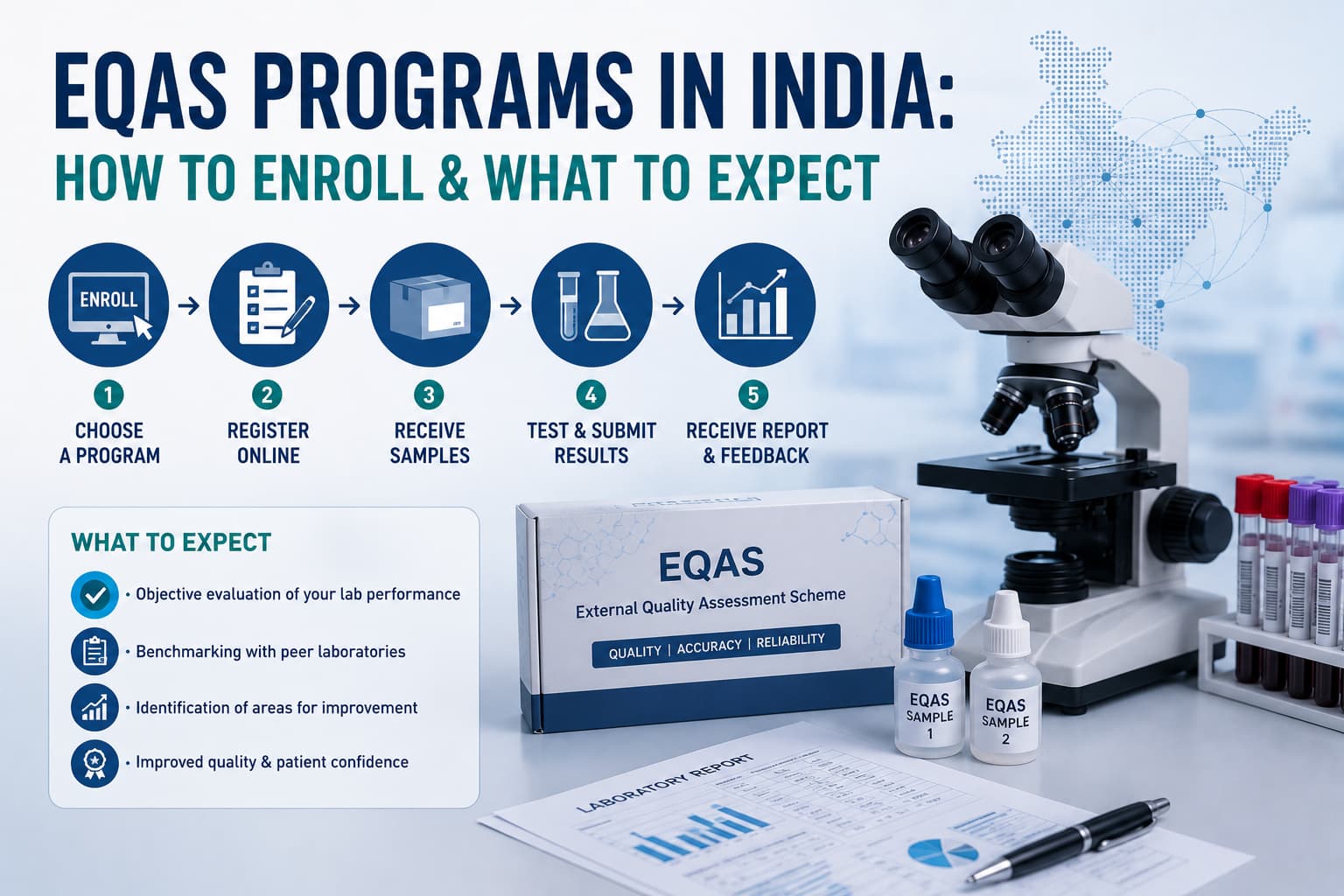
How the EQAS Cycle Runs
- The provider ships lyophilised sera, whole blood, or urine samples coded so you cannot guess the expected value.
- Your team reconstitutes and tests each sample on routine instruments with no special treatment.
- You log in to the provider portal and enter your values before the monthly deadline.
- The provider analyses all submissions and returns an EQAS report scoring your accuracy.
Performance usually appears as a z-score or a percentage deviation from the peer mean. A z-score within plus or minus two signals acceptable accuracy. Anything beyond that flags an outlier worth chasing down before the next round.
Major EQAS India Providers
India hosts several established schemes, each tied to a discipline. CMC EQAS India run by the Department of Clinical Biochemistry at Christian Medical College Vellore under the Association of Clinical Biochemists of India is the oldest. It has operated since 1978 and entered its 47th cycle in 2025 with roughly 15,700 participating labs.
CMC Vellore also runs haematology and blood transfusion schemes on behalf of the Indian Society of Haematology and Blood Transfusion, while AIIMS offers parallel programs in the same space.
Specialised fields are covered as well. Chimera EQA stands as India's first and only NABL-accredited scheme for transplant immunology and flow cytometry, and the National Cancer Grid drives reporting consistency in surgical pathology.
| Provider | Discipline Covered | Notable Detail |
|---|---|---|
| CMC Vellore, Clinical Biochemistry (ACBI) | Chemistry, immunoassays, HbA1c, urine | Running since 1978; monthly, 12 samples a year |
| CMC Vellore (ISHBT) and AIIMS | Haematology, coagulation, transfusion | Periodic challenges |
| IAMM EQAS, CMC Vellore | Clinical microbiology | Three challenges a year |
| Chimera EQA | Transplant immunology, flow cytometry | First NABL-accredited scheme in the field |
| Indian Academy of Tropical Parasitology (JIPMER) | Parasitology | Nationwide proficiency rounds |
| NCG EQAS | Surgical pathology, biomarkers | Periodic rounds |
| BioRad EQAS / RIQAS (Randox) | Broad chemistry, drugs, special proteins | Monthly |
Pick the schemes that map to the tests your lab actually reports. Paying for a panel you do not run adds cost without adding accreditation value. Most labs subscribe to a primary EQAS India scheme for their core chemistry and haematology, then layer on discipline-specific programs for microbiology or histopathology as their menu grows.
How EQAS India Registration Works
Signing up is more administrative than technical. Most EQAS India programs follow a similar route, though payment methods vary between providers.
- Choose the panels that match your reporting menu. You pay per discipline, so map your test list first.
- Complete the provider's enrolment form, usually online through their portal. Your official lab email becomes your username for all correspondence.
- Pay the subscription. Several programs, including CMC Vellore, still accept a demand draft drawn in favour of the named association and sent by courier with the form. Newer portals now add online payment.
- Receive your lab code and the cycle calendar.
The biochemistry cycle at CMC starts every January, but labs can join mid-year by paying the full fee. One detail catches newcomers off guard. You must submit results for a minimum number of months to earn the annual participation certificate that assessors want to see.
At CMC, that threshold is at six months. So, a late start still works if you are consistent afterwards.
What to Expect After You Enrol
Once enrolled, the rhythm becomes predictable. Samples arrive on schedule and you reconstitute them precisely as the instructions state. Accurate reconstitution matters as much as the assay itself. EQAS India schemes reward that kind of discipline round after round.
You enter your EQAS online results through the provider portal before the stated cutoff, usually around the 20th of each month for monthly schemes. A missed window counts as a non-submission and dents your annual record. After the deadline closes, the provider posts your EQAS report. Read it for more than the pass mark. Each report usually shows:
- Your value set against the peer group and the method-specific mean.
- A z-score or standard deviation index for every analyte.
- Trend graphs that expose a slow drift long before it becomes a failure.
A single outlier is not a verdict. A pattern across rounds is. Treat every flagged analyte as a prompt to check calibration, reagent lots, or instrument maintenance.
Labs that act on early indications rarely face a full non-conformity at audit time. The labs that score well on EQAS India schemes are not the ones with the fanciest analysers. They are the ones that respond to a single bad result before it repeats.
The Bottom Line
EQAS India participation is a continuous indication of how far your lab can be trusted with a diagnosis. Choose the schemes that match your menu, register early, and read every report as a chance to tighten accuracy. Do that and accreditation becomes the byproduct of sound practice rather than a year-end scramble.
Also read - The Ultimate Diagnostic Lab Starter Kit
Get Started at ₹1!
Try Flabs for a full month for just ₹1.
Follow us on