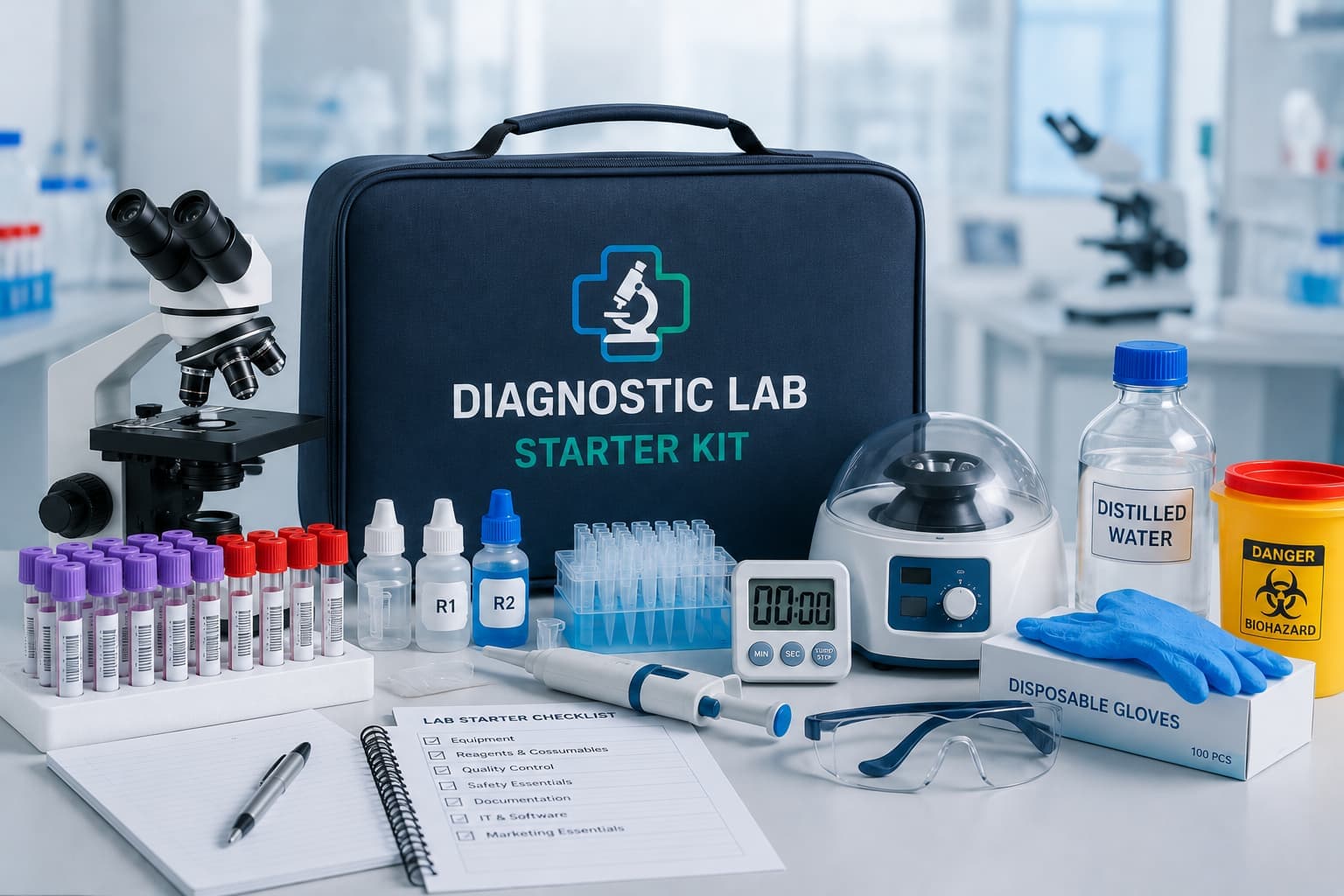
Quality healthcare in India runs on diagnostics. With roughly 1,00,000 labs operating across the country, the demand for accurate, fast, and reliable testing keeps climbing. Yet many new lab owners discover the hard part isn't ambition. It is knowing exactly what to buy, what to license, and what to install before the first sample ever arrives.
If you're a pathologist or healthcare entrepreneur planning your own facility, you need a clear inventory of essentials. Not theory. A concrete checklist you can act on. So here it is.
What You Need to Start a Diagnostic Lab India
To start a diagnostic lab in India correctly, you assemble four building blocks: legal registration, physical space, equipment, and software.
Let's explore each piece, because a complete pathology lab setup depends on getting the sequence right.
1. Legal and Regulatory Approvals
Before you process a single test, your paperwork must be airtight. Indian regulations expect compliance from day one, and inspectors don't grant grace periods.
- Clinical Establishments Act registration (where applicable in your state).
- NABL accreditation for credibility and corporate tie-ups.
- Biomedical waste management authorisation from your state pollution control board.
- Shops and establishment license plus GST registration.
- PCPNDT registration if you provide prenatal diagnostics.
NABL accreditation deserves attention. It indicates quality to referring physicians and unlocks contracts with hospitals and insurers. Apply early, since the audit process takes time.
2. Physical Space and Infrastructure
Your lab layout shapes safety and speed. Sample collection, processing, and storage each demand separate zones to prevent contamination.
Plan for stable power with backup, clean water supply, proper ventilation, and temperature control for reagents and samples. A 600-1,000 square foot space suits a starter pathology lab comfortably. Larger ambitions need proportionally more.
3. The Pathology Lab Equipment List
Your lab equipment determines which tests you can offer, and the top diagnostic centers in India now provide menus with up to 4,500 tests. You won't match that on day one, and you shouldn't try. Start with high-demand categories and expand as volume grows.
| Equipment | Function | Priority |
|---|---|---|
| Automated Hematology Analyser | Performs complete blood counts (CBC) and blood cell analysis | High |
| Biochemistry Analyser | Conducts liver, kidney, lipid, and glucose profile testing | High |
| Centrifuge | Separates blood components such as serum and plasma for testing | High |
| Binocular Microscope | Enables manual examination of blood smears, tissues, and microorganisms | High |
| Refrigerator and Deep Freezer | Stores samples, reagents, and diagnostic kits under controlled temperatures | High |
| Autoclave | Sterilises laboratory instruments and materials using steam pressure | High |
| ELISA Reader | Performs hormone assays, infectious disease screening, and antibody detection tests | Medium |
| Urine Analyser | Conducts routine urinalysis and urine chemistry testing | Medium |
| Microtome | Cuts thin tissue sections for histopathological examination | Medium |
Automation is no longer a luxury reserved for giants. Over 60% of high-throughput labs now run fully automated analysers, and the trend reaches smaller facilities fast. Manual methods slow you down and invite human error. Investing in automation early pays back through accuracy and throughput.
Buy reagents from validated suppliers and confirm service contracts before purchase. A broken analyser with no local technician becomes dead weight.
4. Laboratory Information Software
Equipment runs tests. Software runs the business. Without a strong system tying everything together, you drown in paperwork, lose samples, and delay reports. That single weakness costs you referring doctors.
A modern Laboratory Information System (LIS) manages sample registration, result entry, report generation, billing, and delivery. It connects your analysers, tracks turnaround time, and keeps quality control records ready for any audit. For a serious pathology lab complete operation, software isn't optional. It's the nervous system.
How These Pieces Work Together
A lab succeeds when each part supports the next. Registration earns trust. Infrastructure protects samples. Equipment produces results. Software delivers them on time and gets you paid.
Picture a routine day. A patient registers, a phlebotomist draws blood, the centrifuge spins it, the analyser reads it, and the LIS compiles a report that reaches the patient's phone within hours. Break any link in that chain and the whole experience suffers. Build it well and patients return, doctors refer, and revenue grows.
A Realistic Starter Budget
| Category | Approx. Share of Initial Investment |
|---|---|
| Equipment | 45–55% |
| Infrastructure and Setup | 15–20% |
| Licensing and Accreditation | 5–10% |
| Software and IT | 10–15% |
| Working Capital (Reagents, Salaries) | 15–20% |
Keep working capital healthy. New labs underestimate how long it takes referrals to build. Plan for at least six months of operating costs before you break even.
Common Mistakes to Sidestep
Overbuying equipment for tests you can't yet fill. Match machines to realistic demand.
Treating software as an afterthought. Manual record-keeping cripples growth and fails audits.
Ignoring turnaround time. Slow reports drive doctors to competitors.
Skipping quality control routines. One wrong result destroys a reputation built over years.
Where Flabs Fits In
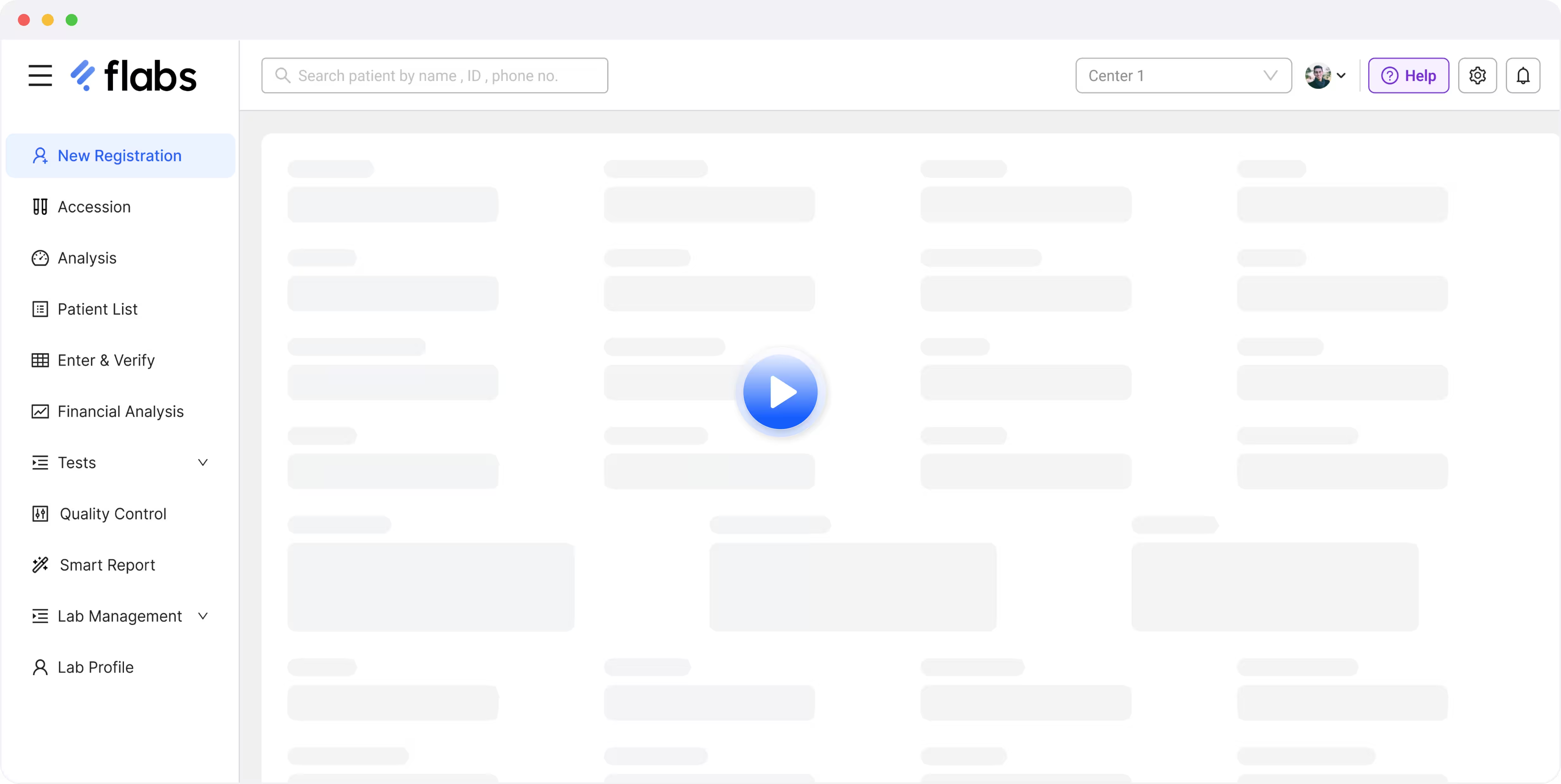
Once your equipment and licenses are in place, your software decides how smoothly the lab actually runs. Flabs builds an AI-Powered LIS trusted by 2000+ NABL labs across India, and it covers the operational gaps most starter setups miss.
TAT Management tracks every test in real time so reports go out on schedule, every time.
AI Smart Reports and AI Interpretation turn raw results into clear, structured outputs without manual rekeying.
Quality Control (QC) runs automated checks so every report meets regulatory standards before it leaves your lab.
Lab Finance Management handles invoicing, payments, and records with full automation.
Multiple Referral Management tracks referral sources and automates commissions from one dashboard.
Dynamic QR Codes and digital signatures keep reports secure, traceable, and department-ready.
For a lab that wants to compete from day one, that combination removes the friction that slows most newcomers down.
Ready to build your lab on a system designed for Indian diagnostics? See how Flabs powers 2000+ NABL labs.
Discover how the leading diagnostic providers compare by exploring our list of the best pathology labs in India
Final Word
Opening a diagnostic lab rewards careful preparation. Sort your licenses, design clean infrastructure, choose equipment that matches real demand, and anchor everything with software that keeps reports accurate and on time.
Each element earns its place in your starter kit. Assemble them in order, and you move from plan to functioning lab without the costly detours that trip up so many first-timers.
Also check - Preventive Health Checkup Trend in India
Get Started at ₹1!
Try Flabs for a full month for just ₹1.
Follow us on