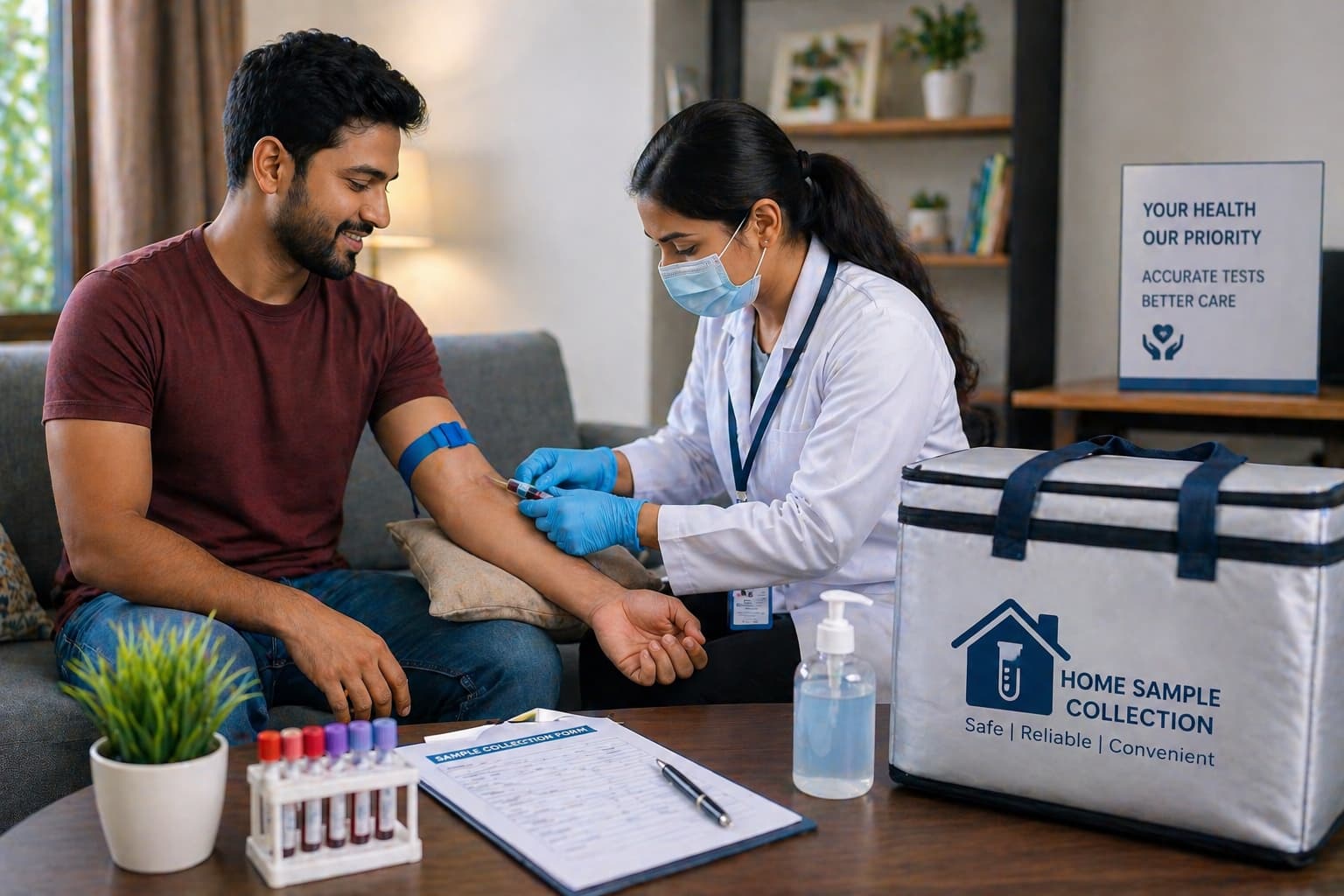
Patients today don't want to travel to a lab for a blood draw. They want the lab to come to them. And that shift in expectation is already changing how pathology labs across India compete for business.
If you run a lab and you're watching home-based diagnostics eat into your walk-in numbers, it's time to act. Starting a home sample collection service for your lab is no longer a premium add-on. It is the baseline for staying relevant.
How to Set Up a Home Sample Collection Service
You don't need a massive budget or a separate company to launch a home sample collection for your lab. You need a system that works repeatedly without breaking down. It includes covering staff, logistics, compliance, and technology.
1. Map Your Service Area First
Before you hire a single phlebotomist or buy a collection kit, define where you'll operate. Start tight, i.e., two to three pin codes around your lab. It keeps travel time low, turnaround manageable, and costs predictable.
As demand grows, expand zone by zone. Trying to cover an entire city from day one is how most labs lose money on home collection.
2. Hire and Train Certified Phlebotomists
Phlebotomist home collection is different from drawing blood in a controlled lab setting. Your team works in living rooms, handles anxious patients, and manages sample integrity without backup nearby.
Ensure that every phlebotomist you deploy meets the following requirements.
- Certified and verified (DMLT or equivalent).
- Trained in patient communication and consent documentation.
- Equipped to handle paediatric and geriatric patients.
- Briefed on your lab's specific SOPs for sample handling.
Don't skip background verification. Your phlebotomist represents your lab brand the moment they enter someone's home.
3. Build Your Sample Collection Kit
Every phlebotomist needs a standardised field kit. Consistency here protects sample integrity and cuts errors.
| Kit Item | Purpose |
|---|---|
| Vacutainers (multiple tube types) | Whole blood, serum, plasma collection |
| EDTA, SST, citrate tubes | Test-specific requirements |
| Cold box/ice packs | Temperature-sensitive samples |
| Barcode labels | Sample identification and tracking |
| PPE (gloves, masks, face shields) | Infection control |
| Consent forms | Legal and regulatory compliance |
| Patient ID verification checklist | Prevent sample mix-ups |
| Biohazard disposal bags | Safe waste management |
4. Fix Your Logistics Chain
The biggest failure point in home visit blood test services is what happens after collection. A sample sitting in a warm bag for three hours because no one planned the pickup route is a wasted visit. It is a repeat appointment your patient won't book again.
Slot-based bookings: Morning slots (6 AM – 9 AM) for fasting samples, afternoon slots for routine tests.
Pickup schedules: Phlebotomists return to the lab at set intervals, not on an ad hoc basis.
Chain of custody documentation: Every sample must have a handoff log from collection to registration.
Real-time tracking: Know where your phlebotomist is and when samples will arrive.
5. Integrate with Your LIS from Day One
Running home sample collection for your lab on WhatsApp messages and Excel sheets is a liability. The moment you scale beyond five daily home visits, manual tracking creates errors.
Your Lab Information System (LIS) should register samples collected at home the same way it handles walk-ins. Every sample gets a barcode, gets tracked, and feeds into the same report delivery pipeline. Patients want their reports online or on WhatsApp, not a phone call telling them to come pick up a printout.
Pricing Your Home Sample Collection Service
Labs across India price sample collection from home in two ways.
Flat visit charge: A fixed fee (typically ₹100–₹200) added per booking regardless of the number of tests. Simple for patients, predictable for you.
Tiered pricing: Free collection above a minimum billing threshold (e.g., free above ₹500 in tests). Encourages higher-value bookings.
Test the model that fits your market. In metro areas, patients are less price-sensitive about collection fees. In Tier 2 and Tier 3 cities, a free collection offer for multi-test packages converts better.
Compliance Requirements
Running pathology tests at home means your collection happens outside your licensed premises. In India, it creates a compliance gap that labs frequently ignore until an inspection.
Consent Documentation: Written consent for every home visit, signed before collection.
Sample Transport Compliance: Follow ICMR and NABL guidelines for sample packaging and transport temperatures.
Phlebotomist Credentials on Record: Maintain updated certifications for every field staff member.
Incident Reporting Protocol: What happens if a patient has an adverse reaction? You need a written protocol before the first visit, not after.
If your lab is NABL-approved, your home sample collection service for the lab must align with your accreditation SOPs. Any deviation is an audit finding.
How to Market Your Home Collection Service
Doctor referrals are your fastest channel. Physicians who trust your lab quality will recommend home-based pathology tests to patients who can't travel, e.g., elderly patients, post-surgical cases, and those with chronic conditions. Make it easy for doctors to refer by giving them a direct booking link or a dedicated line.
Google My Business and local SEO matter more than most lab owners realise. When someone searches "home visit blood test near me," your lab needs to appear. Add your home collection service explicitly to your GMB profile, include service areas, and collect patient reviews consistently.
WhatsApp booking reduces friction. A simple WhatsApp number for home collection bookings converts better than a web form for most patients in India.
Common Mistakes To Check
No defined TAT: Home-collected samples need separate TAT tracking. If your lab promises reports in four hours for walk-ins, your home collection team needs to know what their TAT commitment is and how to meet it.
Treating home collection as informal: Every home visit is a clinical interaction. Skipping consent, skipping documentation, or letting phlebotomists use personal vehicles without cold chain equipment will create problems with patients, regulators, and with your lab's reputation.
Not tracking phlebotomist performance: Which phlebotomist has the most repeat booking requests? Which areas generate the most cancellations? Data from your home sample collection service for your lab should feed back into decisions about staffing and zones.
Scaling Beyond Your First Zone
Once you have your first zone running smoothly with consistent TAT, low complaint rates, and phlebotomist utilisation above 70%, you're ready to expand.
Add one zone at a time. Hire one additional phlebotomist per zone. Use booking data to decide which pin codes come next (high search volume for home visit blood test + low competition from other pathology labs in India = your next zone).
Build a home sample collection service for your lab that scales operationally, not just geographically. Scaling fast without operational depth creates customer service problems that are hard to recover from.
Run Your Home Collection Service on Flabs LIS
Managing home sample collection for your lab demands a system built for real-time visibility. Not spreadsheets patched together with manual calls.
Flabs is an AI-powered LIS trusted by 2,000+ NABL labs. For home collection specifically, it provides barcode-based sample tracking from the moment of collection, real-time TAT management so no home-collected sample falls through the cracks, and automated report sharing via WhatsApp, SMS, and email. Patients will get results without a trip back to the lab.
If you're building or scaling a home sample collection service for your lab, Flabs provides the right infrastructure to get it right.
Start Your 5-Day Free Trial Today.
Also check - How to Buy Refurbished Lab Equipment in India
Get Started at ₹1!
Try Flabs for a full month for just ₹1.
Follow us on