Setting up a pathology lab or expanding an existing one burns through capital faster than most owners expect. A brand-new haematology analyser alone can set you back ₹8-15 lakh, and that's before you factor in biochemistry systems, centrifuges, microscopes, and immunoassay systems like Malgumi X3, Roche Cobas E411, or Siemens Advia Centaur XP.
No wonder a major share of new diagnostic labs in Tier 2 and Tier 3 Indian cities now start operations with pre-owned machines.
But buying second-hand lab equipment comes with real risk. A poorly refurbished analyser can give you drift errors, failed calibrations, and reports you cannot defend during a NABL audit. So how do you buy smart, save money, and still run a clinically sound lab?
What Makes Refurbished Lab Equipment India Worth Considering
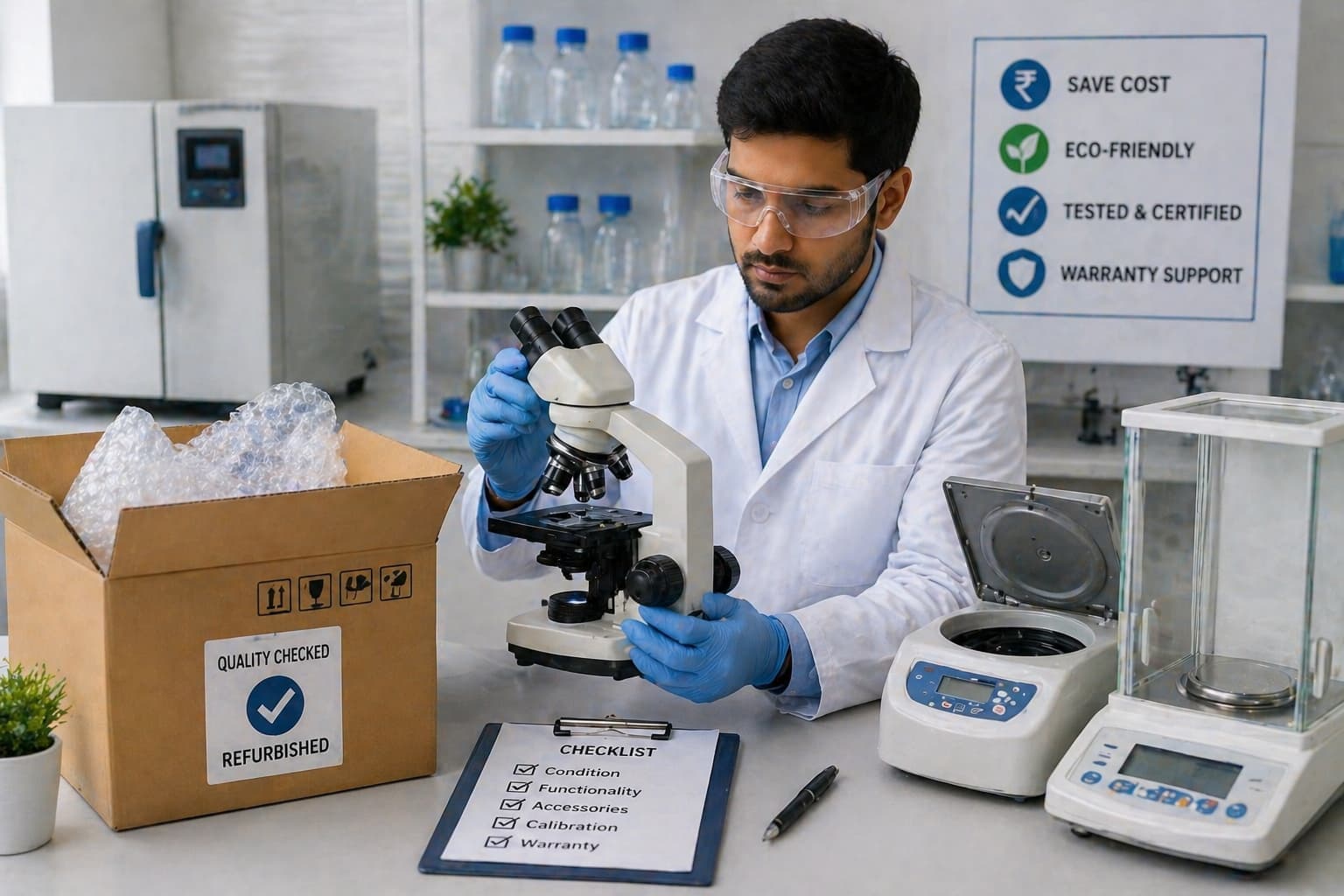
Refurbished lab equipment India refers to pre-owned diagnostic machines that have been professionally restored. They're inspected, cleaned, repaired, and recalibrated. Then tested against original manufacturer specifications before resale.
The Indian market for refurbished medical devices is projected to reach USD 2,765.1 Million by 2033, growing at a CAGR of nearly 16.1% from that of 2024. It means, refurbished lab equipment India is no longer a compromise buy. It's a strategic play.
The core appeal is simple: you get 60-80% of a new machine's performance at 30-50% of the cost. For a growing lab processing 80-200 samples a day, that price gap can fund two extra analysers: a better LIS or a second collection centre.
| Factor | New Equipment | Refurbished Equipment |
|---|---|---|
| Price range | 100% (baseline) | 30-50% of new |
| Warranty | 1-3 years standard | 3-12 months typical |
| Lifespan remaining | 8-12 years | 4-7 years |
| Delivery time | 6-12 weeks | 2-4 weeks |
| Financing options | Widely available | Limited, mostly cash |
| AMC availability | Direct from OEM | Third-party or OEM-certified |
The second hand analyser segment especially for haematology and biochemistry has matured significantly in the last five years.
OEMs like Roche, Sysmex, Beckman Coulter, and Mindray now run their own certified pre-owned programs in India.
Where to Source Refurbished Lab Equipment India: The Safe Channels
Your choice of vendor matters more than the machine itself. Three channels dominate the Indian market.
OEM-Certified Refurbished Programs: Manufacturers recondition returned or trade-in units at their own facilities. You pay a premium, usually 50-60% of the new price. But you get OEM warranty, genuine parts, and service contracts. Safest route for high-complexity instruments like chemistry analysers or flow cytometres.
Authorised Third-Party Refurbishers. Companies like Trivitron, Shree Hospital Equipments, and regional players specialise in used lab instruments across multiple brands.
Seek ISO 13485 certification and a physical service infrastructure in your city. A reliable third-party refurbisher of refurbished lab equipment India will share reference customers and let you visit their workshop before you commit.
Direct Lab-to-Lab Sales. Closing labs or upgrading hospitals sometimes sell directly. Prices drop to 20-30% of new, but you're buying as-is. Only consider lower-risk items: centrifuges, microscopes, water baths, basic incubators.
Avoid online marketplaces and unverified brokers for anything that touches patient samples directly. The second hand lab equipment market has enough dubious resellers that a physical inspection becomes non-negotiable.
The 7-Point Checklist Before You Pay
Before wiring any money, run through these checks. Skipping even one can cost you lakhs in repair bills or failed NABL assessments.
1. Verify the service history: Demand the complete maintenance log, calibration records, and total operational hours. A biochemistry analyser rated for 50,000 tests that has already clocked 45,000 is near end-of-life, regardless of how shiny it looks.
2. Check parts availability. Instruments older than 7-8 years may have discontinued reagent cartridges or spare parts. Confirm with the OEM that consumables will remain available for at least the next 5 years.
3. Insist on a live demonstration: Run actual samples, not manufacturer demo kits. Compare results against your current reference lab or a known control.
4. Get an independent calibration report: A third-party biomedical engineer should verify accuracy, precision, and linearity. Budget ₹5,000-15,000 for the check; it's the cheapest insurance you'll buy.
5. Confirm software version and licensing. Outdated firmware on used lab instruments can block integration with modern LIS platforms. Verify the software license transfers legally to your lab.
6. Negotiate warranty and AMC: Minimum 6 months comprehensive warranty is standard for refurbished lab equipment India. Push for 12. Lock in an AMC rate for years 2 and 3 in writing before purchase.
7. Validate regulatory compliance: The machine must still meet current CDSCO and NABL technical requirements. A 2011-era analyser may no longer satisfy ISO 15189:2022 traceability norms.
The Hidden Cost Most Buyers Miss
Here's something vendors won't advertise. The real cost of a second hand analyser is not the sticker price. It is the reagent lock-in. OEMs sometimes restrict refurbished units to proprietary closed-system reagents, which can run 20-40% higher per test than open-system alternatives.
A quick calculation: if your biochemistry analyser processes 15,000 tests a month and closed-reagent costs add ₹8 per test, that's ₹1.44 lakh extra monthly (₹17.28 lakh a year). You just wiped out your savings from buying refurbished.
Before you finalise any used lab equipment for sale, request a 12-month total cost of ownership projection that includes reagents, service contracts, calibration, and consumables. Compare that against new equipment with open-reagent flexibility. Sometimes new wins on 3-year economics even though refurbished wins on day-one cash flow.
Brands and Price Ranges to Expect in 2026
To give you a realistic ballpark, here's what mid-range refurbished lab equipment India is trading for in the current market. These numbers reflect verified OEM-certified and ISO 13485 authorised reseller pricing across major metros.
| Equipment Type | New Price (₹) | Refurbished Price (₹) | Warranty |
|---|---|---|---|
| 5-part haematology analyser | 10-14 lakh | 4-7 lakh | 6-12 months |
| Biochemistry analyser (400 tests/hr) | 18-25 lakh | 8-12 lakh | 6-12 months |
| Fully automated CLIA immunoassay | 35-50 lakh | 15-22 lakh | 6 months |
| Refrigerated centrifuge | 3-5 lakh | 1.2-2 lakh | 3-6 months |
| Binocular research microscope | 1.5-2.5 lakh | 50,000-90,000 | 3 months |
| Urine analyser | 4-6 lakh | 1.5-2.5 lakh | 6 months |
Prices vary by region, brand prestige, and operational hours. Urban hubs like Mumbai, Delhi, and Bengaluru tend to have more inventory and better pricing than smaller markets.
Regulatory Reality Check
Buying refurbished lab equipment in India is a compliance decision more. The regulatory ground has shifted significantly in 2025.
The CDSCO Import Ban: On January 10, 2025, the Central Drugs Standard Control Organisation (CDSCO) formally notified the Principal Commissioner of Customs that refurbished medical devices cannot be imported into India for sale and distribution. Because no specific provision exists for such devices under the Medical Device Rules, 2017.
Any consignment at ports gets returned. Then, on November 12, 2025, the Ministry of Environment, Forest & Climate Change (MoEFCC) cleared 16 CT scanners, 10 MRI units, and 10 surgical robotic systems for reuse under its hazardous waste framework. It creates a direct conflict with CDSCO's position, which is still under judicial review.
If you're sourcing a second-hand analyser that was imported after January 2025, ask the vendor to produce either a pre-ban import license (MD-15) or MoEFCC authorisation under the Hazardous and Other Wastes Rules.
Domestically sold refurbished units are not affected by the import freeze. Stick to OEM-certified Indian refurbishment facilities.
NABL 112A Requirements: Under NABL 112A (Amendment 01, November 2025), every automated instrument must be calibrated by the manufacturer at least once a year. A manufacturer's calibration certificate is not valid for NABL purposes unless it contains an accepted procedure and traceability to NPL India or an NABL/MRA partner accredited calibration laboratory.
Installation Qualification (IQ), Operational Qualification (OQ), and Performance Qualification (PQ) must be performed and documented before the instrument is put into service.
ISO 15189:2022 Transition: NABL issued its transition notice on December 19, 2025. All medical laboratories must move from ISO 15189:2012 to ISO 15189:2022, which introduces stricter requirements for measurement uncertainty evaluation and metrological traceability. Used lab instruments procured today must meet 2022 standards.
So, always ask for the following.
- Original import documentation or domestic sale invoice chain.
- CDSCO registration number (where applicable).
- Transfer-of-ownership certificate.
- Manufacturer authorisation for refurbishment.
- Traceable calibration certificate from NPL or NABL-accredited lab.
- IQ/OQ/PQ documentation.
A reputable vendor will produce these within 24 hours. Hesitation is a red flag.
Integration That Most Labs Underestimate
You bought the analyser. Now you need it talking to your LIS, pushing results to doctors, and generating NABL-compliant reports.
Older used lab instruments can lack modern connectivity. Some still run on RS-232 serial ports instead of HL7/ASTM protocols. Any shortlist of refurbished lab equipment India should be evaluated against your existing LIS stack.
- Communication protocol supported (ASTM, HL7, POCT1-A).
- Bidirectional interface capability.
- Middleware requirements and licensing costs.
- LIS vendor's compatibility confirmation in writing.
An analyser that cannot integrate cleanly forces manual result entry, which defeats the purpose of automation and introduces transcription errors.
Run Your Refurbished Equipment on a Smarter LIS
Flabs LIS integrates seamlessly with 2000+ analysers, new and refurbished, across 2000+ NABL labs in India.
AI Interpretation, AI Flagger, and AI Smart Report catch errors before they reach patients, while automated Quality Control validates every report against regulatory standards. Add Dynamic QR Codes, barcoding, and multi-doctor digital signatures for audit-ready output.
Start a 5-day free trial and see how Flabs turns your refurbished setup into a fully automated lab.
Final Word
Buying refurbished lab equipment India is a smart move when you do it right. The labs that get it wrong spend their first year firefighting. The ones that get it right redirect the savings into growth: better staff, stronger marketing, and the automation that actually moves the needle.
The refurbished lab equipment India segment will keep expanding as more OEMs launch certified pre-owned programs and as financing partners build lease-to-own structures for diagnostic startups. Getting in now with the right vendor and the right LIS positions your lab to scale.
Your patients never see the equipment. They only see the report. Make sure both live up to the standard you're building your name on.
Related read - ISO 15189 vs NABL: What's the Difference and Which Do You Need?
Get Started at ₹1!
Try Flabs for a full month for just ₹1.
Follow us on