ISO 17025 compliance is a trusted benchmark for laboratories, critical for building credibility and enhancing operations. In settings where precision and dependable data are essential, this certification standardises lab practices and creates a framework for consistent performance. Many labs may initially view ISO 17025 standard as demanding, but it also opens paths to simplified workflows and lower risks.
Beyond certification, ISO 17025 standard encourages labs to adopt structured quality practices that lead to sustained savings and clarity in operations. As we go into ISO 17025, consider how tailored tools like Flabs LIMS can directly support these standards effectively.
What is ISO 17025
ISO 17025 is an internationally established standard that sets requirements for labs to maintain competence, impartiality, and consistency of operations. Just like other ISO standards, ISO 17025 is also revised. Every revised standard is indicated by specifying the year along with the standard. The current standard was revised in 2017, hence it is indicated as ISO 17025:2017.
What’s the revision about? It includes updates on IT (Information Technology), and quality management processes, and emphasises the responsibilities of senior management. The revised ISO 17025 standard was reviewed and re-established in 2023. It serves every laboratory committing itself to producing reliable test results, building trust among stakeholders.
ISO 17025 Requirements for Labs
ISO 17025 compliance isn’t mandatory for laboratories. However, it comes into play for labs aiming to prove their technical competence and reliability to clients, regulatory bodies, and accreditation authorities. Many businesses insist on working only with ISO 17025-accredited labs to ensure dependable results. When accuracy is critical, consider whether not being accredited is a risk you can afford to take.
ISO requirements can be divided into five basic categories: General requirements, structural requirements, resource requirements, process requirements, and management requirements.
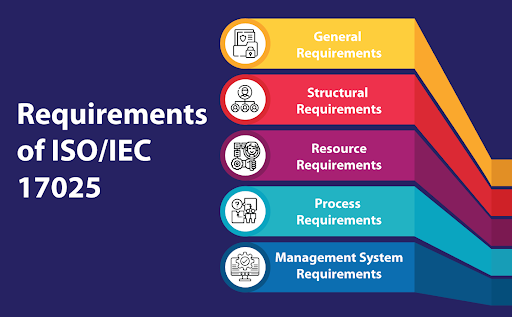
Each of these categories in ISO 17025 standard has a role in shaping a lab’s credibility. General requirements promise impartiality and consistency, while structural requirements define the organisation and responsibilities within the lab. Resource requirements cover staff qualifications, equipment standards, and environment control, setting the stage for quality work.
Process requirements address testing protocols, sample handling, and reporting for reliable and reproducible results. Finally, management requirements focus on continuous improvement, emphasising audits, feedback, and corrective actions to uphold compliance.
Together, these elements create a comprehensive framework that strengthens lab operations and builds trust with clients and regulators.
Labs that Require ISO 17025 Standard
| Laboratory Type | Description |
|---|---|
| Testing Laboratories | Includes labs in fields like chemical, biological, environmental, food, pharmaceutical, and materials testing; ensures safety, compliance, and quality. |
| Calibration Laboratories | Provides calibration for measurement instruments in areas such as temperature, pressure, electrical, dimensional, and optical; ensures accuracy and traceability. |
| Government & Regulatory Labs | Operated by or mandated by government agencies for public interest, regulatory compliance, public health, safety, and environmental monitoring. |
| Research & Development Labs | Labs involved in R&D, especially those offering testing and calibration services, ensuring recognised technical competence and reliable results. |
| Quality Control Laboratories | Found in industries like pharmaceuticals, manufacturing, and construction, performing tests on products and materials to meet standards and regulations. |
How to Get ISO 17025 Accredited
To attain ISO/IEC 17025 accreditation, start by applying to an accreditation body in your country. In the UK, this would be UKAS, while in the US, it’s A2LA or ANAB. In India, it is The National Accreditation Board for Certification Bodies (NABCB). The application process is typically online.
After applying, a pre-assessment or “audit gap analysis” identifies areas needing improvement in your quality management system. This step may reveal gaps requiring updates or new software to meet the standard. Once issues are addressed, a formal audit follows, comparing your operations against ISO/IEC 17025 criteria. The whole certification process usually takes 3 to 6 months, depending on the system’s readiness and the accreditation body’s schedule.
Maintaining ISO 17025 standard certification is also important. To do that, labs undergo yearly “surveillance” checks and a full re-assessment every 3 to 4 years. If requirements are met time and again, then labs can maintain the certification.
Benefits of ISO 17025 Compliance
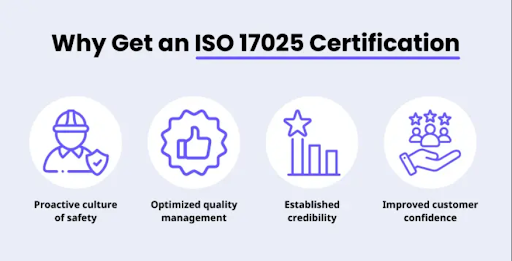
- Enhances reputation locally and internationally, building trust with clients and partners.
- Reduces or even eliminates the need for independent third-party audits.
- Lowers operational costs by streamlining and improving efficiency.
- Saves time through automation of routine tasks and processes.
- Demonstrates a commitment to continuous improvement in lab operations.
- Centralises critical information, ensuring a consistent single source of truth.
- Proactively manages risk, preventing rework and reducing downtime.
- Strengthens the lab’s reliability and credibility in producing accurate test results.
How Can a LIMS Help Achieve ISO 17025 Compliance?
A Laboratory Information Management System (LIMS) has a significant role in supporting ISO 17025 compliance and simplifying processes that ensure quality, consistency, and traceability. With a robust LIMS in place, labs can automate routine tasks like sample tracking, reporting, and data documentation, all essential for ISO 17025’s stringent requirements.
Flabs LIMS stands out in this regard, with dedicated features that directly address ISO standards. It includes automated sample management, real-time analytics, and audit trails, centralising critical data and ensuring readiness for inspections.
Flabs LIMS also integrates seamlessly with lab workflows, enabling accurate tracking, secure documentation, and reliable data management. For labs striving for ISO 17025 compliance, Flabs LIMS combines efficiency with reliability, helping labs achieve and maintain regulatory standards with ease.
More About ISO 17025
Risk-Based Thinking: ISO 17025 encourages labs to adopt a proactive approach to identify and mitigate risks that may affect test results and data reliability. This includes evaluating risks related to equipment, sample handling, and data security.
Non-Standardised Methods: The standard allows for validated, non-standard methods if they meet client requirements and pass rigorous verification, expanding options for labs while maintaining quality standards.
Increased Role of IT and Automation: Updated requirements focus on using technology and automated systems for consistent documentation, error reduction, and seamless workflow integration, especially in areas like LIMS.
Emphasis on Traceability: Labs must ensure traceability not just in their measurements but also in data, equipment, and software, creating a clear, documented trail that supports reproducibility and accountability.
Conclusion
While the ISO 17025 standard strengthens a lab’s credibility and operations, integrating a proactive approach to staff training can further enhance lab efficiency and precision. Regular skill upgrades and awareness sessions help personnel stay aligned with evolving standards, which isn’t covered above. Building a knowledgeable, agile team alongside robust systems like Flabs LIMS keeps labs ready for regulatory demands and fosters a culture of continuous improvement.
Related read: ISO Lab Certification
Get Started at ₹1!
Try Flabs for a full month for just ₹1.
Follow us on