ISO lab certification is essential for laboratories aiming to uphold high operational standards. By aligning with internationally recognised protocols, labs can improve their credibility, attract clients, and maintain consistency in their services. We will look into ISO's role in the medical sector, outlining its significance, vital certifications, and the process of accreditation. Understanding ISO accreditation requirements not only prepares you for ISO lab certification but also positions you to adapt to evolving industry practices.
What is ISO?
ISO (International Organization for Standardization) is a global body founded in 1947, operating in 167 countries. It is based in Geneva, Switzerland. The main goal of the organisation is to protect consumers by ensuring products meet specific standards. ISO has developed over 20,000 standards across various industries, including healthcare and food safety, focusing on quality management, safety, and environmental protection. These standards are essential for industries seeking ISO certification, ensuring that products align with consumer needs and regulatory requirements.
Why Does ISO Lab Certification Matter?
The ISO is a globally recognised body for establishing a gold standard in regulatory practices across industries. When you're getting services from an ISO-accredited laboratory, it means that you can trust the lab to follow the best standards possible and give you the best results possible.
ISO laboratory certification is not mandatory. Every lab has the freedom to establish its standards and operate. But, there's no guarantee for stakeholders that they get the best services. Even if you get the best outcomes, there's no guarantee that you can rely on them time and again. While ISO lab certification is not mandatory to operate, it is mandatory if a lab wants to partner with government bodies or other organisations.
Fulfilling ISO lab certification requirements is a promise about the competence, consistency and trustworthiness of a lab in its practices, from the usage of equipment, and qualified staff to the deliverance of efficient services. Thus, ISO certification matters for every lab seeking to provide quality services and enter global markets as a contender.
Vital ISO Certifications for Medical Labs
There are many ISO certifications, depending on the industry. However, for medical labs, there are mainly six ISO lab certification requirements.
ISO 9001:2015
This standard ensures a complete quality management system, confirming that a lab consistently meets customer, statutory, and regulatory requirements. Through regular audits, an ISO 9001 laboratory aims to improve customer satisfaction by delivering high-quality products or services. This ISO for laboratory management applies to organisations of any size.
ISO 15189:2012
Focused on medical laboratories, this certification ensures quality and competence. Audits cover personnel qualifications, training, and performance, as well as lab environment and facilities for sample handling, storage, and equipment maintenance. It reviews all testing stages—pre-examination, examination, and post-examination—guaranteeing quality in results and information management.
ISO/IEC 17025
This standard supports labs involved in international trade, enhancing test accuracy and providing a framework for global service quality and recognition.
ISO 10012:2003
A general standard for quality management in measurement processes, ISO 10012 ensures metrological compliance and accurate measuring equipment.
ISO 19011
Guidelines for managing and planning audits of management systems, both internal and external, help organisations oversee audit programs and teams effectively.
ISO 15190:2020
Updated in 2020 for medical lab safety, this standard defines requirements to promote a safe lab environment, with roles for lab safety officers and employee responsibility for workplace safety.
Related read: CLIA Certification
The Process of ISO Accreditation
The ISO accreditation process for every lab starts by fulfilling certain ISO lab certification requirements. Once the lab ensures the requirements are met, the process of obtaining ISO certification is straightforward.
ISO Accreditation Requirements
Quality Management System: Establishing a documented quality management system that meets ISO standards (e.g., ISO 9001).
Competence of Personnel: Ensuring staff are qualified, trained, and competent to perform their tasks.
Laboratory Environment: Maintaining a suitable environment for testing and calibration to prevent contamination and ensure reliable results.
Equipment Calibration: Regular calibration and maintenance of equipment to ensure accuracy and reliability.
Document Control: Implementing procedures for managing and controlling documents and records.
Internal Audits: Conduct regular internal audits to assess compliance with ISO standards.
Management Review: Performing management reviews to evaluate the effectiveness of the quality management system.
Customer Satisfaction: Establishing mechanisms for monitoring customer feedback and satisfaction.
Non-Conformance Management: Developing procedures for handling non-conformances and implementing corrective actions.
Continuous Improvement: Fostering a culture of continuous improvement within the laboratory.
ISO Certification Process
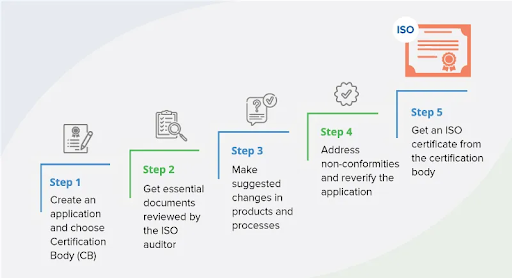
Obtaining ISO lab certification is more straightforward than many believe. Here’s a simple step-by-step guide:
Identify Relevant Standards: Start by identifying which ISO standards apply to your organisation, then find a certification body (CB) that matches these needs.
Application and Contract: Apply the chosen CB and establish a contract. Once terms are agreed upon, the CB assigns an auditor who reviews key documents and suggests any necessary adjustments.
Make Necessary Adjustments: Implement the auditor’s recommendations, who will then verify compliance and submit a final report. After confirming all requirements, the CB grants the ISO lab certification.
Annual Surveillance Audit: To maintain ISO lab certification, expect an annual surveillance audit from the CB, ensuring ongoing compliance. After each successful audit, the certification is renewed.
Cost of ISO Lab Certification
The cost of ISO lab certification depends on various factors, such as the number of processes, complexity, risk levels, and the size of the workforce. While the ISO accreditation process generally takes more than six months, it can extend to a year if any ISO accreditation requirements are not properly addressed.
ISO regularly updates its standards to adapt to shifts in industry trends and consumer behaviour. For example, after the COVID-19 pandemic, significant changes were made to molecular standards for medical laboratories. An ISO accredited laboratory should remain aware of these updates to maintain compliance.
Conclusion
In addition to the benefits of ISO lab certification, labs should consider investing in training for their staff to ensure ongoing compliance and understanding of the standards. This can enhance overall operational efficiency and foster a culture of quality and safety. Staying informed about the latest technological advancements and integrating them into practices can further improve service delivery– labs can not only meet but exceed industry standards with it.
Also read: Medical Diagnosis Using Machine Learning in Healthcare
Get Started at ₹1!
Try Flabs for a full month for just ₹1.
Follow us on