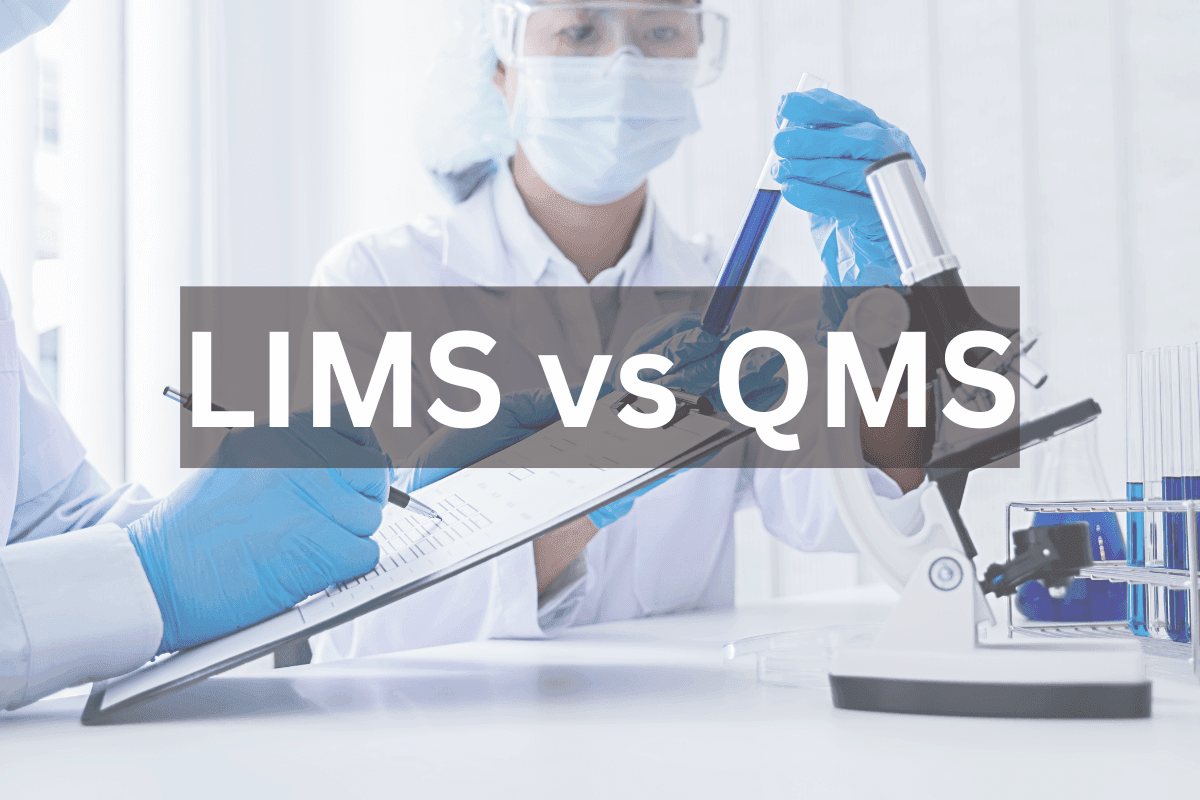
Most laboratories today are responsible for handling volumes of data, whether it is related to documentation or maintaining records. Adhering to regulatory standards is also incumbent upon all types of laboratories, medical or scientific. All these requirements double down when you want to scale up your laboratory. That is where the intervention of software tools comes in. Both LIMS and QMS are software tools created in this direction to take care of various aspects.
A LIMS (Laboratory Information Management System) is essentially for data handling, while a QMS (Quality Management System) stands in charge of quality control of various lab operations. There is a difference between LIMS and QMS, as there are some similarities. This discussion of LIMS vs QMS explores the role and synergy of both systems and lets you decide what you need.
What is LIMS
A Laboratory Information Management System (LIMS) is a software tool designed to manage and track the data associated with sample analysis in a laboratory. From sample collection to reporting, it automates workflows, reduces errors, and improves efficiency.
LIMSs are used across industries like healthcare, pharma, and food testing. They are very useful for lab managers, technicians, and quality control teams, in conducting their work with consistency and accuracy.
What is QMS
A Quality Management System (QMS) is a software solution to manage quality control processes for labs through a centralised platform. It stores and manages data related to inspections, audits, and corrective actions while automating tasks like document management and change control.
QMS improves product and service quality, overseeing regulatory compliance, e.g. FDA or ISO standards. It’s used by industries like chemicals, food, and manufacturing. Quality control professionals, compliance officers, and other team members benefit from using QMS for tracking data, managing corrective actions, and generating compliance reports.
LIMS vs QMS at a Glance
| Feature | LIMS (Laboratory Information Management System) | QMS (Quality Management System) |
|---|---|---|
| Core Purpose | Manages lab data and workflows | Maintains quality and compliance |
| Data Management | Streamlines lab data flow, sample tracking, automation | Prioritises data integrity, accuracy, and consistency |
| Compliance Functionality | May include basic compliance features | Designed to enforce quality and regulatory compliance |
| Reporting Capability | Generates detailed reports on lab results and data | Produces QC and compliance reports |
| Audit Trail | Logs changes and activities related to laboratory data | Tracks adjustments in quality control systems and processes |
| Instrument Connectivity | Directly integrates with lab instruments | Connects to quality control instruments |
| Document Control | Focuses on lab-specific documentation and workflows | Manages and tracks all quality-related documents |
| User Roles | Defines roles related to lab functions | Manages roles focused on quality management and compliance |
| Automation | Automates lab sample workflows and data collection | Automates quality tasks like document approvals, audits, and corrective actions |
| Compliance Support | Assists with lab-related regulatory standards | Ensures adherence to quality standards |
| Risk Management | Provides limited functionality for risk assessment | Strong focus on identifying, mitigating, and managing risks |
| Version Control | Basic versioning for lab data | Fully integrated version control for SOPs, processes, and quality documents |
When Should Labs Implement a LIMS?
Technically, every lab requires the benefits of LIMS to optimise operations, whether it is scientific, medical or R&D. However, depending on the scale of operations, the requirement for a LIMS can be impending.
Increasing Sample Volumes: When the number of samples to handle is growing rapidly, manual entries with pen and paper are simply impractical. It can lead to several errors. If that is the case, you must get a LIMS for smooth and efficient lab operations.
For Adaptable Workflows: When there are intricate testing procedures in labs, standardisation and streamlining of operations are imperative. Getting a good LIMS can adapt well to changing workflow needs.
Increasing Double-Work: If you’re seeing more mistakes, data entry errors, or increased retesting, it’s a clear sign to digitize your lab operations and implement a LIMS.
To Support Scalability: When labs grow or bring in new equipment, a flexible LIMS can effortlessly connect different systems and streamline operations, without downing the efficiency of lab activities.
When Should Labs Implement a QMS?
Every kind of lab can benefit from a Quality Management System (QMS) for consistency, compliance, and accuracy. However, certain indicators highlight when a QMS becomes mandatory for lab operations:
Maintaining Regulatory Compliance: As regulatory requirements become stricter, managing audits, certifications, and reporting through a QMS ensures adherence to standards like ISO, GMP, or FDA guidelines.
Handling Quality Events: When you start seeing frequent deviations, out-of-spec results, or non-conformances, you need a QMS. It can track, document, and resolve these issues and prevent repeat occurrences.
Improving Data Integrity: When data accuracy and traceability become critical, a QMS is necessary. It provides a centralised platform for tracking and managing documents, records, and test results without risking data loss or manipulation.
Managing Risk: If risk management and corrective action tracking are becoming time-consuming or difficult to handle manually, a QMS is necessary. It automates risk assessments and mitigation plans for your lab.
Similarities between LIMS and QMS
- Both LIMS and QMS systems efficiently manage data to ensure accurate and reliable information for decision-making.
- Both LIMS and QMS provide robust tools for generating reports essential for compliance and quality assurance.
- Both systems support labs in achieving and maintaining ISO certifications. LIMS ensures accurate sample management and data reporting for industry standards, while QMS aligns quality management processes with ISO requirements.
- Both systems maintain detailed histories of data modifications, tracking who made changes, when, and what was altered. Traceability is key for compliance with industry standards and regulations.
- Both LIMS and QMS can integrate with laboratory instruments, automating data collection and reducing human error.
- Current LIMS systems often incorporate QMS functionalities, blurring the lines between the two systems.
LIMS vs QMS, Which is better?
Choosing between LIMS vs QMS is a tricky affair. While there is a difference between LIMS and QMS, there are many aspects where both overlap. The right choice depends on the following arguments:
The Role of Lab in Your Business
If your lab is core to your business, it is better to go for laboratory information management systems (LIMSs). They are specially tailored to manage lab data, everything from sample tracking to test results. A LIMS greatly optimises functionalities that otherwise can impede the speed of your business operations. Reducing the suspicion of manual errors, a LIMS strengthens the conviction of consistent work.
If your business deals with manufacturing, but you own laboratories as in the R&D department or material testing, then both LIMS and QMS are suitable.
The Type of Industry
What type of industry is your industry into? It can simplify the discussion of LIMS vs QMS for you. Laboratory information management systems are more suitable for laboratory settings, e.g. medical, chemical, research, etc. Quality management systems are designed to handle and manage quality control processes in a production environment, e.g. manufacturing or aerospace industry. But if you have laboratories as part of your industry, once again you should have LIMS.
The Scale of Your Lab
LIMS is ideal for small to medium-sized laboratories. For example, a small research lab focused on pharmaceutical testing can efficiently utilise LIMS functionality. In contrast, the benefits of QMS serve larger laboratories with extensive production processes, such as those in the food or manufacturing industries, where maintaining consistent quality is imperative. For labs handling high product volumes or complex operations, using both LIMS and QMS provides an integrated solution to handle both quality control and operational efficiency.
Exploring the Integration of LIMS and QMS
While both LIMS and QMS share differences and similarities, laboratories can benefit from the integration of both systems to ensure standardised and sophisticated outcomes. You can manage both lab operations and quality in one place to derive many benefits. Some of them are:
- With LIMS and QMS in one system, you can prevent data duplication and set off the need for additional integrations.
- You can quickly locate and reference lab documents like SOPs and various protocols for smooth lab operations.
- Employees can stay up-to-date with the latest procedures, linking their training status directly to tasks they can perform.
- You can access all test steps and results in one place.
- Speed up the resolution process by addressing deviations or out-of-spec issues directly from the problem.
- Management of every step of batch production, from data capture to release in one integrated system.
- Oversee supplier or material changes with ease, minimising risks and keeping plans on track.
Suggested - Top Advantages of LIMS Systems for Modern Laboratories
Conclusion
Both LIMS and QMS play vital roles in improving laboratory efficiency, data integrity, and regulatory compliance. While LIMS focuses on managing lab data and workflows, QMS ensures quality control and adherence to industry standards. Depending on your lab’s size and needs, integrating both systems offers a wholesome solution for streamlined operations and quality management. Implementing the right system can significantly improve your lab's performance and long-term success.
Also read: Comparing LIS vs LIMS
Get Started at ₹1!
Try Flabs for a full month for just ₹1.
Follow us on