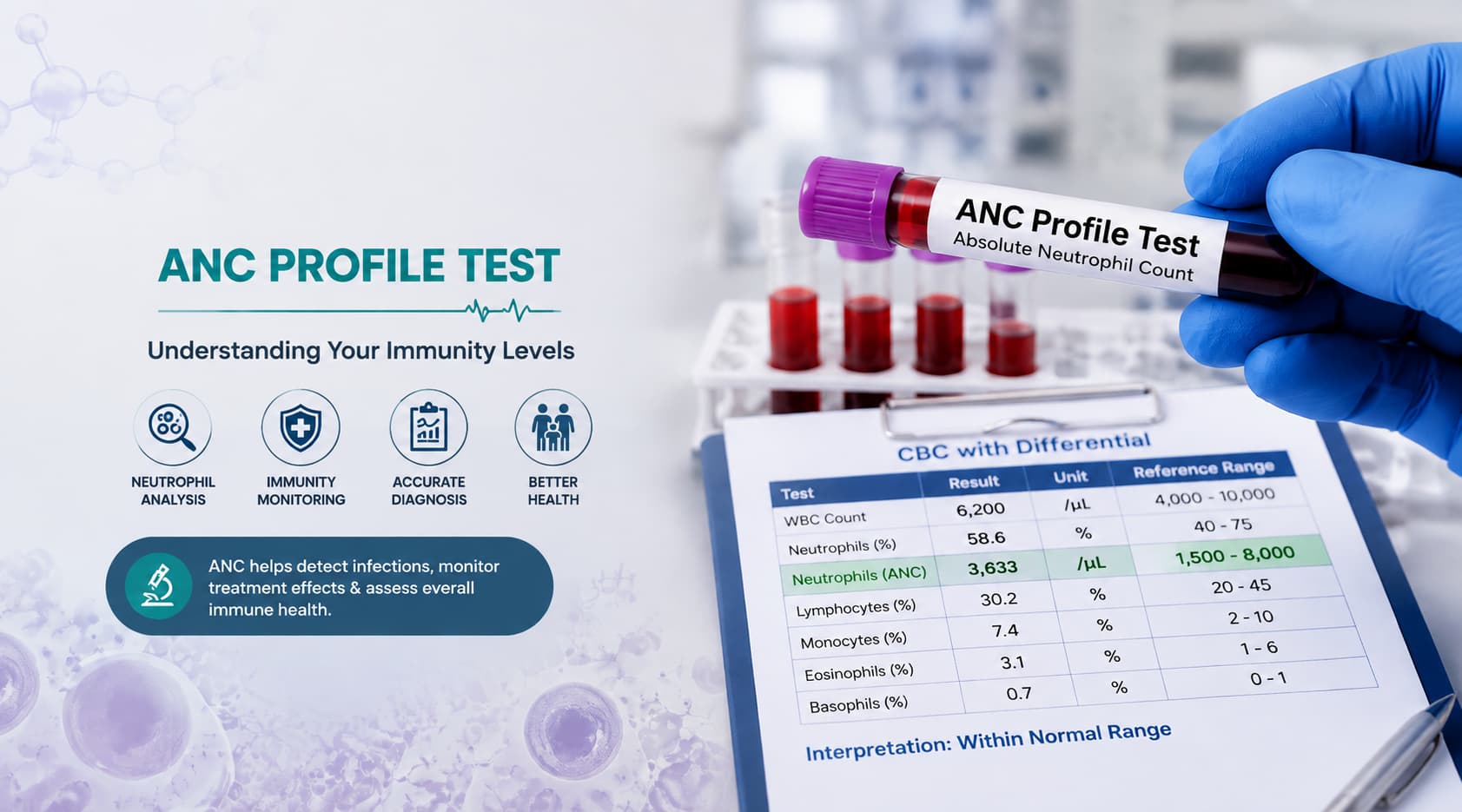
The immune system relies on a coordinated network of cells that identify, respond to, and control foreign antigens. Among these cells, lymphocytes, viz., T cells, B cells, and NK cells, are central regulators of adaptive and innate immune responses. Their concentration in circulation changes in response to infections, inflammatory activity, marrow function, and malignant transformation.
A lymph blood test measures these lymphocytes as part of a complete blood count (CBC) or differential count and provides actionable information for clinical decisions.
Lymph Blood Test
A lymph blood test quantifies lymphocyte concentration as both percentage and absolute count. It aligns closely with immune system activity. When antigens enter the body, lymphocytes expand, differentiate, and mount a defence.
When production decreases or destruction accelerates, circulating levels fall, indicating possible immunodeficiency, marrow suppression or disease-related cytopenias. Pathologists rely on the parameter to evaluate immune function, stratify risk in infection workups, support hematologic malignancy screening and monitor therapy.
The test integrates into routine CBC operations, requires no dietary preparation, and provides clear interpretive value within minutes.
Clinical Purpose
The lymph blood test supports a focused interpretation of immune activity in the following use cases.
- Assess immune system status in symptomatic or surveillance settings.
- Detect viral infections such as influenza, mononucleosis and COVID-19.
- Evaluation of autoimmune diseases, chronic inflammatory conditions and blood cancers.
- Diagnose hematologic disorders, including marrow dysfunction and lymphoproliferative processes.
- Generate objective data points that fit into longitudinal monitoring for patients on immunosuppressive agents.
Each of these scenarios relies on precise differentiation and absolute lymphocyte quantification.
For labs operating under strict TAT commitments, integrating AI-driven modules in Flabs LIS ensures that every lymphocyte parameter is processed, flagged and delivered within TAT using AI Flagger, AI Interpretation and automated QC systems.
Preparation
Fasting is not required, unless the test is part of a broader panel that mandates timing constraints. Patients should relay details about medications that may influence lymphocyte levels, e.g., corticosteroids, immunosuppressants or cytotoxic chemotherapy.
Hydration maintains venous access quality, and a calm state reduces transient stress-related lymphocyte shifts. For individuals undergoing serial monitoring, consistent timing ensures that results remain comparable.
Flabs LIS supports such monitoring through customisable patient details, structured test scheduling, and automated reminders. For high-volume centres, Bulk Registration and Bulk Report Sharing across WhatsApp, SMS or email streamline the workflow.
Blood Collection Procedure
A standard venous draw provides the required specimen. After collection, automated analysers quantify lymphocyte percentage and absolute count.
The analyser output enters the LIS, where AI modules review the values, apply rule-based interpretations, and flag outliers. TAT Management modules track each sample’s progress in real time.
Once validated through QC, pathologists review the values, finalise comments or add custom interpretations.
Reference Values and Interpretation
- 20–40% of total WBCs.
- 1,000–4,800 cells/µL absolute count.
Interpretation centres around two deviations: lymphocytosis and lymphopenia.
Each deviation should be evaluated in the context of patient history, clinical findings, medication status and concurrent hematologic parameters.
High lymph blood test results (Lymphocytosis)
A lymph blood test with a high result indicates increased lymphocyte production, decreased lymphocyte migration to tissues, or clonal expansion. This may correspond to:
- Viral infections (e.g., EBV, influenza, COVID-19).
- Chronic inflammatory conditions.
- Autoimmune disorders.
- Leukaemia or lymphoma.
- Reactive processes in children (including blood test poly and lymph in baby scenarios).
Clonal lymphocytosis requires careful correlation with smear findings, flow cytometry and molecular assays.
For labs using Flabs LIS, AI Test Suggestion modules can prompt reflex tests such as peripheral smear review, LDH or flow cytometry when lymphocyte values exceed thresholds set by the laboratory director.
Low lymph count in blood test (Lymphopenia)
A lymph blood test with a low result indicates reduced production, accelerated destruction or redistribution.
- Acute infections.
- Immunodeficiency states such as HIV.
- Bone marrow disorders or infiltration.
- Cytotoxic chemotherapy.
- Severe physiological stress.
- Malnutrition or chronic illness.
- Immunosuppressive therapy in transplant or autoimmune management.
Reduced lymphocyte levels warrant expanded testing. For comprehensive hematologic evaluation, Flabs LIS supports automated test panels, AI-assisted report interpretations and rapid communication tools for urgent cases.
Lymph Blood Test Normal Range Table
| Parameter | Adult Reference Range | Clinical Notes |
|---|---|---|
| Lymphocyte % | 20–40% of total WBCs | Used to evaluate immune response patterns |
| Absolute Lymphocyte Count | 1,000–4,800 cells/µL | Guides infection, malignancy and immunodeficiency assessment |
| Lymph Percent Blood Test | Integrated into the CBC differential | Provides the proportion of lymphocytes relative to other leukocytes |
Diagnostic Value of the Test
Lymphocyte elevation is prominent in several viral infections, serving as a quick indicator of immune activation. When combined with neutrophil counts, this parameter helps differentiate viral from bacterial etiologies.
In a lymph blood test with high results associated with viral syndromes, clinicians may correlate with AST, ALT, CRP or specific viral markers.
Autoimmune and Chronic Inflammatory Conditions
Fluctuations in lymphocytes can reflect disease activity. Serial values assist clinicians in therapy adjustment, particularly when biologics or immunomodulators contribute to marrow suppression.
Hematologic Malignancies
Persistent or extreme deviations must be assessed for clonal processes. Lymphocyte morphology, flow cytometry immunophenotyping and marrow evaluation may confirm leukaemia or lymphoma.
Pathologists may question whether lymph node cancer can be detected by a blood test; while lymphomas originate in lymphoid tissue, the blood test may show indirect signs such as cytopenias or circulating abnormal lymphoid cells. Confirmation, however, requires tissue biopsy and imaging.
Pediatric Considerations
In infants and young children, lymphocyte percentages run higher due to immune system maturation. Blood test poly and lymphocyte interpretations in babies must use age-matched reference intervals. Flabs LIS allows labs to configure age-stratified ranges and automated comments to safeguard report accuracy.
Managing Abnormal Patterns
- Perform repeat CBC to confirm persistent deviation.
- Order complementary tests, including ESR, CRP, viral panels or flow cytometry.
- Consider imaging when lymphoproliferative disorders are suspected.
- Evaluate medication profiles for contributors such as steroids or immunosuppressants.
- Escalate to bone marrow biopsy when marrow pathology is a concern.
Treatment may involve anti-infectives, immunomodulators, nutritional support or targeted oncology regimens.
Flabs LIS supports this continuum using AI Assistant modules that provide structured recommendations, automated interpretive comments and clinically relevant flags.
Turnaround Time and Reporting
For lymphocyte parameters, rapid reporting improves clinical decision cycles. Flabs LIS integrates:
- Real-time TAT dashboards.
- Automated QC checks.
- Flaggers for high-risk lymphocyte values.
- AI Voice Reporting for fast dictation and structured output.
- Multi-referral management with automated commission calculation.
- Lab finance management for streamlined billing and invoicing.
Reports can be shared instantly using secure channels, with QR-coded and barcoded documents enhancing traceability.
Why Modern LIS Strengthens Reporting
Precise lymphocyte interpretation relies on stable analyser calibration, consistent reference intervals and seamless communication channels. A laboratory information system that integrates AI Interpretation, customisable report components and strict TAT Management elevates operational reliability. NABL labs using Flabs LIS gain additional assurance through automated checks, audit trails and error-proof operations.
Laboratories can also configure personalised interpretations, test parameter styling, digital signatures and reflex rule-based suggestions. Bulk Actions streamline high-volume operations, supporting peak-load processing without workflow disruption.
Summary
A lymph blood test provides direct insight into immune system status through quantitative evaluation of lymphocytes. It identifies immune activation, immunosuppression and possible malignant processes, and remains essential in infection assessments, autoimmune monitoring and hematologic oncology.
Integrated LIS systems such as Flabs offer structured, AI-supported operations that strengthen accuracy, consistency and speed across all stages. With real-time TAT tracking, automated QC and customisable interpretive layers, laboratories can maintain precision in reporting while improving operational efficiency.
Also check - Eosinophils Blood Test: Importance and Uses
Get Started at ₹1!
Try Flabs for a full month for just ₹1.
Follow us on