Early detection of malaria remains a clinical priority in regions where the disease is prevalent. The malaria card test offers a rapid, on-the-spot diagnostic option to identify Plasmodium falciparum and Plasmodium vivax infections using a small blood sample. Unlike conventional microscopy, which requires laboratory infrastructure and trained personnel, the malaria card test is designed for ease of portability.
What is a Malaria Card Test?
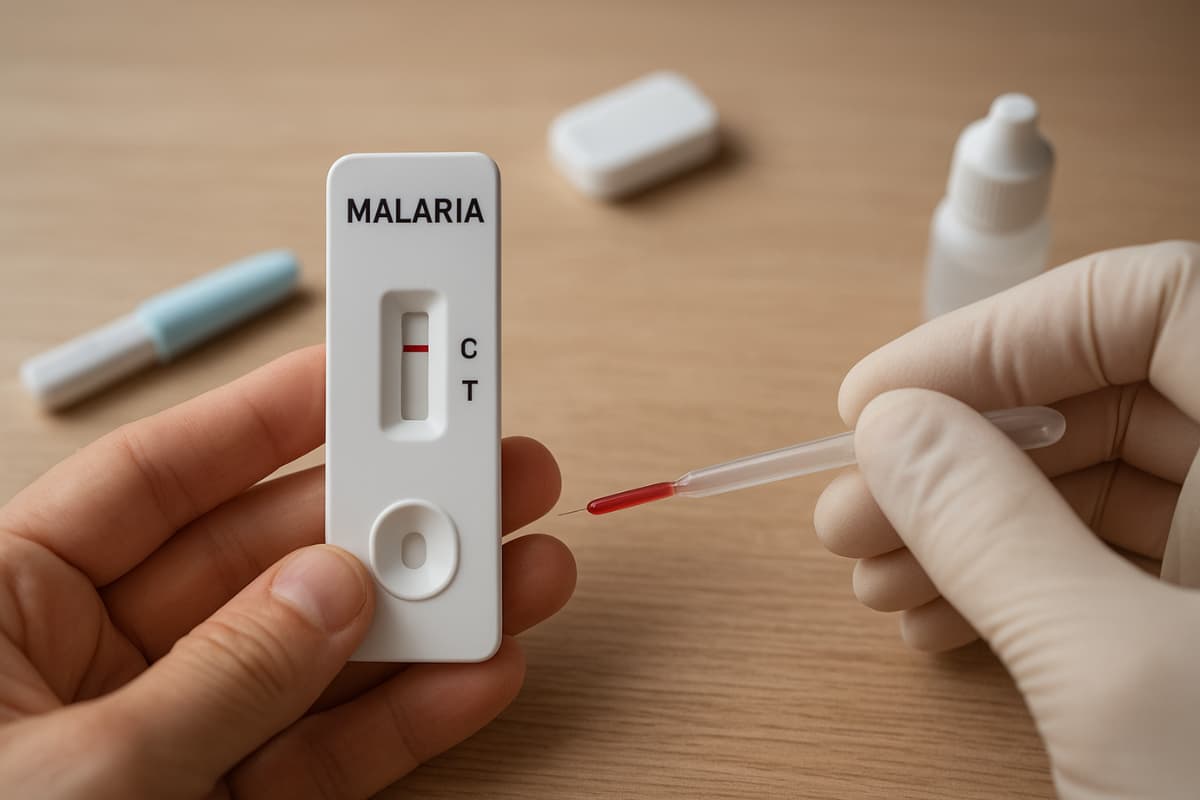
A malaria card test is a rapid diagnostic test (RDT) used to detect specific malaria antigens in human blood. It is commonly used for the differential detection of P. falciparum and P. vivax infections. These tests are immunochromatographic assays that deliver results within 15–20 minutes.
The Malaria Rapid Card Test is commonly used in various field settings viz., fever screening camps, remote outreach health missions, emergency outbreaks, travel medicine setups, and in military or disaster response zones.
It has a long shelf life of up to 30 months at temperatures between 4°C and 30°C with stable packaging. Hence, it is highly suitable for storage and transportation in diverse environments.
Malaria Card Test Principle
The malaria card test works on the Sandwich immunoassay principle. It involves antigen-antibody binding facilitated by monoclonal antibodies.
- Colloidal gold-labelled antibodies specific to P. falciparum HRP-2 and P. vivax pLDH are used as conjugates.
- These antibodies are placed on a nitrocellulose strip inside the card.
- When blood is added and mixed with the assay buffer, red cells are lysed, releasing malarial antigens if present.
- The antigen binds to the antibody-gold conjugate and migrates along the strip.
- When it encounters its specific immobilised capture antibody (HRP-2 for P. falciparum or pLDH for P. vivax), a visible purplish-pink band appears at the respective line (F for P. falciparum, V for P. vivax).
- A third line (control) confirms the procedural integrity of the test.
- The intensity of the test band may vary with parasite density. Control line strength may decrease at very high parasite levels due to antibody saturation.
Malaria Card Test Procedure
| Step | Description |
|---|---|
| Specimen Collection | Collect fresh capillary or venous whole blood using venipuncture. |
| Test Setup | Open the test pouch just before use. Place the card on a flat surface. |
| Sample Application | Use the provided pipette to add ~5μl of blood into the sample well. |
| Buffer Addition | Add 2–3 drops of assay buffer into the buffer well. |
| Wait for the Result | Let the test run for 15–20 minutes before reading the result. |
No special preparation is required for the test. The blood collection procedure takes 5-10 minutes with minimal to no-risks.
Interpretation
- Two Bands (T + C): Positive (either F or V line indicates P. falciparum or P. vivax).
- One Band (C): Negative.
- No C Band: Invalid test; repeat with a new device.
Accuracy and Performance
Evaluation data show high sensitivity and specificity in detecting both P. falciparum and P. vivax. According to in-house testing:
| Parameter | Details |
|---|---|
| Sensitivity (P. falciparum) | Detects >100 parasites/µL |
| Sensitivity (P. vivax) | Detects >200 parasites/µL |
| Specificity | 99.95% in malaria-negative samples |
| Cross-reactivity | 0% in samples positive for Dengue, TB, HIV, HCV, HBV, etc. |
Precision studies using negative, weak-positive, and medium-positive samples showed a <10% coefficient of variation within and between runs.
However, clinicians should be cautious of a false positive malaria card test in rare instances due to technical errors, expired reagents, or improper storage.
Advantages of the Malaria Card Test
- Results in under 20 minutes.
- Minimal training is required.
- Suitable for field settings and home diagnostics.
- No microscope or power supply is needed.
- Simultaneous identification of P. falciparum and P. vivax.
- Easy-to-read colour bands.
Malaria Card Test vs. Traditional Microscopy
| Feature | Malaria Card Test | Microscopy |
|---|---|---|
| Turnaround Time | 15–20 minutes | 1–2 hours or longer |
| Equipment Requirement | None | Microscope, stains, trained staff |
| Detection Capability | Antigen detection (Pf & Pv) | All Plasmodium species (with skill) |
| Portability | High | Low |
| Operator Skill | Minimal | High |
| Quantification | No | Yes |
While microscopy remains the gold standard for malaria diagnosis, especially for parasite quantification and rare species detection, rapid card tests offer practical speed and accessibility in most clinical scenarios.
Malaria Parasite Card Test Report
The malaria parasite card test report should include: Patient name and ID, Sample type (capillary or venous blood), Test date and time, Result: Negative; Positive for P. falciparum (HRP-2); Positive for P. vivax (pLDH); Positive for both (co-infection), Interpretation remarks, Technician's or pathologist's signature.
Malaria Card Test Price in India
The Malaria card test price in India generally ranges between ₹12 and ₹17 per piece for individual test kits. Bulk packs are often available at discounted per-unit rates, e.g., boxes of 50 tests. Pricing can vary based on several factors, including the brand, pack size, location, and any additional services associated with testing.
Online platforms and medical supply stores offer a wide range of options for both individual users and healthcare providers.
Limitations and Cautions
- False negatives may occur with very low parasitemia (<100 parasites/µl).
- False positives could be triggered by test degradation, contamination, or improper storage.
- Cannot differentiate between recent and active infection.
- Does not quantify parasitemia.
- Not suitable for detecting P. malariae or P. ovale.
For patients with persistent fever and negative rapid test results, confirmatory microscopy or PCR may be warranted.
Conclusion
The malaria antigen card test presents an accessible and quick diagnostic method for detecting P. falciparum and P. vivax infections, particularly in primary healthcare setups. Its ease of use, minimal infrastructure requirements, and fast turnaround make it a practical choice for frontline detection of malaria in India and other endemic regions. While not a replacement for microscopy in all cases, it complements routine diagnostics effectively.
Related read - MP Antigen Test: Malaria Diagnosis Made Simple
Get Started at ₹1!
Try Flabs for a full month for just ₹1.
Follow us on