Every minute a patient waits for their report is a minute of anxiety they didn't need. And for clinical labs, delays don't just hurt patient experience. They affect referrals, revenue, and your lab's reputation in a competitive market.
Pathology labs in India are under growing pressure. Patients compare labs. Clinicians shift referrals based on speed. And NABL audits now scrutinise turnaround time (TAT) closely. If your lab is consistently delivering reports late, no amount of quality branding fixes that.
So what separates labs that consistently beat TAT benchmarks from those that don't? It comes down to systems, discipline, and, increasingly, the right technology decisions.
What Is TAT for Diagnostic Labs?
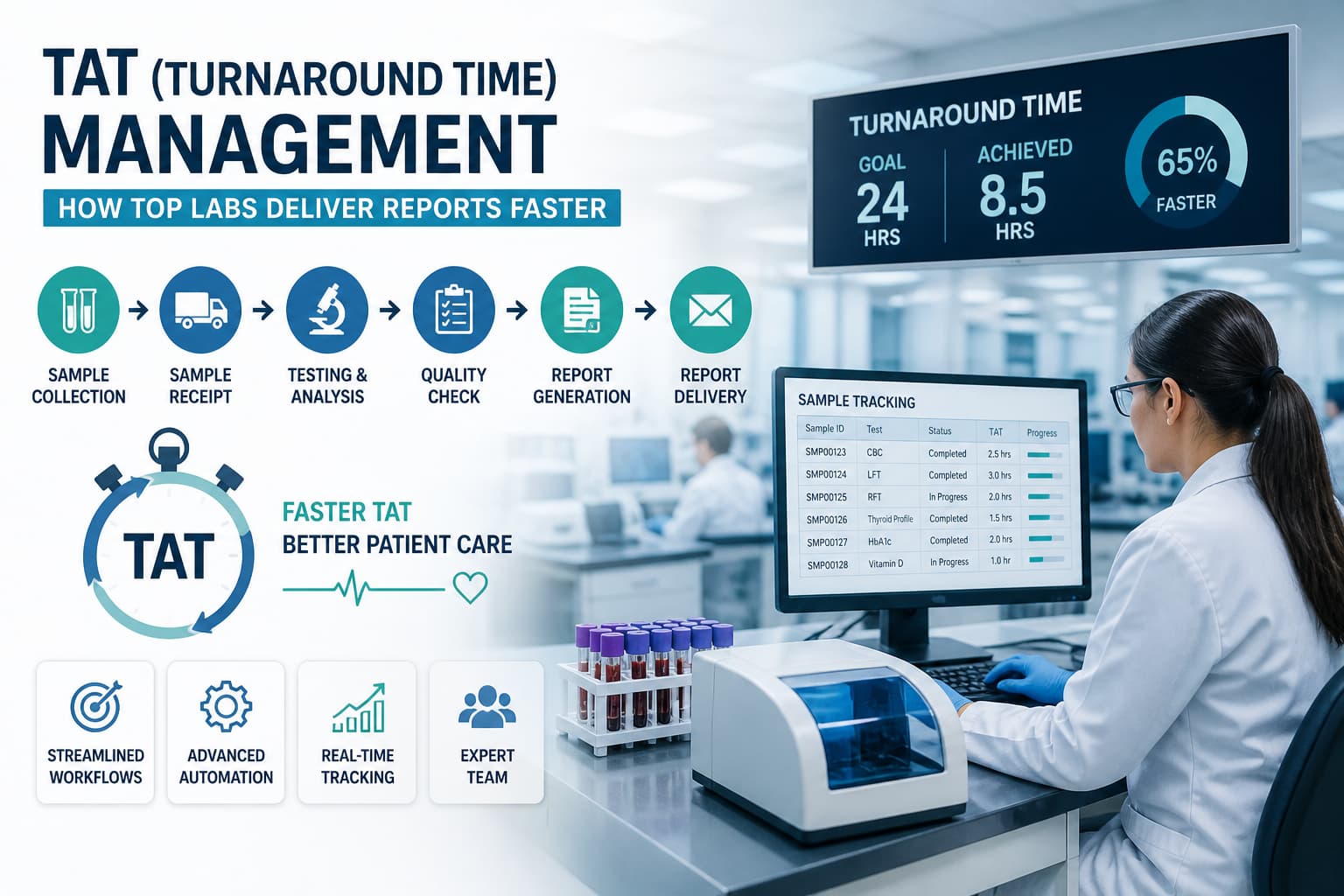
TAT for diagnostic labs refers to the total time taken from the moment a sample is received (or collected) to the moment the final report reaches the patient or clinician. That's your lab report delivery time. It is one of the most-watched metrics in modern pathology.
TAT's full form is Turnaround Time. While the phrase sounds administrative, it carries real clinical weight. A delayed lipid profile report is a nuisance. A delayed sepsis culture report can be the difference between life and death.
TAT in laboratory settings is measured across three distinct phases:
- Pre-analytical (sample collection and transport)
- Analytical (testing and result entry)
- Post-analytical (reporting and delivery).
Most labs lose time in all three stages without realising where exactly the bleeding happens. A study found that while analytical performance met quality standards, substantial delays in TAT occurred in the pre- and post-analytical phases.
When you start tracking TAT for diagnostic labs with precision, you find that the biggest delays are rarely inside the analyser room. They live in manual entries, approval queues, inter-department handoffs, and report dispatch gaps that nobody owns.
Traditional Ways to Improve TAT in the Diagnostic Labs
These are the time-tested, operationally proven methods that high-performing labs have used long before digital systems entered the picture. If you haven't locked these down, no software will rescue you.
1. Defined TAT Targets by Test Type
Vague targets produce vague results. High-performing labs set specific TAT benchmarks for each test category, not a single lab-wide target. A CBC has a different urgency and complexity than a biopsy. When every department knows its exact target, accountability becomes concrete.
A simple register or board showing each test's expected TAT and current status, visible to all bench staff, has improved lab performance long before LIS systems existed.
2. STAT Lanes for Emergency Samples
One of the most impactful operational decisions a lab can make is separating STAT (urgent) samples from routine samples, both physically and procedurally. Labs that process STAT samples on the same bench, in the same queue as routine work, inevitably compromise both.
A dedicated STAT lane with a separate receiving point, priority centrifuge access, and a defined technician on duty ensures urgent samples are never delayed by routine load.
3. Staff Scheduling Around Peak Hours
Sample volumes in most labs spike between 7 AM and 11 AM. Labs that schedule staff uniformly across shifts leave that peak window under-resourced. The best labs stagger shifts so that the most trained staff are present exactly when the sample load peaks.
This single scheduling change can meaningfully reduce pre-analytical and analytical TAT during the morning rush.
4. SOPs for Each Phase
Inconsistency kills TAT. When different technicians handle the same task in different ways, you get variable timelines and compounding errors.
Labs with well-documented, regularly audited standard operating procedures (SOPs) for sample receipt, centrifugation, instrument loading, result entry, and report release move faster because every step is predictable. SOPs also make training faster. It reduces TAT disruptions during staff turnover.
5. Schedules for Instrument Maintenance
Instrument downtime is one of the top causes of analytical TAT delays. And most of it is preventable. Labs that run scheduled preventive maintenance, track instrument error logs, and keep reagent buffer stock avoid unplanned shutdowns.
For pathology lab equipment, reactive maintenance is expensive in two ways: the repair itself, and the report delays that accumulate during the downtime.
6. Internal TAT Audits and Reviews
High-performing labs don't just track TAT. They review it. A weekly or biweekly review of TAT breaches, mapped back to specific phases and specific shifts, reveals patterns that are otherwise invisible.
Is Monday morning always problematic? Is one technician consistently slower at result entry? These insights only surface through regular internal audits. Labs that institutionalise TAT reviews improve faster than labs that treat delays as isolated incidents.
7. Phlebotomy Training and Standardisation
Haemolysed samples. Insufficient volume. The wrong collection tube was used. These pre-analytical errors don't show up as TAT problems immediately. But they cascade. A rejected sample means re-collection.
Labs that invest in structured phlebotomy training and enforce pre-analytical checklists at the collection stage prevent a significant share of such delays before they start.
What are the Modern Ways in Use
Foundational discipline gets you to good. Modern technology gets you to great. It keeps you there consistently, even at scale. Here's how leading labs are now using technology to reduce TAT in labs across every phase.
8. Real-Time Test Tracking
Top labs today don't wait for a delay to occur. They see it coming. Digital dashboards that show where every sample stands in the pipeline in real time. They let supervisors intervene before a test misses its deadline.
When you can see that a sample has been sitting at centrifuge for 45 minutes without moving, you fix it immediately.
9. Barcoding and Sample Registration
Manual sample registration is where pre-analytical delays pile up fast. A lab tech manually typing patient details and test codes introduces errors that lead to re-registrations, re-collections, and delayed start times.
Barcode-based tracking eliminates this. The moment a sample is labelled and scanned, it's live in the system and tracked at every station with zero manual input. No lost samples, no transcription errors, no guesswork about which tube belongs to whom.
10. Automated Quality Control
Quality control checks are imperative. But in traditional labs, manual QC creates a bottleneck at the end of the analytical phase. Automated QC built into the LIS flags results outside predefined ranges before they reach the pathologist, and clears compliant results for reporting without waiting in a review queue.
This reduces TAT in laboratory post-analytical stages significantly in high-volume labs where a manual QC reviewer would otherwise become the single chokepoint.
11. Bulk Processing
In high-volume labs, operational speed is lost not in individual tasks but in repetition. Approving 300 routine reports one by one. Downloading reports individually. Sharing via email manually. Each action takes seconds. But at scale, they consume hours daily.
Modern LIS platforms support bulk registration, bulk approval, bulk report download, and bulk sharing over WhatsApp, SMS, and email simultaneously. Labs that activate bulk operations compress what used to take two hours into under ten minutes.
12. Multi-Doctor Digital Signatures
Reports in multi-department labs (biochemistry, haematology, microbiology, histopathology) frequently queue because only one specific doctor can sign off. If that pathologist is in a meeting, on leave, or occupied, reports pile up.
Modern systems allow multiple pathologists to hold digital signing authority by department and role. Any authorised pathologist within that domain can release a report. It eliminates the single-point dependency that delays dozens of reports at once.
13. QR-Coded Digital Reports
The final step of getting the report to the patient is where labs lose TAT silently. Printing, sorting, counter handoffs, and courier coordination: these steps add time that no one accounts for.
QR-coded reports let patients download their soft copy instantly from any device. No counter queue, no missed calls, no courier delay.
14. AI-Powered Report Generation and Voice Reporting
Post-analytical reporting is one of the most time-intensive phases for pathologists, especially for complex or narrative reports. AI-assisted voice reporting allows pathologists to dictate findings naturally, with AI converting speech into structured, formatted diagnostic reports in real time.
Combined with AI interpretation tools that auto-generate reference-based interpretation for standard panels, labs significantly reduce the time pathologists spend writing. It frees them for clinical judgement rather than documentation.
15. AI Test Suggestion and Smart Flagging
One underappreciated source of TAT delays is incomplete test orders discovered after the sample is already processed. The lab then has to contact the referring doctor, wait for a new order, and sometimes recall the patient. It adds hours or even days.
AI test suggestion tools catch these gaps at the registration stage, before any processing begins. Smart flagging systems also escalate abnormal results automatically. So priority reports surface immediately rather than sitting in a general queue.
How to Calculate Turnaround Time
Before you can improve it, you need to measure it correctly. Here's how to calculate turnaround time in laboratory settings.
TAT = Report Delivery Time − Sample Registration Time
| Phase | Start Point | End Point | What to Watch |
|---|---|---|---|
| Pre-analytical | Sample collection | Sample registration in LIS | Transport delays, manual entry errors |
| Analytical | Sample registration | Result entry | Instrument downtime, batch queuing |
| Post-analytical | Result entry | Report delivery | Approval bottlenecks, print/dispatch delays |
| End-to-end | Patient registration | Report received by the patient | Total patient experience TAT |
Some TAT Benchmarks Worth Knowing
How to Improve Lab TAT
If you want to improve lab TAT systematically, not just patch individual problems, start here.
- Audit your phase-wise TAT first. You can't fix what you haven't measured. Map where time is actually being lost before deciding what to change.
- Set test-specific targets. A CBC and a culture are not the same problem.
- Fix the foundational gaps before onboarding technology. Automation on top of a broken process just speeds up the chaos.
- Invest in real-time visibility. An LIS that shows you live TAT status changes how your team operates.
- Make TAT everyone's responsibility. Each team member should know which phase they own, what the target is, and what a breach looks like.
The Bottom Line
TAT for diagnostic labs is not just an operational metric. It's a patient experience metric, a clinician trust metric, and a business growth metric.
The labs consistently delivering reports on time are not doing it through hustle. They've locked in the operational fundamentals: clear targets, defined SOPs, STAT separation, and regular audits. Then they've layered on the right technology to maintain speed at scale.
Start with one phase. Measure it. Audit it and fix it. Then move to the next. The compounding effect is significant.
Also check - Lab Test Outsourcing Guide: When, What & How to Outsource
Get Started at ₹1!
Try Flabs for a full month for just ₹1.
Follow us on