According to 2023 reports, India produces close to 743 tonnes of biomedical waste every single day. Yet the World Health Organisation points out that only around 15% of healthcare waste actually poses a hazard. The other 85% could safely join regular municipal trash if labs segregated it correctly at the source. That gap between what's truly dangerous and what gets treated as dangerous is where diagnostic labs either save money or haemorrhage it.
What happens to the biological material waste, that chemical reagent, or that contaminated glassware after the test determines whether your lab runs a clean operation or sits on a compliance time bomb. It is the core focus of biomedical waste management in a diagnostic lab.
For pathologists and lab directors across India, it has moved from a back-office concern to a boardroom priority. Rising inspection frequency, stricter BMW rules for labs, and growing patient awareness mean diagnostic centres can no longer treat waste handling as an afterthought.
What Is Biomedical Waste Management in a Diagnostic Lab?
Biomedical waste management in a diagnostic lab refers to the structured process of identifying, segregating, storing, transporting, treating, and disposing of all discarded materials generated during testing procedures. It covers everything from blood samples and culture plates to used syringes, expired reagents, and chemical byproducts.
In India, the Biomedical Waste Management Rules 2016 (amended in 2018 and 2019) govern how pathology labs in India handle these materials. The Central Pollution Control Board (CPCB) and respective State Pollution Control Boards enforce these rules, and compliance is non-negotiable for any lab seeking NABL accreditation or operating license renewal.
Biomedical waste management in a diagnostic lab covers the full lifecycle: generation, on-site segregation, internal storage, treatment, transportation to a Common Biomedical Waste Treatment Facility (CBWTF), and final disposal with documented proof at every stage.
Why Proper Waste Management Matters
Disease Transmission: Improperly discarded blood samples and sharps have been linked to Hepatitis B, Hepatitis C, and HIV transmission among sanitation workers and scavengers. A single needle-stick injury can alter a life permanently.
Environmental Contamination. Formaldehyde dumped down a drain doesn't disappear. It travels to groundwater. Heavy metals like mercury from old reagents accumulate in soil and enter the food chain.
Legal Exposure. Under India's Environment Protection Act, 1986, violations can attract imprisonment up to five years, fines up to ₹1 lakh, or both. Repeat offences invite additional daily penalties of ₹5,000.
Accreditation Loss: NABL-approved labs face suspension or withdrawal of accreditation for documented BMW violations. Losing NABL status means losing insurance panel empanelment, corporate tie-ups, and patient trust simultaneously.
Financial Strain: It costs 10-15x more to dispose of hazardous waste. Yet a study across healthcare facilities found that 20-30% of waste classified as hazardous was actually non-hazardous.
Types of Waste Generated in Pathology
Diagnostic labs generate four broad waste categories.
Infectious (Biohazardous) Waste
Anything contaminated with blood, serum, plasma, urine, sputum, stool, or tissue qualifies. Used swabs, culture plates from microbiology, contaminated PPE, blood bags, pipette tips touched by specimens, and waste from isolation patients all fall here. This material requires autoclaving, microwaving, incineration, or chemical disinfection before final disposal.
Hazardous Chemical Waste
Pathology labs use more chemicals than most people realise. Strong acids and bases like sulfuric acid and sodium hydroxide feature in cleaning and testing protocols. Histopathology departments use formaldehyde, xylene, and chloroform routinely.
Heavy metals need specialised treatment, viz., mercury from old thermometers, lead compounds, and cadmium traces from reagents. Explosive or reactive chemicals like peroxides and azides demand separate storage entirely.
Radioactive Waste
Labs running nuclear medicine tests or radioimmunoassays generate radiopharmaceutical waste, contaminated PPE, and liquid radioactive effluent. The Atomic Energy Regulatory Board (AERB) governs this stream in India, adding another layer above standard BMW rules for labs.
Non-Infectious General Waste
Office paper, cardboard packaging, uncontaminated plastic containers, food wrappers from the break room, and administrative waste.
Colour-Coded Segregation in BWM
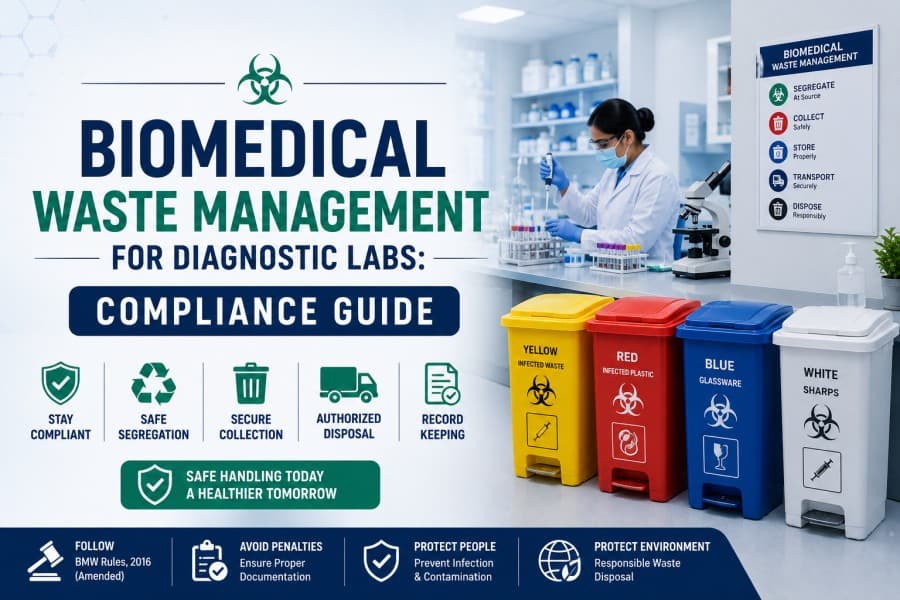
India's BMW Rules 2016 mandate a four-colour segregation system. Getting this wrong is the single most common compliance failure during inspections.
Yellow bags and containers hold human anatomical waste, soiled waste (blood-contaminated dressings, PPE), expired medicines, chemical waste, discarded linen, and microbiology/biotechnology waste. Treatment involves incineration or deep burial.
Red bags and containers receive contaminated recyclable plastic waste, i.e., tubing, bottles, intravenous sets, urine bags, syringes (without needles), and gloves. Autoclaving or microwaving followed by shredding handles this category.
White translucent puncture-proof containers collect sharps, viz., needles, syringes with fixed needles, scalpels, blades, any contaminated sharp object. Autoclaving or dry heat sterilisation precedes final disposal.
Blue cardboard boxes or puncture-proof containers store broken or discarded contaminated glass and metallic body implants. Disinfection followed by recycling through authorised vendors closes the loop.
A rule of thumb inspectors love: sharps containers should never exceed three-fourths capacity. Overfilled containers cause needle-stick injuries during transport and trigger immediate non-conformance reports.
Lab Waste Disposal India: Category-Wise
Sharps Handling
Use puncture-resistant, leak-proof containers labelled with the biohazard symbol. Seal at three-fourths fill, never shake or compress. Store in a dedicated area away from patient traffic until the CBWTF vehicle arrives.
Chemical Waste
Store chemicals in corrosion-resistant, clearly labelled containers with secondary containment trays underneath. Never mix acids with bases. The exothermic reaction can crack containers or release toxic fumes.
Xylene and formaldehyde waste from histopathology needs vendor-authorised pickup; pouring it down drains is both illegal and environmentally destructive.
Biological Waste
Autoclave infectious solids at 121°C for at least 30 minutes before bagging for pickup. Liquid biological waste should be collected in leak-proof containers, chemically disinfected with 1% sodium hypochlorite for a minimum of 30 minutes contact time, then disposed as per protocol. Maintain autoclave validation records; inspectors check Bowie-Dick test logs and biological indicator results religiously.
Common Errors
Throwing blood-soaked cotton into general trash happens more than labs admit. Pouring reagent residues down sinks "because it's just a little" adds up across months.
Mixing pharmaceutical waste with infectious waste contaminates both streams. Storing waste longer than 48 hours on-site without refrigeration violates BMW rules for labs explicitly.
Regulatory Framework For BWM Rules
Biomedical waste management in a diagnostic lab in India operates under a layered regulatory structure.
BMW Rules 2016 (and amendments) form the backbone. Every Healthcare Facility (HCF) must obtain authorisation from the State Pollution Control Board, maintain annual reports, and tie up with a CBWTF for treatment and disposal.
The Environment Protection Act, 1986, provides the parent legal framework and defines penalty structures.
NABL 112 standards for medical labs incorporate waste management as a mandatory clause. Auditors verify segregation practices, training records, and disposal documentation during assessment visits.
Ministry of Health and Family Welfare guidelines supplement BMW rules with infection control protocols applicable during outbreaks (COVID-19 brought several temporary amendments that remain relevant for preparedness).
The Atomic Energy Act, 1962 covers any lab handling radioactive isotopes, requiring separate AERB licensing.
Penalties You Want to Avoid
Violations under BMW rules invite closure notices, prosecution under Section 15 of the Environment Protection Act, and personal liability for occupiers (usually the lab director or owner). Recovery from such incidents takes years, if it happens at all.
Globally, the picture is equally strict. UK regulators have levied fines up to £250,000 for improper chemical disposal under the Environmental Protection Act. A UK hospital lab was fined £100,000 in 2022 for dumping infectious waste in a general landfill. Indian enforcement is catching up rapidly, with digital manifest tracking and GPS-enabled CBWTF vehicles already operational in most metros.
Training Your Team
Waste identification. Staff must distinguish biological from chemical, sharps from infectious, pharmaceutical from general at a glance. Laminated posters near each waste station reinforce this daily.
Safe disposal procedures. Hands-on demonstrations of autoclave loading, container sealing, and spill response stick better than lectures.
Emergency spill handling. Every lab needs spill kits for chemical, biological, and mercury incidents, with trained responders on every shift. Response protocols should be drilled quarterly.
Needle-stick injury response. Immediate wound care, source patient identification, post-exposure prophylaxis protocols, and incident reporting. Every phlebotomist should know this sequence by heart.
Measure training effectiveness through monthly waste audits, anonymous feedback surveys, and compliance incident tracking. A lab running quarterly audits catches 80% of segregation errors before they become inspection findings.
The Role of Technology
Manual registers and paper manifests are slowly fading from serious labs. Digital waste tracking systems log generation, classification, and disposal in real time. Barcode-based systems deployed in UK labs have cut classification errors by up to 30%. AI-powered waste classification tools using image recognition have pushed sorting accuracy above 90% in pilot deployments.
When your Laboratory Information System talks directly to your waste tracking module, compliance reporting stops being a monthly scramble. Automated alerts flag improper handling, generate CPCB-ready reports, and keep audit trails tamper-proof.
Building Your Lab Compliance
CPCB projections indicate that India's annual biomedical waste generation may rise to nearly 165 million tonnes by 2030. It is a volume that will strain CBWTF capacity, tighten inspection cycles, and push non-compliant labs out of the market. Medical labs that build robust systems now will absorb the coming regulatory pressure.
Biomedical waste management in a diagnostic lab is a discipline running through every testing activity. Labs that treat it as paperwork eventually pay the price, either in penalties or in lost accreditation.
The pathology profession demands precision in every result. Extend that same precision to what leaves your lab, and compliance becomes part of how you deliver trustworthy diagnostics.
Also check - Diagnostic Lab Setup Cost in India
Get Started at ₹1!
Try Flabs for a full month for just ₹1.
Follow us on