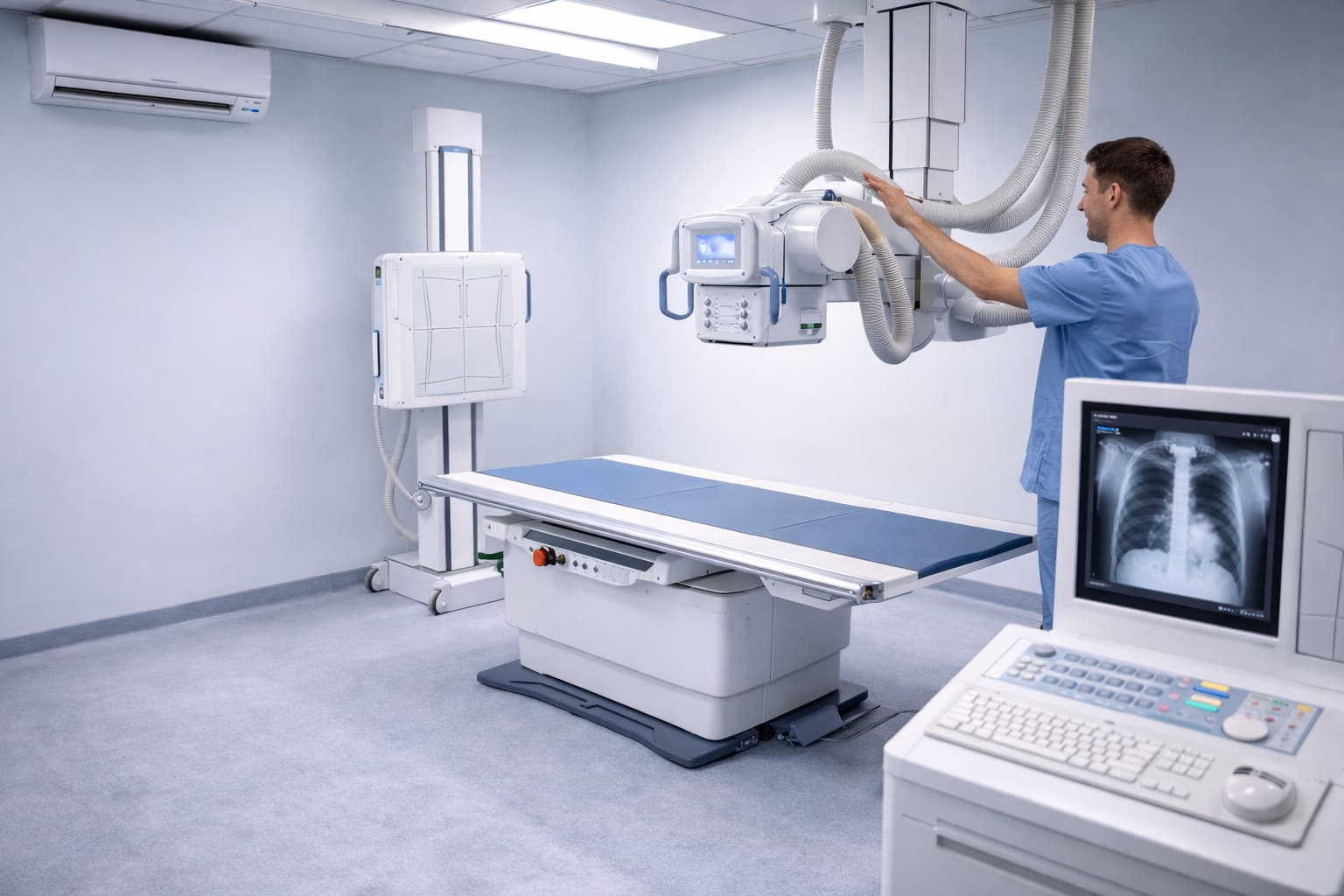
Pathology labs have to deliver faster imaging with tighter margins. In reality, film-based radiography slows reporting, adds recurring costs, and complicates compliance. Delays at the imaging stage affect patient flow and trust. Digital radiography addresses those pressures. However, uncertainty around the pricing of the machines still causes hesitation during procurement.
Pathologists and healthcare professionals need a grounded view of the digital X-ray machine price in India, aligned with budget planning for 2026. The following sections present a cost-focused perspective to manage capital equipment choices daily.
Digital X-Ray Machine Price in India: A Snapshot
The digital X-ray machine price in India can start from around ₹1.5 lakh to ₹8 lakh for basic or entry-level listed equipment, but the full setup cost for a clinic, diagnostic centre or hospital can be much higher.
A practical full digital X-ray setup may cost anywhere from ₹8 lakh to ₹25 lakh or more depending on whether you choose a portable unit, fixed DR system, 100mA/300mA generator, detector panel, shielding work, PACS or reporting software, AERB documentation, workstation, printer, UPS and service contract.
For serious diagnostic use, buyers should evaluate the total setup cost, not only the machine price.
Digital X-Ray Machine Price in India: Updated 2026 Range
| Setup Type | Approximate Price Range | Best Suited For |
|---|---|---|
| Entry-level portable X-ray unit | ₹1.5 lakh – ₹5 lakh | Small clinics, basic imaging, outreach use |
| Battery-operated portable X-ray | ₹5 lakh – ₹10 lakh | ICU, bedside imaging, mobile diagnostics |
| Digital portable DR X-ray | ₹8 lakh – ₹15 lakh | Hospitals, emergency care, mobile radiology |
| Fixed CR-based X-ray setup | ₹7 lakh – ₹12 lakh | Mid-volume diagnostic centres |
| Fixed DR X-ray setup | ₹12 lakh – ₹25 lakh | Diagnostic centres, hospitals, higher daily volume |
| Advanced 300mA/500mA DR setup | ₹15 lakh – ₹35 lakh+ | High-throughput radiology departments |
| U-arm digital X-ray system | ₹20 lakh – ₹40 lakh+ | Hospitals, automated positioning, high-volume imaging |
Note: These are indicative ranges. Actual pricing varies by brand, detector type, generator capacity, installation scope, service coverage, warranty, location and supplier quotation.
Generator capacity shifts pricing sharply. A 100 mA system aligns with basic chest and extremity imaging. A 300 mA unit supports higher throughput and denser anatomical studies, which pushes capital cost upward.
Equipment Price vs Full Setup Cost
Many buyers search for “digital X-ray machine price” but receive only the machine cost. A complete setup includes several additional costs.
| Cost Component | What It Includes | Budget Impact |
|---|---|---|
| X-ray machine | Generator, tube, stand or U-arm system | Main capital cost |
| DR detector panel | Flat-panel detector for instant digital imaging | Major cost driver |
| Workstation | Computer, monitor and image-processing system | Required for digital workflow |
| PACS / DICOM software | Image storage, viewing and sharing | May be bundled or charged separately |
| Radiology reporting software | Report templates, approvals and digital report delivery | Important for diagnostic workflow |
| Room shielding | Lead lining, barium plaster, lead glass or approved wall structure | Mandatory planning area |
| AERB / eLORA documentation | Registration, approval workflow and compliance documents | Must be planned before operation |
| UPS / power backup | Stabilizer, UPS or backup power | Protects equipment and workflow |
| AMC / CMC | Annual maintenance or comprehensive maintenance | Long-term recurring cost |
| Training | Technician and radiology workflow training | Needed for safe operation |
A low machine quote may become expensive if detector, shielding, software, installation and maintenance are excluded.
100mA vs 300mA Digital X-Ray Machine Price
Generator capacity is one of the biggest price factors.
| Capacity | Common Use Case | Price Impact |
|---|---|---|
| 100mA | Basic chest, extremity and low-volume imaging | Lower cost |
| 300mA | General radiography, orthopaedic, chest and higher throughput | Mid to high cost |
| 500mA and above | Hospital radiology, heavier workload and advanced studies | Higher cost |
A small clinic may not need a 300mA or 500mA system if it mainly performs routine low-volume imaging. However, diagnostic centres handling chest, orthopaedic and high-volume referrals should evaluate higher-capacity systems for workflow consistency.
Portable vs Fixed Digital X-Ray Machine
| Factor | Portable Digital X-Ray | Fixed Digital X-Ray |
|---|---|---|
| Mobility | High | Low |
| Installation | Easier | Requires dedicated room planning |
| Image consistency | Moderate to good | Usually stronger for routine radiology |
| Best use | ICU, bedside, outreach, emergency | Diagnostic centres, hospitals, routine radiology |
| Price range | Lower to mid | Mid to high |
| Workflow | Flexible but operator-dependent | More standardized |
| Best buyer | Mobile unit, small clinic, hospital support use | Imaging centre, hospital radiology department |
Portable machines are useful when patients cannot be moved easily. Fixed DR systems are better for diagnostic centres that need consistent image quality, higher volume and structured radiology workflows.
Hidden Costs Before Buying a Digital X-Ray Machine
Before finalizing a quotation, ask the supplier to clearly mention whether the price includes:
- DR detector panel
- X-ray tube and generator
- Workstation and medical-grade monitor
- PACS or DICOM image storage
- Radiology reporting software
- Installation and commissioning
- Room shielding guidance
- Lead door, lead glass or barium plastering requirements
- AERB/eLORA documentation support
- Technician training
- Warranty period
- AMC or CMC charges
- UPS or stabilizer
- GST, freight and installation charges
If these items are excluded, the final project cost can be significantly higher than the quoted machine price.
AERB Compliance and Room Planning
Digital X-ray machines involve ionising radiation, so compliance planning is mandatory in India. Diagnostic radiology facilities should follow AERB requirements, including registration or licensing through the eLORA system where applicable.
Before buying, confirm:
- Whether the equipment model is approved or registered as required
- Whether the supplier supports documentation
- Whether the room layout meets radiation safety requirements
- Whether shielding, lead door, lead glass or wall thickness requirements are covered
- Whether qualified personnel are available for operation
- Whether the facility has the required radiation-safety documentation
Do not purchase only on price. A low-cost machine without proper compliance support can delay installation and operation.
Reference Models to Check
A published digital X-ray machine price list from Indian distributors updated in September 2025 provides practical benchmarks still relevant for 2026.
| Model | Generator Capacity | Listed Price (INR) |
|---|---|---|
| BPL X-RAD 10 | 100 mA | ₹260,000 |
| RMS MDX-100 / FS | 100 mA | ₹180,000 |
| RMS MDX-300 | 300 mA | ₹460,000 |
What Influences the Price in India
Pricing differences rarely come from branding alone. Technical and operational variables play a much bigger role when it comes to the price of medical equipment.
1. System Type
Portable systems sit at the lower end. Essentially, mobility defines their appeal. The limited features suit camps and satellite collection centres well.
Straight-arm machines occupy the middle ground. Fixed installation supports consistent alignment and smoother workflow. Many pathology labs in India favour these units for daily loads.
U-arm systems command the highest prices. Automation also accelerates positioning and exposure sequencing. High-volume hospital radiology departments lean toward such designs more.
2. Generator Capacity and Output
Higher mA ratings expand study range and reduce retakes. That capability adds to acquisition cost. A lab focused on chest imaging rarely needs 300 mA. Orthopaedic referrals change that calculation.
3. Detector Technology
Flat-panel detectors with higher resolution, faster refresh, and longer lifecycle raise system pricing.
4. Brand Reputation and Support
Established manufacturers invest in compliance, installation protocols, and service. Initial pricing reflects that structure. There is less risk of downtime too.
5. Intended Use
For a clinic performing routine radiographs, cost control is the priority. On the other hand, a tertiary care hospital weighs throughput and automation.
In 2026, the digital X-ray machine price in India spans a wide range. It reflects differences in system architecture, generator, detector technology, and service depth. Market data from Indian distributors shows entry points near ₹140,000 for compact systems, with advanced automated units approaching ₹800,000.
Compared with international benchmarks, Indian pricing sits at a competitive level.
Global markets quote digital radiography systems from roughly USD 20,000 to beyond USD 100,000, particularly for automated U-arm designs. Moreover, Indian buyers benefit from local manufacturing, distribution, and region-specific configurations.
Portable Digital X-Ray Machines
A portable digital X-ray machine attracts attention for outreach diagnostics and space-constrained practices. Pricing usually stays below that for fixed systems due to lower power output and compact design.
Rapid deployment and reduced room preparation are the best advantages of portable machines. For pathology labs in India running high daily volumes, portable units fit best as supplementary assets rather than primary workhorses.
Hidden and Ancillary Costs to Budget
- Freight and on-site installation charges.
- Initial staff training.
- Annual maintenance or service contracts.
- Radiation shielding adjustments.
- Software licensing for image management or PACS.
- Insurance coverage.
Compliance and Certification
Regulatory alignment influences pricing. Certified systems meeting Indian radiation safety norms and quality standards carry higher upfront costs. That premium offsets inspection risk and reporting delays. For pathology labs in India working with hospital partners or insurance panels, compliance assurance matters more than marginal savings.
Digital X-Ray Machines Within Lab Equipment Planning
Radiography no longer sits at the periphery of diagnostic services. The choice also depends on the integration with the broader workflows of the pathology lab equipment. Digital imaging feeds directly into reporting systems, clinician dashboards, and archival storage.
Pathologists evaluating equipment stacks for 2026 weigh interoperability alongside price. Systems that connect cleanly with laboratory information systems reduce manual handling and lag.
Buying Strategy for 2026
Procurement cycles in healthcare move slowly. Prices quoted today may shift with detector supply, regulatory updates, or service coverage terms. Sound purchasing decisions emerge from workload analysis rather than headline pricing.
Consider patient volume projections. Review referral patterns. Match generator capacity to clinical demand. Align service agreements with expected uptime requirements.
A lower digital X-ray machine price appeals during budgeting. Long-term operational stability carries equal weight for diagnostic credibility.
Which Digital X-Ray Setup Should You Choose?
| Buyer Type | Recommended Setup | Why |
|---|---|---|
| Small clinic | Entry-level or portable X-ray | Lower cost and basic imaging support |
| Diagnostic centre | Fixed DR or CR-to-DR setup | Better workflow and image consistency |
| High-volume imaging centre | 300mA/500mA DR system | Supports higher patient load |
| Hospital | Fixed DR + portable unit | Covers radiology room and bedside imaging |
| Rural or outreach program | Portable battery-operated unit | Easier mobility and field use |
| Orthopaedic-heavy centre | Higher-capacity fixed system | Better for dense anatomy and repeat workload |
The right choice depends on patient volume, clinical use case, available space, compliance readiness, reporting workflow and service support.
Digital X-Ray Machine Buyer Checklist
Before buying a digital X-ray machine, check:
- What is included in the quoted price?
- Is the detector included or charged separately?
- Is it CR, DR or retrofit DR?
- What is the generator capacity?
- Is installation included?
- Does the supplier help with AERB/eLORA documentation?
- Is room shielding guidance included?
- What is the warranty period?
- What is the AMC or CMC cost after warranty?
- Is PACS or DICOM software included?
- Can images connect with radiology reporting software?
- Is technician training included?
- What is the expected downtime support?
- Are spare parts available locally?
- Can the system scale if patient volume increases?
How FLABS Supports Digital X-Ray Reporting Workflows
Buying a digital X-ray machine solves only one part of the diagnostic workflow. Imaging centres also need a reliable way to create, approve, store and deliver radiology reports.
FLABS Radiology Report Software helps diagnostic centres manage radiology report templates, approvals, digital signatures, patient and doctor report access, and report delivery workflows.
For centres managing both pathology and radiology, FLABS can support connected diagnostic reporting workflows so teams can reduce manual coordination and deliver approved reports through digital channels.
Final Thoughts
The digital X-ray machine price in India for 2026 reflects a balance between accessibility and technological depth. Entry-level systems open doors for smaller practices. Advanced configurations suit hospitals and imaging-heavy pathology labs.
Clarity on the trends of pricing supports smarter capital allocation. For healthcare professionals, informed selection supports both diagnostic quality and financial resilience in the years ahead.
Also check - CT Scan Machine Price in India
Get Started at ₹1!
Try Flabs for a full month for just ₹1.
Follow us on