The need for understanding HCG levels is highly emphasised in the diagnosis and management of ectopic pregnancy. HCG (Human Chorionic Gonadotropin) is a hormone produced during pregnancy. In a normal pregnancy, HCG levels double every 48-72 hours. But in an ectopic pregnancy, these levels rise more slowly.
Monitoring HCG levels helps healthcare providers detect ectopic pregnancies early, reducing the risk of complications. Knowing the differences in HCG patterns can guide timely medical intervention and improve outcomes. Hence, we will look at the significance of HCG levels in an ectopic pregnancy and what one needs to be aware of.
Signs and Symptoms in Ectopic Pregnancy
Ectopic pregnancy in individuals comes with the following signs and symptoms, when healthcare providers order appropriate tests.
Early Symptoms
- Missed menstrual period (Amenorrhea)
- Positive pregnancy test
- Breast tenderness and nausea (typical early pregnancy signs)
- Light vaginal bleeding
- Mild to moderate pelvic pain, often on one side
Progressive Symptoms
- Shoulder pain (referred pain due to intra-abdominal bleeding)
- Urge to defecate (caused by blood irritating pelvic nerves)
- Increasing pelvic or abdominal pain as the ectopic pregnancy grows.
- Absence or presence of vaginal spotting, which may vary.
Emergency Symptoms (Tubal Rupture)
- Sudden, severe abdominal or pelvic pain
- Heavy internal bleeding
- Extreme lightheadedness or dizziness
- Syncope or fainting
- Signs of hypovolemic shock.
Variable Presentation
- Some patients remain asymptomatic in the early stages.
- In rare cases, fetal cardiac activity may be detected in the ectopic location.
- Classic triad (missed period, pelvic pain, vaginal bleeding) may suggest ectopic pregnancy but is not diagnostic, as these signs can occur in intrauterine pregnancies as well.
Close clinical monitoring and timely imaging are essential to distinguish ectopic pregnancy from other early pregnancy complications.
Diagnosis of Ectopic Pregnancy
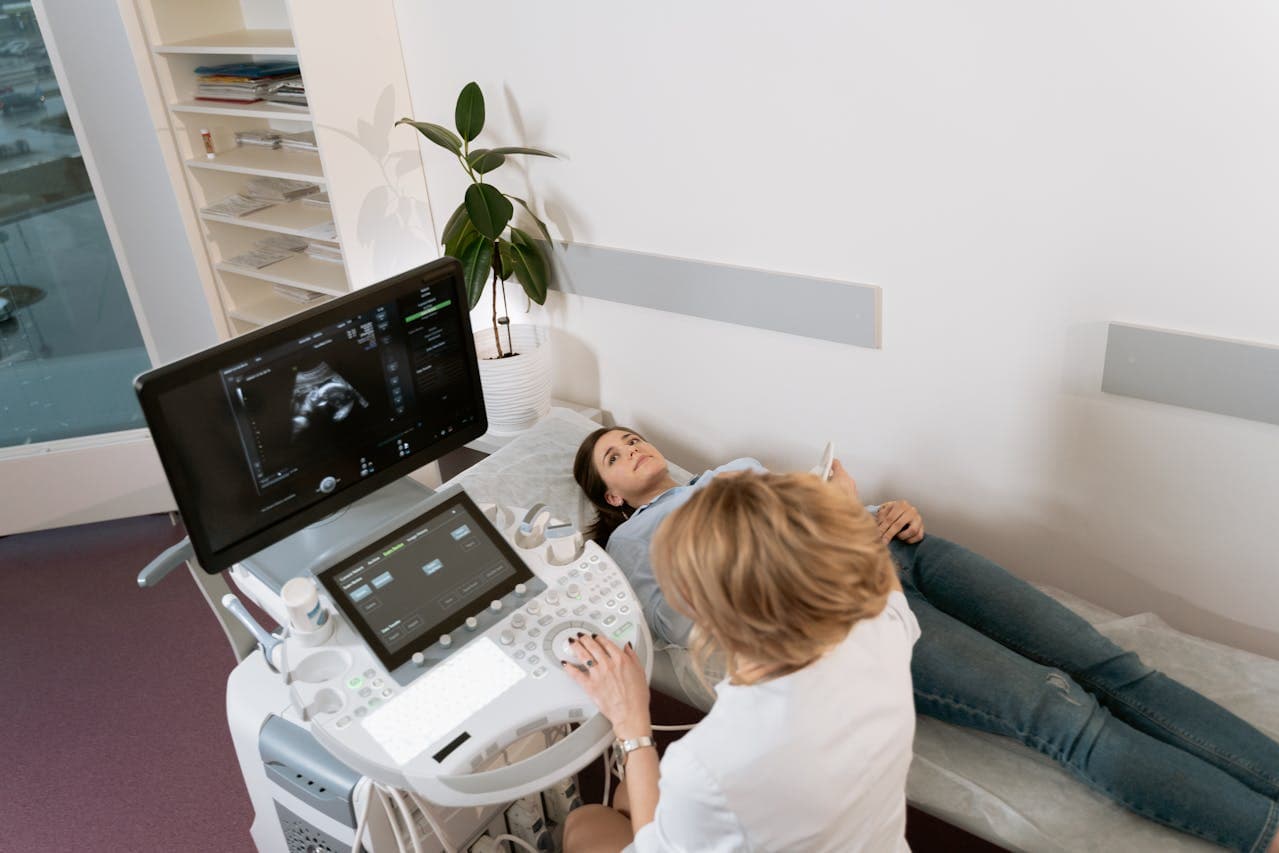
Ectopic pregnancies are most commonly identified between the 6th and 9th weeks of gestation. Patients usually present with symptoms such as abdominal or pelvic pain and/or vaginal bleeding. When these symptoms are reported, initial evaluation includes transvaginal ultrasound and measurement of serum beta-hCG levels.
If an intrauterine pregnancy is not visualized, differential diagnoses include early intrauterine pregnancy, ectopic pregnancy, or pregnancy loss. The absence of a visible intrauterine embryo does not confirm ectopic pregnancy, particularly in very early gestation. However, specific sonographic findings—such as a gestational sac or embryo located outside the uterus, particularly in the fallopian tube—can definitively indicate an ectopic pregnancy.
Sonographic images may reveal an adnexal mass without a clearly defined embryo. It may suggest an ectopic pregnancy, especially when correlated with rising but abnormal beta-hCG trends.
When neither an intrauterine nor ectopic pregnancy is identified on imaging, the condition is classified as a pregnancy of unknown location (PUL). In such cases, close follow-up is suggested. Serial beta-hCG measurements and repeat ultrasounds are used to monitor progression. They also differentiate between a resolving pregnancy, an early intrauterine pregnancy, and an ectopic pregnancy.
HCG Levels in Ectopic Pregnancy Vs. Normal Pregnancy
| Parameter | Normal Intrauterine Pregnancy | Ectopic Pregnancy |
|---|---|---|
| hCG Doubling Time | Every 48–72 hours (2–3 days) | Slower rise; often >72 hours; may exceed 2.2 days |
| hCG Pattern | Predictable exponential increase in early pregnancy | Inconsistent or plateauing increase; may even decline |
| hCG Levels by 6 Weeks | Often >10,000–20,000 mIU/mL | Typically lower; often below 6,000 mIU/mL |
| hCG Peak Range | Peaks around 100,000–200,000 mIU/mL (8–11 weeks gestation) | Rarely reaches peak levels; may plateau at lower thresholds |
| Diagnostic Threshold for Ultrasound | Gestational sac usually visible at hCG >1,500–2,000 mIU/mL (transvaginal) | May not see intrauterine pregnancy at these levels |
| Serum hCG Use in Diagnosis | Reliable for assessing pregnancy progression | Must be interpreted with ultrasound and serial measurements |
Many times, HCG measurements are combined with ultrasound and clinical symptoms to diagnose ectopic pregnancies. In some cases, HCG levels in ectopic pregnancies may initially rise normally, making early detection challenging.
Unusual HCG patterns don't always indicate an ectopic pregnancy, and normal patterns don't completely rule it out.
Test to Determine Beta HCG levels in Ectopic Pregnancy
- Quantitative Serum Beta HCG Test: Measures precise HCG levels in blood.
- Qualitative Urine HCG Test: It serves as an initial screening test, but less sensitive than blood tests.
- Ultrasound: The test combines HCG levels with transvaginal ultrasound. It determines if a pregnancy is visible in the uterus at specific HCG levels.
- Serial Beta HCG Measurements: Multiple blood tests over time to track HCG progression.
- Progesterone Level Test: It is often used in conjunction with HCG tests. Low levels can indicate ectopic pregnancy.
- Complete Blood Count (CBC): A suggestive test, which checks for anaemia that can occur in ectopic pregnancy.
- Culdocentesis: This test is rarely used now, but it can detect blood in the abdominal cavity.
- Laparoscopy: This test is used when other tests are inconclusive through surgical diagnostic procedure.
Ectopic Pregnancy HCG Levels Chart
| Weeks From Last Menstrual Period | Approx. Amount of HCG (in mIU/mL) |
|---|---|
| 3 weeks | 5 to 50 |
| 4 weeks | 5 to 426 |
| 5 weeks | 19 to 7,340 |
| 6 weeks | 1,080 to 56,500 |
| 7-8 weeks | 7,650 to 229,000 |
| 9-12 weeks | 25,700 to 288,000 |
| 13-16 weeks | 3,300 to 253,000 |
| 17-24 weeks (Second Trimester) | 4,060 to 165,400 |
| 25 to term (Third Trimester) | 3,640 to 117,000 |
| After several days postpartum (Nonpregnant levels) | <5 |
Facts about HCG Levels in Ectopic Pregnancy
- Pseudo-Sac Phenomenon: Sometimes, an intrauterine fluid collection can be mistaken for a gestational sac on ultrasound, even with rising HCG levels in an ectopic pregnancy.
- Hook Effect: In rare cases, extremely high HCG levels can paradoxically result in falsely low readings on certain tests, potentially masking an ectopic pregnancy.
- Heterotopic Pregnancy: It's possible to have both an intrauterine and ectopic pregnancy simultaneously, which can lead to confusing HCG patterns.
- Persistent Low HCG: Some ectopic pregnancies can maintain low but persistent HCG levels for weeks without rupturing.
- Normal Doubling Time: A small percentage of ectopic pregnancies may show normal HCG doubling times initially, making early detection challenging.
- Cornual Pregnancies: These rare ectopic pregnancies implanted in the uterine corner can sometimes produce HCG levels similar to normal pregnancies.
- Chronic Ectopic Pregnancies: These can present with fluctuating, low HCG levels over an extended period.
- Influence of Fertility Treatments: IVF and other fertility treatments can sometimes lead to atypical HCG patterns, complicating ectopic pregnancy diagnosis.
- Vanishing Twin Phenomenon: In cases of initial multiple pregnancies, the loss of one embryo can affect HCG levels unpredictably.
- Individual Variations: There's significant variability in HCG levels among women, making strict cutoffs for diagnosis challenging.
Therapeutic Management
The management of ectopic pregnancy depends on the patient’s clinical stability, β-HCG levels, and imaging findings. The primary treatment options include expectant management, medical therapy with methotrexate, and surgical intervention.
Expectant Management
This approach is considered when the patient is: Asymptomatic, Hemodynamically stable, and showing evidence of spontaneous resolution (e.g., declining serum β-HCG levels).
Requirements:
- No signs of tubal rupture
- Close monitoring and regular follow-up are essential
- Patients must be reliable and compliant with outpatient care
Note: Even with low and falling β-HCG levels, there remains a risk of tubal rupture.
Medical Management with Methotrexate
Methotrexate is the preferred non-surgical option for unruptured ectopic pregnancies. A single intramuscular dose is commonly used when the candidate is hemodynamically stable, has no severe or ongoing abdominal pain, and is willing and able to return for serial monitoring. A normal baseline renal and liver function is also important.
Absolute Contraindications:
- Intrauterine pregnancy
- Immunodeficiency
- Hematologic disorders (moderate to severe anemia, leukopenia, or thrombocytopenia)
- Known methotrexate hypersensitivity
- Active pulmonary or peptic ulcer disease
- Significant hepatic or renal dysfunction
- Breastfeeding
- Evidence of tubal rupture
Surgical Management
Laparoscopy is the preferred surgical approach for most cases of ectopic pregnancy.
Laparotomy is reserved for:
- Hemodynamically unstable patients
- Cornual ectopic pregnancies
- Surgeons without laparoscopic experience
- Cases where laparoscopy is not feasible
Prompt surgical intervention is critical in patients with rupture or instability to prevent severe complications.
Natural Management
While HCG levels are primarily controlled by the developing pregnancy itself, there are some natural ways to support overall pregnancy health, which may indirectly influence HCG production.
- Eat nutrient-rich foods to support foetal development.
- Drink plenty of water to support overall health and blood volume.
- Ensure to get enough sleep and relaxation. Practice relaxation techniques such as meditation or prenatal yoga.
- Gentle activities like walking can improve circulation.
- Ensure to get all essential nutrients, especially folic acid.
- Avoid alcohol, tobacco, and unnecessary medications.
- Being overweight or underweight can affect hormone levels. Manage weight levels.
- Some herbal teas like red raspberry leaf may support pregnancy health (consult your doctor first).
- Attend all scheduled appointments for monitoring.
Conclusion
Understanding HCG levels is key in diagnosing and managing ectopic pregnancies. While HCG tests provide valuable insights, they should be interpreted with other clinical findings. Regular prenatal care, a balanced diet, and overall health maintenance support a healthy pregnancy. Always consult your healthcare provider for personalised advice and follow-up care for a smooth pregnancy journey.
Related read: Pathology test list
Get Started at ₹1!
Try Flabs for a full month for just ₹1.
Follow us on