Becoming an MD in Pathology is a rigorous and rewarding journey that requires dedication, perseverance, and a strong passion for the field of medicine. For those interested in pursuing this career path, it is important to have a clear understanding of the steps involved and the challenges that lie ahead.
The journey to MD Pathology starts from selecting the right undergraduate degree to completing medical school and residency training. After that gain admission to MD Pathology, take fellowships and apply for various professional roles. There is also an option to finish MD Pathology abroad. Let’s look at the different steps involved in this guide.
Steps to Become an MD in Pathology
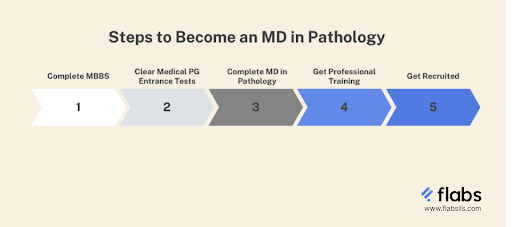
Complete MBBS
Aspirants aiming for MD in pathology must complete an MBBS degree at a recognised medical institute in India or abroad. To do MBBS abroad and come back to India, it is important to choose colleges recognised by the Medical Council of India. Ensure to complete the MBBS degree with minimum 50% marks.
Note: The common setback for MBBS in India is disproportion between seat availability and number of candidates. For 2022-2023, there were 45,337 medical seats for 2 lakh applicants. So many opt for doing MBBS out of the country.
Clear Medical PG Entrance Tests
MD in Pathology is offered in all the recognised medical colleges of India. To gain admission, aspirants have to clear entrance tests held by respective universities. NEET-PG is the common exam accepted by most colleges. However, colleges such as AIIMS and JIPMER have their own entrance tests (INI CET).
MD in Pathology Eligibility:
- MBBS degree from a recognised medical college in India with minimum 50% marks.
- Completion of 1-year internship in a professional medical facility.
- For reserved candidates, appropriate reservations will be available.
Entrance Tests for MD in Pathology
| Entrance Examination | Application Last Date | Exam Dates |
|---|---|---|
| NEET PG | April 2024 | July 7, 2024 |
| INI CET 2024 | Yet to be Released | May 19, 2024 |
After clearing the entrance tests with cut-off marks, gain admission to the medical colleges.
Complete Professional Training/Fellowships
After earning an MD Pathology degree, practical training is required to enter the professional market. The duration is 1-3 Years as required by respective employers
Get Recruited
After completion of professional training, start by applying to prominent pathology labs in India. Alternatively, an MD Pathology holder can also enter teaching profession in eminent institutes of India like AIIMS; take R&D jobs in various Government and Private medical research facilities.
Top Recruiters for MD Pathologists in India:
- Path Kind Lab.
- Thyrocare.
- Apollo Diagnostics.
- RedCliffe Labs
- Agilus Diagnostics (formerly SRL).
- Metropolis Pathology Lab.
- Vijaya Diagnostics.
- Healthians.
- Max Healthcare.
- Lal Path Lab.
MD in Pathology Abroad
As mentioned, the competition in India is heavy for a smaller number of seats. It is true for Medical PG also. So many students plan to complete PG abroad and return to India for practising. MD Pathology is available in most popular countries like the USA, UK, Australia, Russia, etc.
Gaining admission may require clearing entrance tests. After completing MD in Pathology abroad, one has to obtain a licence to practise or get employed in India. For that, clearing FMGE (Foreign Medical Graduate Examination) exam is mandatory to get the required licence.
MD Pathology Salary in India
According to Glassdoor, MD in pathology salary has an average of ₹6.24 Lakh per year in India. They earn an compensation of ₹64,000 on average (₹8,000 - ₹1,20,000).
Average MD in Pathology Salary in India
| Job Profile | Average Annual Salary (INR) |
|---|---|
| Neuropathologist | ₹26.27 Lakh |
| Histopathologist | ₹21.6 Lakh |
| Medical Pathologists | ₹10.00 Lakh |
| Clinical Pathologist | ₹9.00 Lakh |
| Veterinary Clinical Pathologist | ₹8.00 Lakh |
| Forensic Pathologist | ₹8.00 Lakh |
| Pathologist Professor | ₹7.20 Lakh |
Best Colleges for MD Pathology in India
Medical education in India is very sophisticated. Institutes like AIIMS, JIPMER or PGIMER are world-renowned. Every year, NIRF (National Institute of Ranking Framework) gives them a rating based on various criteria. The below table presents the NIRF 2023 ratings along with MD pathology fees in various colleges.
Best Colleges in India for MD Pathology
| Medical College in India | NIRF Ranking 2023 | First Year Fees |
|---|---|---|
| All India Institute of Medical Sciences, Delhi (AIIMS) | 1 | ₹1,567 |
| Post Graduate Institute of Medical Education and Research (PGIMER) | 2 | ₹3,370 |
| Christian Medical College, Vellore | 3 | ₹1,86,210 |
| Jawaharlal Institute of PostGraduate Medical Education & Research, Puducherry (JIPMER) | 5 | ₹12,810 |
| Sanjay Gandhi Postgraduate Institute of Medical Sciences, Lucknow | 7 | ₹72,800 |
| Banaras Hindu University, Varanasi | 8 | ₹14,326 |
| Kasturba Medical College, Manipal | 9 | ₹33,98,000 |
| Madras Medical College & Government General Hospital, Chennai | 11 | ₹1,47,000 |
| King George's Medical University, Lucknow | 12 | ₹1,08,200 |
| All India Institute of Medical Sciences, Jodhpur | 13 | ₹2,147 |
| Vardhman Mahavir Medical College & Safdarjung Hospital, New Delhi | 14 | ₹30,000 |
| Dr. D. Y. Patil Vidyapeeth, Pune | 15 | ₹16,10,000 |
| Siksha `O` Anusandhan, Bhubaneswar | 16 | ₹30,00,000 |
Suggested - Future of Pathology in India
MD Pathology Disadvantages
- Pathologists generally have less direct patient contact, focusing mainly on analysing samples and interpreting data. This makes the field less suitable for those seeking patient-facing roles.
- Pathologists often work in labs and offices, spending considerable time examining specimens and writing reports. It may not appeal to those desiring a physically active career.
- Pathologist careers necessitate extensive education, involving medical school and a four-year residency in pathology, with additional time for subspecialty fellowships.
- Pathologists frequently face heavy workloads and long hours to handle diagnoses.
- Pathologists must be highly detail-oriented, since minor diagnostic mistakes can greatly impact patient outcomes. So the stakes involved are high.
Conclusion
Becoming an MD in Pathology is an exercise of dedication and perseverance. The course is definitely not for the faint hearted, but for the highly-passionate people. Though the job seems demanding, the rewards of playing a critical role in determining the course of a disease, helping doctors make accurate decisions, and helping patients receive better healthcare are invaluable. It gives a sense of fulfilment like no other.
Today, pathologists are not just involved in diagnosis, but discovering new medical avenues for advanced medical care as well. They are the backbone of medical industry standards across the world. If you’re looking forward to becoming an MD in Pathology, prepare yourself well without doubt.
Related read: How to become pathologist
Get Started at ₹1!
Try Flabs for a full month for just ₹1.
Follow us on