PDW stands for Platelet Distribution Width. It is a platelet index reported on many Complete Blood Count (CBC) results and describes how much the platelets in a blood sample vary in size.
A higher PDW means there is greater variation between smaller and larger platelets. A lower PDW means platelet sizes are more uniform.
PDW does not diagnose a disease by itself. Its interpretation depends on the platelet count, Mean Platelet Volume (MPV), other CBC findings, symptoms and—most importantly—the reference interval and unit used by the testing laboratory.
Different haematology analysers may calculate and report PDW differently, so an online cutoff should never replace the range printed on your actual blood report.
What is PDW?
PDW Full Form and Meaning - The full form of PDW is Platelet Distribution Width.
In a blood report, PDW indicates the degree of variation in platelet size. Platelets are blood components responsible for clot formation and bleeding control. When platelet sizes vary significantly, PDW values increase. When platelets are more uniform in size, PDW values decrease.
Healthcare providers interpret PDW along with other platelet indices such as:
- Platelet Count (PLT)
- Mean Platelet Volume (MPV)
- Plateletcrit (PCT)
- P-LCR (Platelet Large Cell Ratio)
Together, these parameters provide a comprehensive assessment of platelet health and function.
PDW full form is Platelet Distribution Width. It is a measure of platelet size variability, which helps assess platelet activation and overall function. It is a parameter included in a Complete Blood Count (CBC test) and is expressed as a percentage.
High PDW values indicate increased variability in platelet size. It may be linked to vascular diseases, anemia, or certain malignancies.
Low PDW values suggest uniform platelet size, which can be associated with bone marrow disorders or chronic inflammatory conditions.
What Is PDW in a Blood Test?
Platelets are small cell fragments produced in the bone marrow that help form blood clots when a blood vessel is injured.
Platelets are not all exactly the same size. Newly produced platelets may differ in size from older circulating platelets, and platelet activation or changes in platelet production can increase this variation.
PDW quantifies this variation in platelet size.
PDW is usually interpreted with other platelet parameters:
| Parameter | What It Measures |
|---|---|
| Platelet Count (PLT) | Number of platelets in the blood |
| PDW | Variation in platelet size |
| MPV | Average platelet size |
| P-LCR | Proportion of larger platelets |
| Plateletcrit (PCT) | Approximate proportion of blood volume occupied by platelets |
PDW is not the same as a platelet-function test. Dedicated platelet-function tests evaluate how effectively platelets participate in clot formation.
Why is the PDW Blood Test Conducted?
General health assessment: PDW is analysed along with other CBC parameters for an overview of a patient’s health.
Investigation of bleeding disorders: Used when patients exhibit symptoms like frequent bruising, prolonged bleeding, or small red spots (petechiae).
Evaluation of Diseases Affecting Platelets: Conditions such as infections, inflammatory disorders, and autoimmune diseases can impact platelet function and distribution.
Indication for the PDW Test
Excessive menstrual bleeding, Presence of blood in urine (Hematuria), chronic muscle pain, Persistent headaches, fatigue or dizziness, explained bruising, bleeding gums, and suspected internal bleeding.
PDW Blood Test: Procedure and Considerations
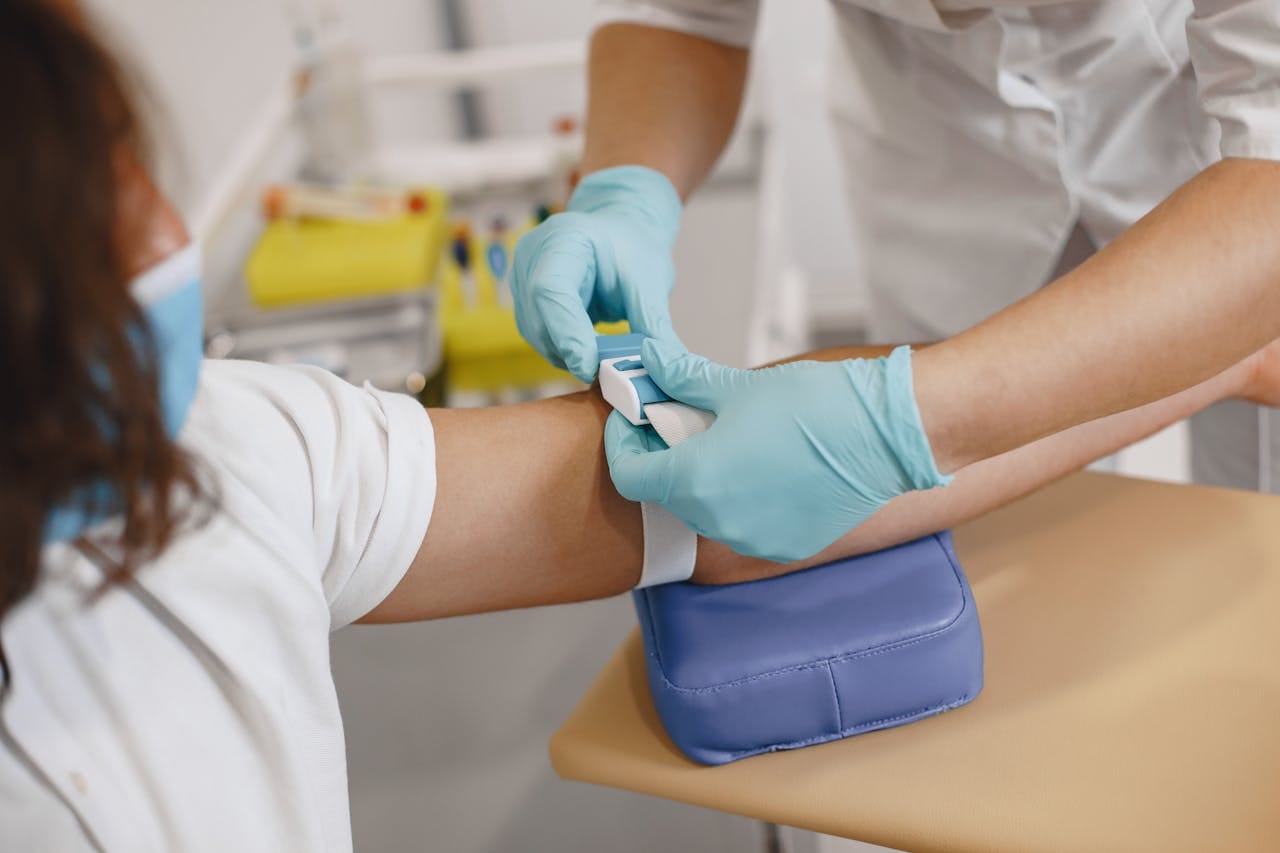
The PDW test involves collecting a blood sample from a vein, typically in the arm. A healthcare professional applies a tourniquet to make the vein more prominent before cleansing the area with an antiseptic. A sterile needle is then inserted to withdraw the blood, which is stored in a vial and sent for laboratory analysis. After the procedure, a bandage is applied to the puncture site to minimise bleeding.
Generally, no special preparations are required for a PDW test. However, if additional blood tests are ordered, fasting may be necessary. Patients should inform their healthcare provider about any medications or supplements they are taking, as these can influence test results.
While the procedure is safe, some individuals may experience mild discomfort, bruising or temporary dizziness. In rare cases, anxiety related to blood draws may also occur. But such effects are usually short-lived.
What Is the Normal PDW Range?
There is no single universal PDW normal range that applies to every laboratory or analyser.
PDW reference intervals differ according to:
- The haematology analyser
- The way the instrument calculates platelet distribution
- The unit in which PDW is reported
- The laboratory's validated reference population
- Sample collection and processing conditions
Published studies illustrate this variation. Different analyser/population combinations have produced reference intervals expressed either in femtolitres or percentages.
The safest approach is therefore:
Use the unit and reference range printed beside PDW on your own CBC report.
Do not convert a percentage-based PDW value directly into femtolitres or compare a value reported by one analyser with the cutoff used by another laboratory.
Is PDW 9–17% Normal?
Some laboratories and analyser systems use percentage-based PDW ranges around this level, but 9–17% should not be treated as a universal reference interval.
If your result is reported as a percentage, use the percentage reference range supplied by the laboratory.
What About PDW Reported in fL?
Other systems report PDW in femtolitres (fL). Published fL reference intervals vary considerably between analyser systems and populations.
Again, use the fL interval printed on the actual report rather than applying a percentage-based range.
PDW-CV vs PDW-SD: What Is the Difference?
Some laboratory reports include labels such as PDW-CV or PDW-SD.
These are different ways of describing platelet-size distribution, and the terminology and calculation can depend on the analyser.
The important practical rule is:
- Check which PDW parameter is reported.
- Check whether the unit is % or fL.
- Use the reference interval printed for that exact parameter.
- Do not assume PDW-CV and PDW-SD values are interchangeable.
If a result is transferred between laboratories, compare the analyser method and reference interval before interpreting a change.
How to Read PDW in a Blood Report
PDW usually appears within the platelet section of a CBC report.
An example may look like this:
| Report Field | Illustrative Result |
|---|---|
| Platelet Count | 250 × 10⁹/L |
| PDW | XX.X |
| PDW unit | % or fL according to analyser |
| PDW reference interval | Laboratory-specific |
| MPV | X.X fL |
| P-LCR | XX% |
| Result flag | Normal / High / Low according to laboratory range |
When reading your own result:
- Check the PDW unit.
- Compare the result with the laboratory's own reference interval.
- Review platelet count.
- Check MPV and other platelet indices.
- Look for any high or low flags in the rest of the CBC.
- Compare with previous results when available.
- Discuss persistent or significant abnormalities with a healthcare professional.
The values above are illustrative only and should not replace the ranges on an actual laboratory report
PDW Sample Report
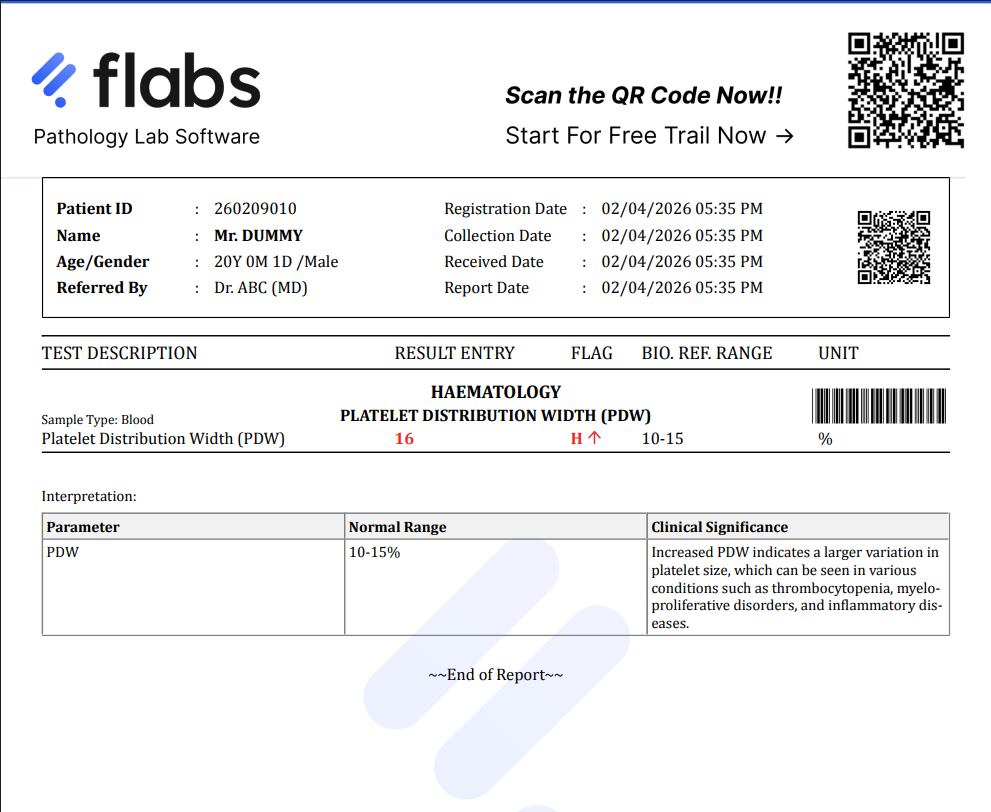
Download the complete PDW blood test report for detailed information.

What Does High PDW Mean?
A high PDW means there is greater-than-expected variation in platelet size according to the laboratory's reference range.
This may occur when platelet production, turnover or activation changes and the circulating platelets become more varied in size.
Higher PDW has been reported in association with several conditions, including:
- Iron deficiency
- Inflammatory states
- Some infections
- Increased platelet destruction or turnover
- Certain platelet and bone-marrow disorders
- Some cardiovascular and metabolic conditions
However, these are associations rather than diagnoses.
A high PDW does not prove that a person has:
- A blood clot
- Cancer
- Cardiovascular disease
- A bone-marrow disorder
- An autoimmune disease
The result becomes more useful when platelet count and MPV are considered at the same time.
What Does Low PDW Mean?
A low PDW means that the platelets measured by the analyser are relatively similar in size.
A mildly low PDW often has limited clinical significance when:
- Platelet count is normal
- MPV is normal
The rest of the CBC is normal - There are no concerning symptoms
Low PDW should therefore not be used on its own to diagnose bone-marrow disease, vitamin deficiency, liver disease or another condition.
When PDW is low together with an abnormal platelet count or other CBC changes, the healthcare professional may review the complete blood count, medical history and—in selected cases—a peripheral blood smear or additional testing.
How to Interpret PDW With Platelet Count and MPV
PDW is most useful as part of a platelet pattern rather than as an isolated number.
| PDW | Platelet Count / MPV Pattern | General Interpretation |
|---|---|---|
| High PDW + abnormal platelet count | Greater platelet-size variation occurring with an abnormal number of platelets | Requires interpretation of the underlying platelet-count abnormality |
| High PDW + high MPV | Greater variation plus larger average platelet size | May reflect increased platelet turnover or activation |
| High PDW + normal platelet count | May represent platelet-size variation without a major count abnormality | Clinical significance depends on MPV, symptoms and other results |
| Low PDW + normal platelet count | Platelets are relatively uniform in size | Often has limited significance in isolation |
| Abnormal PDW + abnormal MPV/PLT | Multiple platelet indices are abnormal | May justify closer review of the CBC and clinical context |
No combination in this table is diagnostic on its own.
Learn more about MPV blood test
What Do PDW Values Such as 16, 17, 20 or 25 Mean?
Specific PDW numbers should only be interpreted after confirming the unit and laboratory reference range.
| Example PDW Result | How to Approach It |
|---|---|
| PDW 16 | May fall within the reference interval on some reports and be near the upper limit on others |
| PDW 17 | May be normal, borderline or high depending on the analyser and unit |
| PDW 18–19 | More likely to be flagged on some systems, but the laboratory range remains the deciding factor |
| PDW 20–25 | May be above many commonly used ranges, but it cannot determine the underlying cause |
| PDW 26–30 | Often warrants review when clearly above the laboratory's own range, especially if other platelet indices are abnormal |
For example, PDW 17% and PDW 17 fL are not automatically equivalent results.
When searching for the meaning of PDW 16, 17, 20, 25 or another number, first check:
- Is the unit % or fL?
- What is the laboratory's reference interval?
- Is platelet count normal?
- What is the MPV?
- Are other CBC values abnormal?
- Is the result new or persistent?
Is High PDW Dangerous?
An isolated high PDW is not automatically dangerous.
Its clinical importance depends on:
- How far it is outside the laboratory's range
- Platelet count
- MPV and other platelet indices
- Other CBC abnormalities
- Symptoms
- Whether the result persists
- The person's medical history
PDW has been studied in cardiovascular disease, inflammation, infection and other conditions, but a high result alone cannot determine a person's risk of a blood clot, cancer, stroke or heart attack.
Speak with a healthcare professional if an abnormal PDW occurs with:
- Unexplained bruising
- Frequent or prolonged bleeding
- Petechiae
- An unusually low or high platelet count
- Repeatedly abnormal CBC results
- Other persistent or concerning symptoms
Does High or Low PDW Need Treatment?
There is no standard treatment whose purpose is simply to raise or lower PDW.
When treatment is required, it is directed at the underlying cause of the abnormal blood findings.
For example, further evaluation may identify an iron deficiency, inflammatory condition, platelet disorder or another cause that requires its own management.
Do not start supplements, aspirin, antiplatelet medicines or dietary treatments solely because a PDW value is outside the reference interval unless a healthcare professional has recommended them for a diagnosed condition.
Conclusion
While PDW is valuable in assessing platelet function, its integration with other platelet indices, e.g., Mean Platelet Volume (MPV) and Plateletcrit (PCT), can improve diagnostic precision. Combining these parameters provides a comprehensive view of platelet behavior, aiding in distinguishing between reactive and pathological conditions.
Future research could focus on PDW’s role in predicting treatment responses, particularly in oncology and hematology. For healthcare professionals, these combined indices may refine haematological care.
Suggested read: P-LCR Blood Test
Get Started at ₹1!
Try Flabs for a full month for just ₹1.
Follow us on