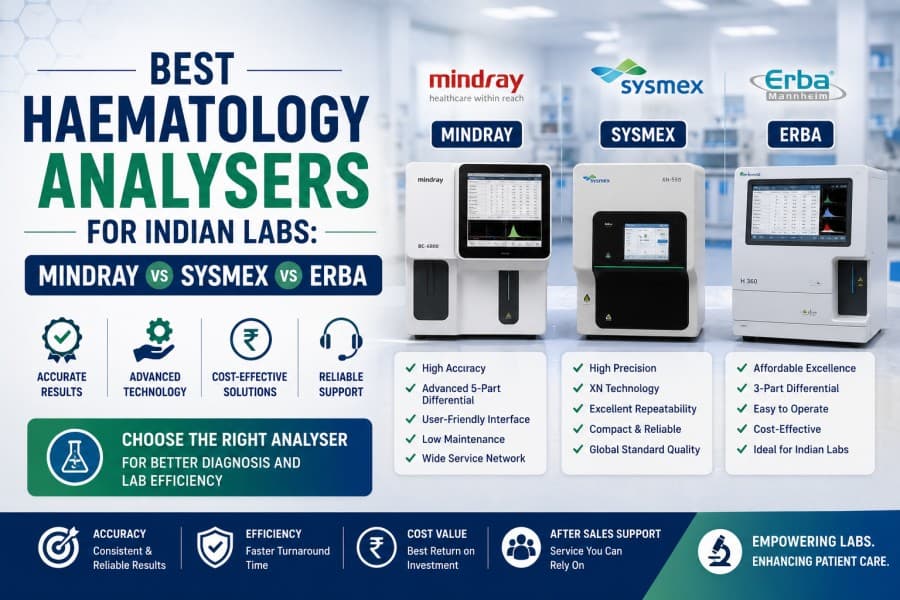
A haematology analyser is a long-term commitment. The machine you pick shapes turnaround time, reagent cost, and report quality for years. Three brands dominate shortlists across Indian labs: Mindray, Sysmex, and Erba. Each one suits a different lab size and budget. Let us compare them on the points that decide daily bench life, then show how the right software ties the setup together.
What Is a Haematology Analyser?
A haematology analyser is a laboratory instrument that performs automated blood cell analysis using a small blood sample. It measures parameters such as red blood cells (RBC), white blood cells (WBC), haemoglobin (Hb), platelets (PLT), and other complete blood count (CBC) values, helping clinicians diagnose infections, anaemia, blood disorders, and monitor patient health.
Choosing a Haematology Analyser in India
The best haematology analyser in India depends on your daily sample load and the differential you report. Small clinics run well on a 3-part machine like the Mindray BC-20 or Sysmex XP-300.
Mid-size labs that report eosinophils and basophils separately need a 5-part system. Price, throughput, differential type, and service reach decide which haematology analyser in India earns a place on your bench.
| Brand & Model | Differential | Throughput | Parameters | Best Fit |
|---|---|---|---|---|
| Mindray BC-20 | 3-part | 40/hour | 20 + 3 histograms | Small clinics, low daily volume |
| Sysmex XP-300 | 3-part | 60/hour | 20, with a separate neutrophil count | Clinics needing ANC, reliable backup |
| Erba H360 | 3-part | 60/hour | 24, incl. Mentzer index & RDWI | Small to mid labs, anaemia panels |
How the Three Brands Compare on the Bench
The Mindray BC-20: It is a compact 3-part analyser built for small labs. It runs 40 samples an hour on roughly 9 µL of blood and reports 20 parameters with three histograms. Reagent cost stays low because the system uses only three reagents.
For a clinic processing 30 to 60 CBCs a day, the BC-20 works as a dependable haematology analyser in India. Mindray's service network across India keeps downtime to a minimum.
The Sysmex XP-300: It pushes throughput to 60 samples an hour. It counts neutrophils and lymphocytes separately, so you get an absolute neutrophil count that many rivals fold into a single granulocyte group.
Barcode reagent management cuts manual entry errors. Sysmex has a strong reputation for consistent results, which counts when a haematology analyser in India feeds reports to demanding clinicians. The trade-off is a higher price for both the unit and its reagents.
The Erba H360: The analyser delivers 24 parameters at 60 samples an hour. It adds anaemia-focused indices, such as the Mentzer index and RDWI. Those matter in a country where iron deficiency and thalassemia screening rates are high.
RFID reagent tracking and onboard LIS connectivity come standard. Transasia distributes and services Erba nationwide, so spares and engineers are close by. For anaemia-heavy menus, the H360 is a capable haematology analyser in India.
All three rely on electrical impedance to determine the core cell count, so raw CBC accuracy is close across the trio. The gaps show up elsewhere. Sysmex reads neutrophils as a discrete value, which sharpens infection screening.
Erba layers anaemia indices on top, a strong fit for high-burden thalassemia regions. Mindray keeps the menu lean and the price low for clinics that mainly need a fast, clean CBC.
One point unites all three brands: local service decides real uptime. Confirm the engineer response time in your city, the annual maintenance contract cost, and reagent availability before you commit. A cheaper unit with slow support drains more across a year than a pricier one with a strong network.
Match the Analyser to Your Lab Size
The choice “3-part vs 5-part” comes down to volume and clinical need. A 3-part analyser splits white cells into lymphocytes, mid-cells, and granulocytes. A 5-part analyser separates neutrophils, lymphocytes, monocytes, eosinophils, and basophils. The wider differential suits labs running allergy, infection, and oncology panels.
- Under 50 samples a day: a 3-part unit like the Mindray BC-20 or Sysmex XP-300 keeps spend sensible.
- 50 to 150 samples a day: a faster 3-part or an entry-level 5-part fits well.
- Above 150 samples: a 5-part system such as the Mindray BC-5150, Sysmex XN-330, or Erba Elite 580 justifies the higher cost.
A standard haematology analyser test list covers WBC, RBC, haemoglobin, haematocrit, platelets, red-cell indices, RDW, and the differential count. A 5-part menu extends that range with discrete eosinophil and basophil values.
Buyers comparing Haematology Analysers in India should weigh reagent cost per test, not the sticker price alone. Over five years, consumables account for the running costs of any haematology analyser in India far more than the purchase price.
Plan for redundancy too. A single analyser means a single point of failure, and a dead counter halts every CBC report. Many growing labs keep a second 3-part unit behind a 5-part primary. The backup covers breakdowns, peak loads, and the engineer's travel time during a fault.
Where FLABS LIS Turns an Analyser into a System
A machine is only half the setup. Results still need to reach reports, doctors, and billing without manual retyping. Flabs LIS connects to your haematology analyser in India over HL7 or ASTM and pulls counts straight into the patient record.
Trusted by 2000+ NABL labs, Flabs automates the steps that slow a busy bench. Manual keying of counts invites transcription errors and slows sign-off. Direct capture removes both. For a lab clearing 200 CBCs a day, the saved minutes add up to hours every week.
- AI-powered reporting: AI interpretation, AI test suggestion, smart reports, an AI flagger, an AI assistant, and voice reporting.
- Lab operations: real-time TAT tracking, automated QC, barcode tracking, and secure QR-coded reports.
- Finance and referrals: automated invoicing, payment management, and referral commission tracking.
- Bulk actions: registration, approvals, invoicing, report downloads, and sharing over WhatsApp, SMS, and email.
- Custom reporting: flexible patient details, test parameters, interpretations, notes, and multi-doctor digital signatures.
When your haematology analyser in India sends a flagged count, the AI flagger marks it for review before sign-off. Automated QC logs every run, so NABL audits stay smooth. Pair any model above with Flabs LIS software. All raw counts become traceable reports.
Related read - How Sysmex XN550 Enhances Haematology Diagnostics
The Bottom Line
No single machine wins for every lab. The best haematology analyser in India is the one matched to your sample load, your panel, and your service reach. For a small clinic, the Mindray BC-20 balances price and reliability. For separate neutrophil reporting and steady results, the Sysmex XP-300 stands out. For anaemia-heavy menus on a tight budget, the Erba H360 leads its class.
Hardware sets the ceiling on speed. Software decides how much of that speed reaches your patients and your revenue. Pair your chosen haematology analyser in India with Flabs LIS, and you move from counting cells to running a connected lab. Book a demo to see the integration on your own bench.
Also check - Zybio Z3 Haematology Analyser
Get Started at ₹1!
Try Flabs for a full month for just ₹1.
Follow us on