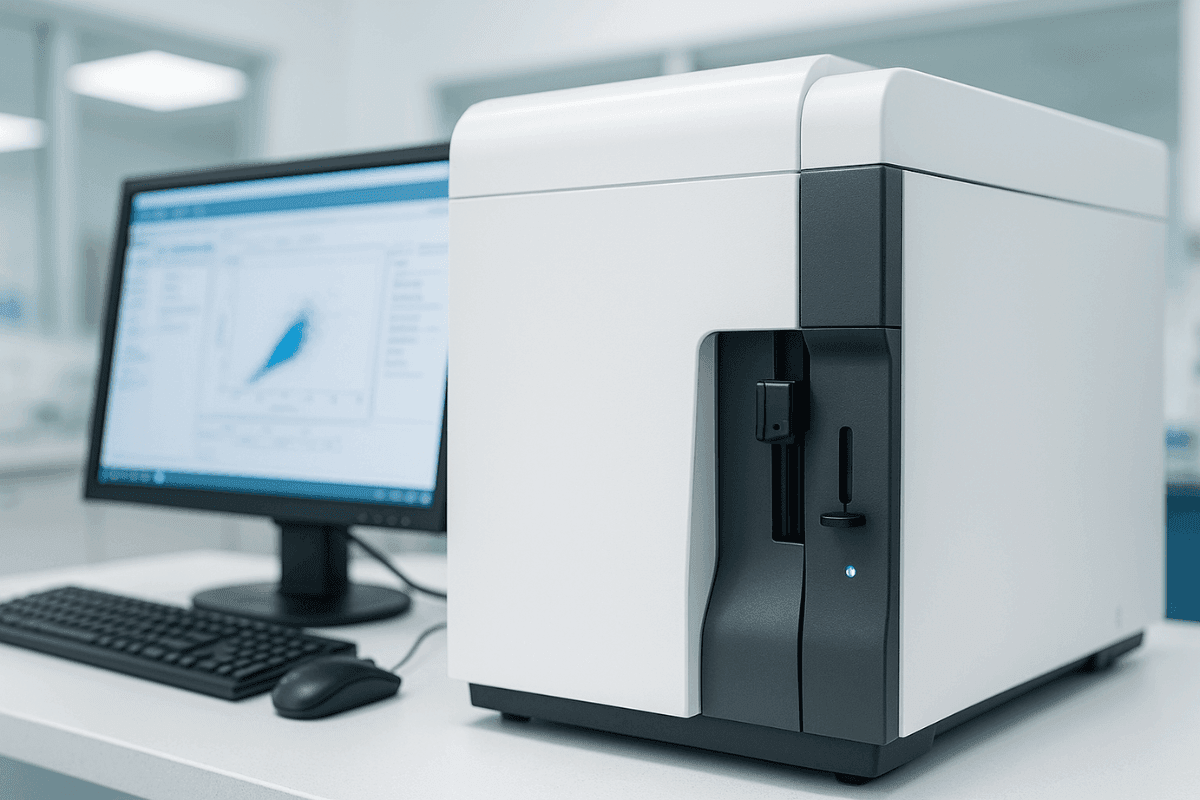
The flow cytometer is a sophisticated laser-based instrument designed to analyse populations of cells and particles. It does so quickly and precisely. By harnessing the power of fluorescence detection, a cytometer allows pathologists and laboratory professionals to gain insights into cell characteristics. The immediate application is in medical diagnostics and research.
It enables simultaneous measurement of multiple parameters on a single cell viz., size, granularity and protein expression. The tool facilitates immunophenotyping, cell cycle analysis and identifying rare cell populations. Flow cytometers are also used in haematology, oncology and vaccine development. With its ability to process thousands of cells per second, these instruments have streamlined data-rich results for complex biological samples.
What is a Flow Cytometer?
A flow cytometer is part of pathology lab equipment. It is an analytical device that evaluates cells suspended in fluid as they pass individually through a focused laser beam. Each cell or particle interacts with the laser, emitting signals captured and processed by the instrument. Fluorescent markers like conjugated antibodies are utilised to tag specific cellular components. It enables targeted analysis. These signals provide data on cell size, granularity and various other markers necessary for cellular identification.
Flow Cytometry Principle
The flow cytometry principle involves suspending cells in a fluid medium and passing them through the detection chamber in single file. As the cells intersect with a laser beam, scattered and emitted fluorescent light is detected by sensors positioned around the flow channel.
Forward-scattered light provides information about cell size, while side-scattered light reveals cell complexity or granularity. Fluorescent signals indicate the presence and quantity of specific molecules on or within the cells.
Types of Flow Cytometry Instruments
In pathology laboratories, several types of flow cytometry instruments are used based on specific analytical needs. They vary in capabilities. For example, the number of fluorescence channels, cell sorting functions and sensitivity. Choosing the appropriate type depends on the complexity of the analysis, sample throughput, and if cell isolation is required.
1. Traditional Flow Cytometers
Traditional flow cytometers provide basic to advanced cellular analysis through fluorescence detection. These instruments can quantify cellular markers, count cells and perform cell-based assays efficiently.
2. Cell Sorters
Cell sorters are specialised flow cytometry machines. They are capable of isolating specific cell populations based on specific characteristics. After analysis, these instruments can physically separate selected cells for further experimentation or culturing.
3. Image Cytometers
Image cytometers combine traditional flow cytometry with microscopy imaging capabilities. They deliver comprehensive visual analyses of cellular morphology and structure alongside standard flow cytometric data. Ultimately, they enable deeper cellular investigations.
Applications of Flow Cytometers in Pathology
Flow cytometry machines have diverse applications across pathology and clinical research. They also enable functional assays like apoptosis detection, cytokine profiling, and DNA content analysis apart from those mentioned above.
- Cell Counting: Flow cytometers enable rapid counting of various cell types that are main for monitoring immune cells, blood disorders and malignancies like leukaemia or lymphoma. They also facilitate cellular characterisation.
- Biomarker and Protein Detection: Through fluorescent tagging, flow cytometry instruments precisely measure the presence and levels of specific biomarkers and proteins within cells. Fluorescent tagging is widely used in cancer research, immunology, and infectious disease monitoring.
- Cell-Based Assays: Flow cytometry is effective in performing sophisticated cell-based assays that investigate cell viability, apoptosis (programmed cell death) and proliferation. These assays provide direct insights into cellular health, drug efficacy and toxicological impacts.
- Microbial Analysis: Pathology laboratories utilise flow cytometers for microbial detection and characterisation, including bacterial and fungal populations. The rapid processing time and high throughput of flow cytometry machines facilitate timely identification of pathogens.
Selecting the Right Flow Cytometry Machine for Your Lab
When evaluating flow cytometry instruments, pathology labs must consider several factors to ensure suitability and performance.
Number of Detection Parameters
The number of detection parameters defines how many cellular markers can be analysed simultaneously. Labs performing multi-parametric analysis should opt for flow cytometers with numerous fluorescent channels.
Laser Configuration
Flow cytometers vary by the number of lasers and wavelengths they accommodate. Laboratories should choose instruments matching their specific fluorescent dyes and experimental requirements. Lasers directly influence the range and quality of detectable signals.
Sample Input Formats and Throughput
Consider instruments that support diverse sample input formats, e.g., tubes, plates, or automated sample loading systems. High-throughput instruments can efficiently handle large sample volumes.
Automation and Ease of Use
User-friendly software and automated instrument functions like automatic start-up, shutdown, and cleaning, can improve lab efficiency. Flow cytometry novices benefit from intuitive software interfaces. Whereas experienced users require advanced customisation capabilities for complex setups and data analyses.
Imaging Capability
For labs requiring detailed morphological data alongside flow cytometric analysis, instruments with integrated imaging capabilities are advantageous. Image cytometers provide comprehensive cellular visualisation for pathology labs engaged in detailed cellular studies.
Service and Support
Reliable customer support and prompt servicing from manufacturers can’t be overlooked. They ensure minimal instrument downtime and consistent performance. Thoroughly evaluate service agreements and support responsiveness when selecting a flow cytometry machine.
Flow Cytometer Price in India
Flow cytometers in India range widely in price depending on the model, features, and application. Entry-level systems designed for basic clinical use may start at around ₹5,00,000. Mid-range flow cytometers with additional fluorescence channels, automation options and software support can range from ₹10,00,000 to ₹30,00,000.
High-end research instruments with advanced features such as multi-laser configurations, cell sorting and high-throughput analysis can exceed ₹1.5 crore.
Along with initial cost, laboratories should also consider long-term costs for calibration, software updates, warranty coverage, and service support before choosing the right tool.
Also check - About Tissue Processors for Histopathology Labs
Future Trends
Flow cytometry’s future lies in integrating higher-dimensional analysis with artificial intelligence, real-time diagnostics and improved multiplexing. Techniques like multicolor staining and FACS are already enabling researchers to isolate rare cell types and monitor subtle cellular events with precision.
Continued innovations like 3D instrumentation and molecular probe integration are set to improve resolution further. Clinical adoption is also expanding rapidly. For labs investing in long-term capabilities, knowing about panel design, software compatibility and system calibration will be as important as the instrument’s analytical power.
Related read - Why Incubators Are Essential in Clinical and Pathology Labs
Get Started at ₹1!
Try Flabs for a full month for just ₹1.
Follow us on