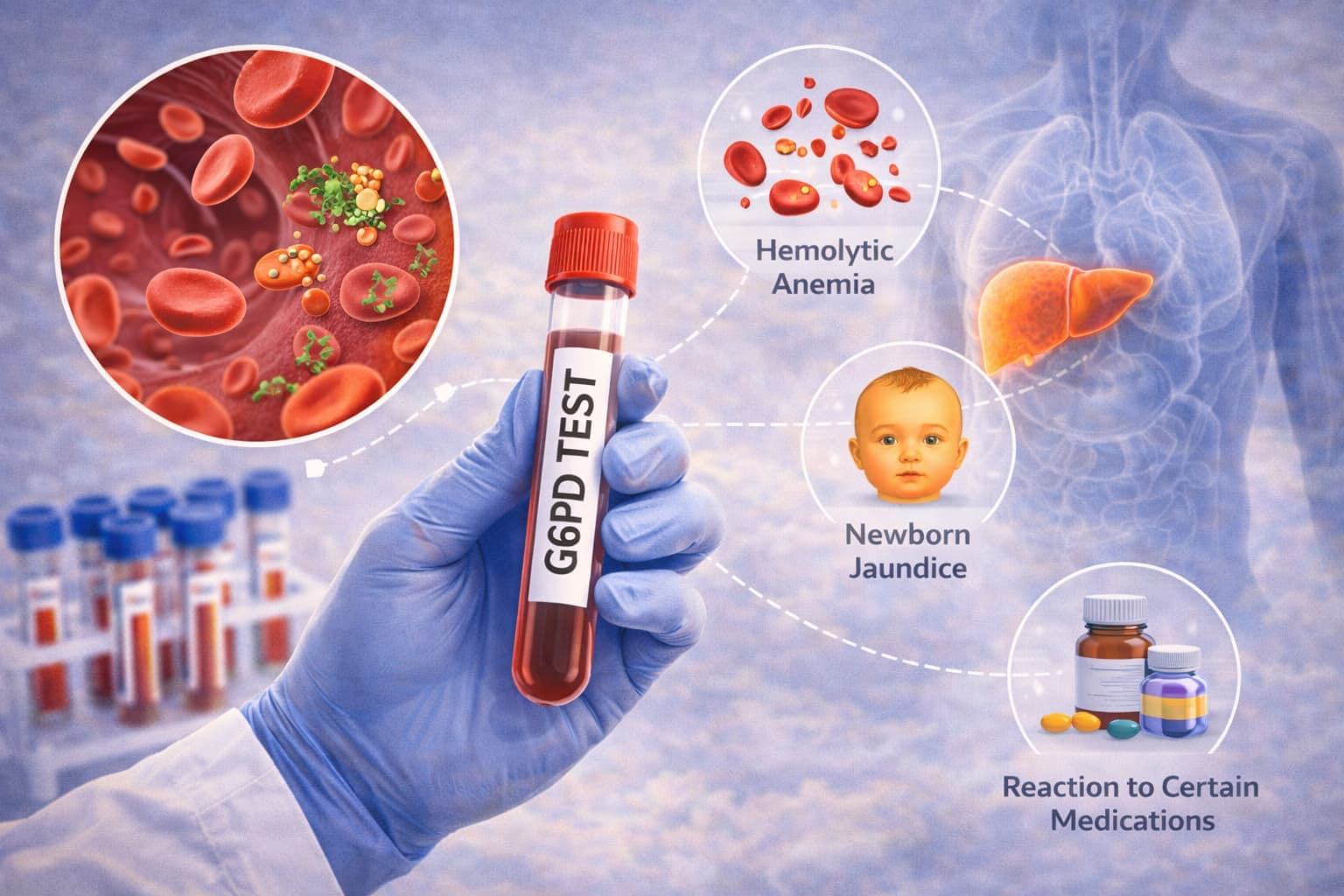
As a pathologist, you may encounter patients presenting with unexplained jaundice or sudden anaemia. The complete blood count flags low haemoglobin, but the cause isn't immediately obvious. You suspect a hemolytic event. In these clinical scenarios, the Glucose-6-Phosphate Dehydrogenase (G6PD) assay becomes your primary investigative tool.
This enzyme, vital for red blood cell survival, protects against oxidative damage. When absent or functioning poorly, cells succumb to stress, leading to hemolysis. For pathologists and clinicians, accurately ordering and interpreting the G6PD test is fundamental to differential diagnosis in haematology.
The Enzyme Mechanism and Clinical Relevance
Before reviewing the assay itself, consider the biochemistry. Glucose-6-Phosphate Dehydrogenase facilitates the first step in the pentose phosphate pathway. It reduces NADP to NADPH. Red blood cells rely entirely on this to maintain glutathione in a reduced state.
Reduced glutathione neutralises reactive oxygen species. Without adequate G6PD, oxidative stress from infections, drugs, or fava beans causes haemoglobin to denature and precipitate. You see these precipitates as Heinz bodies on a peripheral smear. The spleen subsequently destroys these damaged cells, causing acute haemolytic anaemia.
You order the G6PD blood test to confirm if this enzymatic defect drives the patient's symptoms. It differentiates G6PD deficiency from other causes of non-immune haemolytic anaemia.
When to Order the Assay
Clinical presentation varies. Some patients live their entire lives asymptomatic. Others suffer severe crises. You should consider screening or diagnostic testing in specific contexts:
Unexplained Neonatal Jaundice: Newborns presenting with hyperbilirubinemia persisting beyond two weeks require investigation.
Drug-Induced Hemolysis: Patients developing dark urine or pallor after starting antimalarials (primaquine), sulfonamides, or nitrofurantoin.
Acute Hemolytic Anaemia: Sudden onset of fatigue, tachycardia, and jaundice without a positive Coombs test suggests an intrinsic red cell defect.
Family History: An X-linked pattern in the family tree warrants screening, especially in males.
Pre-treatment Screening: Before prescribing oxidising medications like rasburicase or dapsone, guidelines mandate testing to prevent precipitating a crisis.
The G6PD Test Principle and Methodology
Laboratories utilise different methods depending on the required sensitivity. The G6PD test full form is Glucose-6-Phosphate Dehydrogenase assay, and its core principle relies on measuring the rate of NADPH formation.
Qualitative Screening (Fluorescent Spot Test): You verify if the enzyme activity is present or absent. The G6PD deficiency test principle here involves incubating the G6PD test sample with glucose-6-phosphate and NADP. If the enzyme is active, it generates NADPH, which fluoresces under UV light. Lack of fluorescence indicates a deficiency.
Quantitative Assay (Spectrophotometric): For a definitive diagnosis, especially in females or borderline cases, you need the G6PD quantitative test. This method measures the actual rate of NADPH production at 340 nm. It expresses activity in Units per gram of Haemoglobin (U/g Hb).
The G6PD quantitative test procedure is more rigorous. It corrects for the patient's haemoglobin level and reticulocyte count, offering a precise enzymatic activity level rather than a simple binary result.
Specimen Collection and Pre-Analytical Factors
The blood collection method is standard but requires strict adherence to handling protocols to preserve enzyme activity.
Sample Type: Whole blood collected in EDTA (lavender top) or Acid Citrate Dextrose (ACD) tubes. Heparin is also acceptable in some protocols.
Volume: Pediatric samples may use a heel-prick; adults require a standard venipuncture.
Transport: Samples must be kept at 4°C if processing is delayed. Heat degrades the enzyme rapidly.
Never test during an active hemolytic crisis. Young red blood cells (reticulocytes) possess higher enzyme activity than mature cells. During hemolysis, the older, enzyme-deficient cells are destroyed, leaving a population of young cells. This skews the data, potentially yielding a "false normal" result. You must wait 2-3 months after the acute episode resolves to get an accurate baseline.
Interpreting the Data
Analysing G6PD test results requires correlation with the clinical picture. Reference ranges vary by method and laboratory temperature (30°C vs 37°C), but general patterns apply.
Below is a reference framework for G6PD test result interpretation.
| Result Category | Enzyme Activity Level | Clinical Interpretation |
|---|---|---|
| Normal | >70% of mean normal | No deficiency. The patient can safely process oxidising drugs. |
| Intermediate | 30% – 70% of the mean normal | Moderate deficiency. Common in female heterozygotes (carriers). Clinical risk varies; caution advised. |
| Deficient | <30% of the mean normal | Severe deficiency (Class I or II variants). High risk of hemolysis upon trigger exposure. |
| Severe Deficiency | <10% of the mean normal | Chronic non-spherocytic hemolytic anaemia. Constant low-level hemolysis occurs even without triggers. |
The G6PD test normal range generally falls between 4.6 and 13.5 U/g Hb for adults, though you must consult your specific lab's reference values.
Turnaround Time and Cost
Operational efficiency matters to your practice. The turnaround time for a screening test is usually rapid, often within 24 hours. Quantitative assays may take 2 to 4 days if sent to a reference lab.
Regarding the G6PD test price, costs fluctuate based on the methodology. Screening tests are economical. The quantitative analysis involves more complex reagents and labor, leading to a higher fee. Pathology labs in India and globally set these rates based on local overhead and technology availability. Patients paying out-of-pocket might ask for estimates, so having a general range for your region is useful.
Managing the Diagnosis
Once you confirm a deficiency, the primary medical intervention is education. You don't "treat" the genetic defect; you manage the lifestyle.
Advise patients to avoid known triggers:
- Foods: Fava beans are the classic culprit.
- Chemicals: Naphthalene (mothballs) and henna applications.
- Medications: Provide a comprehensive list of unsafe drugs.
For pathologists, the report you generate is the final deliverable. Ensure it clearly states the activity level, the reference range, and a comment regarding the timing of the test relative to any recent transfusions or hemolytic episodes.
Conclusion
The G6PD test is a specific, high-value diagnostic marker. It moves a patient from a state of unknown anaemia to a confirmed genetic diagnosis with actionable lifestyle changes. By understanding the G6PD test principle, selecting the correct assay (quantitative vs. qualitative), and timing the sample collection correctly, you ensure clinical accuracy.
Ready to streamline your lab's haematology reporting? Our LIS software automates enzyme activity calculations and integrates directly with your analysers. Would you like a demo of our reporting module?
Also check - Rheumatoid Arthritis Test: Diagnosis and Types
Get Started at ₹1!
Try Flabs for a full month for just ₹1.
Follow us on