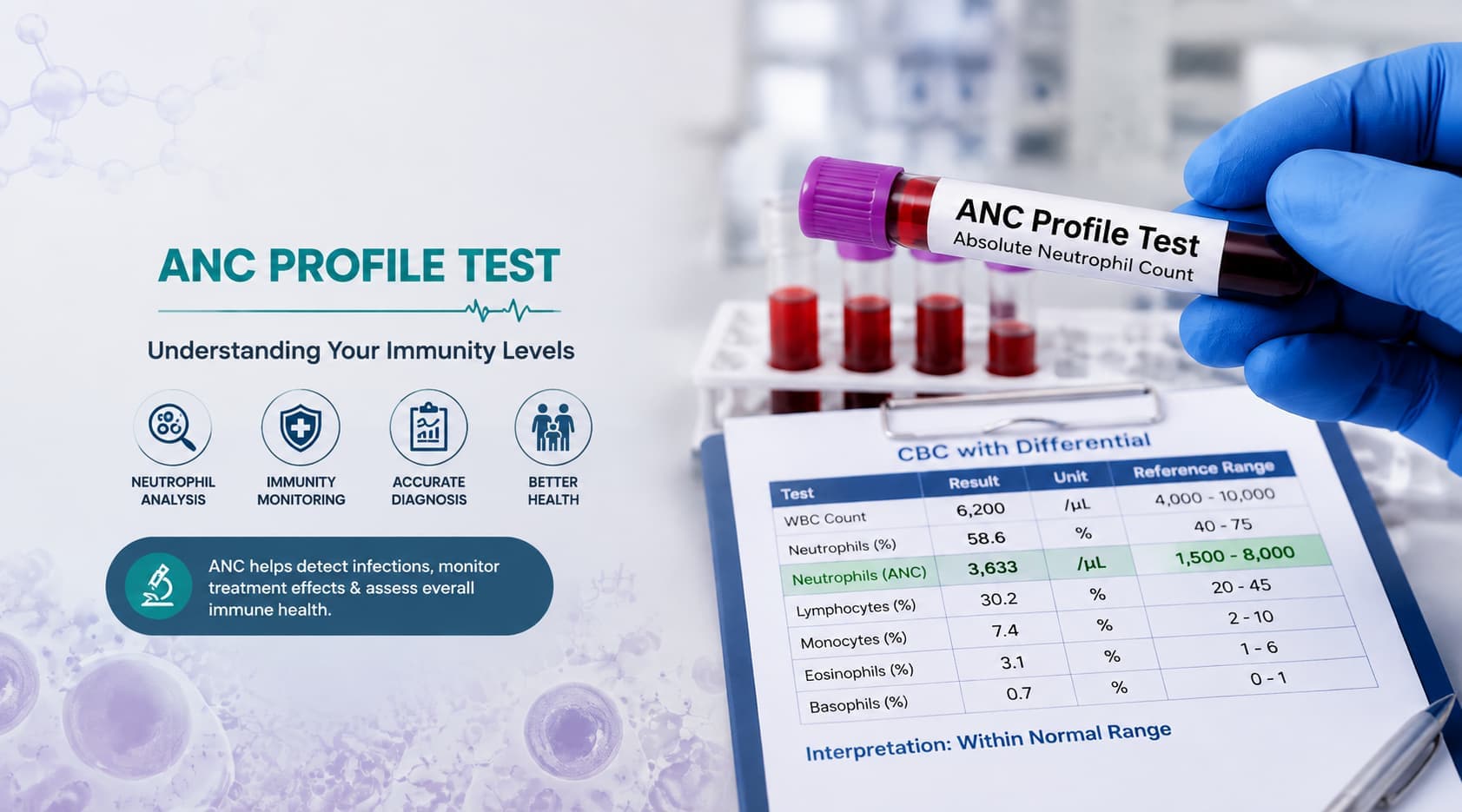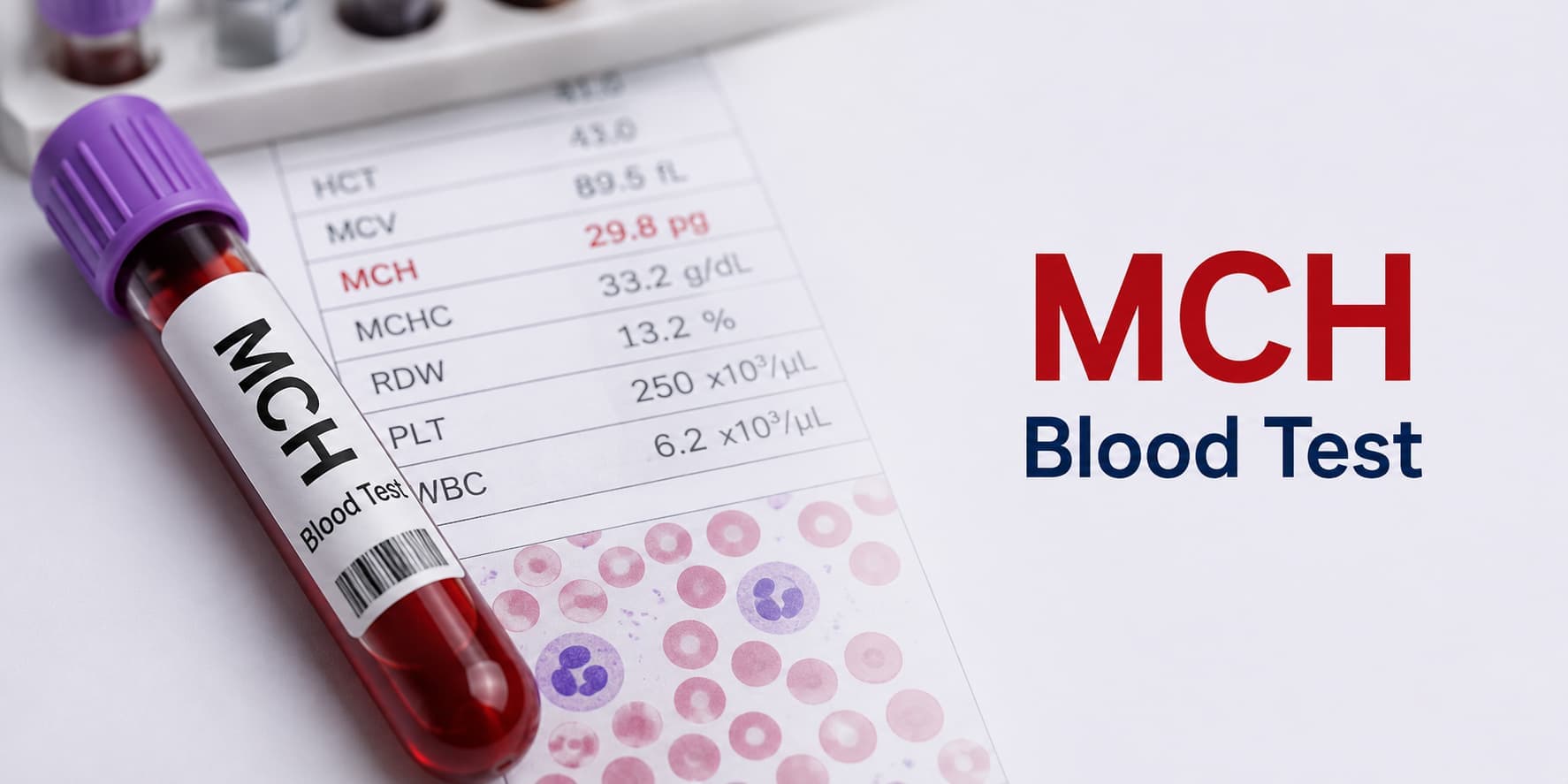
The MCH blood test measures the average amount of haemoglobin inside each red blood cell. MCH stands for Mean Corpuscular Haemoglobin and is one of the red blood cell indices reported as part of a complete blood count (CBC).
MCH is measured in picograms (pg) per red blood cell. A low MCH means each red blood cell contains less haemoglobin than expected, while a high MCH means the average haemoglobin amount per cell is above the laboratory's reference range.
MCH does not diagnose a condition by itself. Healthcare professionals interpret it together with haemoglobin, MCV, MCHC, RDW, red blood cell count and other findings when investigating anaemia and other blood abnormalities. MedlinePlus similarly recommends interpreting red blood cell indices together rather than relying on an isolated result.
This guide explains the MCH normal range, what low and high MCH results may mean and how to understand an MCH value on your CBC report.
What Is MCH in a Blood Test?
MCH stands for Mean Corpuscular Haemoglobin. It tells you the average amount of haemoglobin contained in one red blood cell.
Haemoglobin is the iron-containing protein in red blood cells that carries oxygen from the lungs to tissues throughout the body.
MCH is normally reported as part of a CBC rather than being ordered as a separate blood test. The result is expressed in picograms per cell (pg/cell).
MCH belongs to a group of measurements known as red blood cell or RBC indices:
| RBC Index | What It Measures |
|---|---|
| MCV | Average size of each red blood cell |
| MCH | Average amount of haemoglobin in each red blood cell |
| MCHC | Average concentration of haemoglobin within red blood cells |
| RDW | Variation in red blood cell size |
These measurements provide different pieces of information about red blood cells and are generally interpreted together when investigating anaemia.
For a detailed explanation of red blood cell size, see the MCV blood test.
What Is the Normal MCH Range?
MCH is measured in picograms per red blood cell (pg/cell).
A commonly used adult reference range is approximately 27–33 pg/cell, although the exact interval depends on the laboratory, analyser, methodology and population being tested. Cleveland Clinic currently uses 27–33 pg/cell as its general adult range, while MedlinePlus gives common examples of 26–33 pg/cell for females and 27–33 pg/cell for males.
| MCH Result | General Interpretation |
|---|---|
| Below the laboratory range | Low MCH |
| Within the laboratory range | Normal MCH |
| Above the laboratory range | High MCH |
Always compare your result with the reference interval printed on your own CBC report rather than treating one online range as a universal cutoff. Reference ranges can vary between laboratories.
An abnormal MCH is usually interpreted together with:
- Haemoglobin
- MCV
- MCHC
- RDW
- RBC count
- Other CBC findings
What Does Low MCH Mean?
A low MCH means each red blood cell contains less haemoglobin than the reference range used by the laboratory.
Low MCH commonly occurs when red blood cells are smaller than normal or when the body does not have enough haemoglobin available for normal red blood cell production.
Possible causes include:
- Iron deficiency
- Iron-deficiency anaemia
- Thalassaemia
- Certain haemoglobin disorders
- Long-term blood loss
- Some chronic conditions affecting red blood cell production
Cleveland Clinic describes low MCH as a finding that may occur with hypochromic anaemia, in which red blood cells contain less haemoglobin than expected. Iron deficiency and haemoglobin disorders such as thalassaemia are among the recognised causes.
Important correction: Low MCH may be associated with hypochromia, not “hypothermia.”
Low MCH alone does not prove iron deficiency. Healthcare professionals may review haemoglobin, MCV, RDW and iron studies such as ferritin before determining the cause.
When iron deficiency is suspected, an iron profile test can provide additional information about markers such as serum iron, ferritin, TIBC and transferrin saturation.
Low MCH + Low MCV
When both MCH and MCV are low, red blood cells are generally smaller and contain less haemoglobin than expected.
This pattern is commonly seen with:
- Iron-deficiency anaemia
- Thalassaemia
Low MCV is associated with microcytic anaemia and may occur in iron deficiency or thalassaemia.
Ferritin, iron studies, RDW and the remaining CBC parameters may help distinguish between possible causes.
Low MCH + Normal MCV
A low MCH with a normal MCV may require closer review of the remaining CBC findings, laboratory reference intervals and clinical history.
A borderline MCH result should not be interpreted in isolation, particularly when haemoglobin and other RBC indices remain within their laboratory ranges.
What Does High MCH Mean?
A high MCH means the average amount of haemoglobin inside each red blood cell is above the laboratory's reference range.
High MCH frequently occurs alongside larger-than-normal red blood cells. This is why high MCH and high MCV may appear together.
Possible causes or associated patterns include:
- Vitamin B12 deficiency
- Folate deficiency
- Macrocytic or megaloblastic anaemia
- Liver disease
- Long-term heavy alcohol use
- Hypothyroidism
- Certain medicines or medical treatments
- Other conditions associated with enlarged red blood cells
MedlinePlus notes that higher-than-normal MCH may occur with anaemia related to vitamin B deficiency, while elevated MCV can occur with vitamin B12 or folate deficiency, chemotherapy or liver disease.
Cleveland Clinic similarly notes that macrocytosis may be associated with vitamin B12 or folate deficiency, liver disease and certain treatments.
High MCH itself does not cause symptoms.
Symptoms such as fatigue, weakness, shortness of breath, pale skin, dizziness or neurological symptoms may occur because of an underlying anaemia, vitamin deficiency or another medical condition rather than because the MCH number itself is elevated.
A high MCH result should therefore be interpreted together with MCV, haemoglobin and the rest of the CBC.
How to Interpret MCH With Other CBC Values
MCH becomes more useful when it is interpreted with other red blood cell indices.
| Pattern | Possible Interpretation |
|---|---|
| Low MCH + Low MCV | Common in iron deficiency or thalassaemia |
| High MCH + High MCV | May occur in macrocytic patterns such as vitamin B12 or folate deficiency |
| Low MCH + High RDW | May support iron deficiency when the remaining findings agree |
| Normal MCH + abnormal haemoglobin | Normal MCH does not rule out anaemia |
| Abnormal MCHC | Requires separate interpretation because MCHC measures haemoglobin concentration rather than haemoglobin amount per cell |
These combinations provide clues rather than diagnoses.
For example, low MCH combined with low MCV may point toward a microcytic pattern, but iron studies may be needed to distinguish iron deficiency from another cause. MedlinePlus notes that low MCV can occur in iron-deficiency anaemia or thalassaemia, while RBC indices are interpreted together to classify anaemia.
Likewise, high MCH with high MCV may lead a healthcare professional to consider vitamin B12, folate, liver function, medication history and other relevant clinical factors.
What Do Common MCH Values Mean?
People frequently search for individual values such as MCH 25, 26, 26.6, 27, 30 or 31 pg after reading a CBC report.
The meaning of any value depends on the laboratory's own reference range.
| MCH Result | General Interpretation |
|---|---|
| 23–25 pg | Usually below common adult reference intervals; interpret with haemoglobin, MCV and iron status |
| 26–26.9 pg | May be low or borderline depending on the laboratory |
| 27 pg | Near the lower end of many commonly used adult ranges |
| 30–31 pg | Falls within many commonly used adult reference intervals |
| 33 pg | Near the upper end of commonly used adult ranges |
| Above 33 pg | May be considered elevated depending on the laboratory |
These examples are based on commonly used adult reference intervals rather than universal clinical cutoffs. Cleveland Clinic uses 27–33 pg/cell, while MedlinePlus lists common examples extending from 26–33 pg/cell depending on sex.
What Does MCH 25 Mean?
An MCH of 25 pg is below many commonly used adult reference intervals.
It may occur with a microcytic or hypochromic pattern, but the value itself cannot determine the cause.
If MCV is also low and ferritin or other iron studies indicate low iron stores, iron deficiency may be considered.
Is MCH 26 or 26.6 Low?
It depends on the laboratory.
MedlinePlus lists a common lower reference limit of 26 pg/cell for females and 27 pg/cell for males, while other laboratories use approximately 27 pg/cell for adults.
An MCH of 26 or 26.6 pg may therefore be borderline or low according to one laboratory but within range at another.
Is MCH 27 Normal?
An MCH of 27 pg falls near the lower end of many commonly used adult reference intervals.
It should still be interpreted with haemoglobin, MCV, MCHC, RDW and the reference range printed on the report.
Is MCH 30 or 31 Normal?
Values around 30–31 pg fall within many commonly used adult reference ranges.
However, a normal MCH does not guarantee that the entire CBC is normal. Haemoglobin, MCV and the other blood-cell parameters still need to be considered.
MCH vs MCV vs MCHC: What Is the Difference?
These three measurements are closely related but answer different questions.
MCH
Measures the average amount of haemoglobin inside one red blood cell.
MCV
Measures the average size of red blood cells.
MCHC
Measures the average concentration of haemoglobin within red blood cells.
MedlinePlus identifies MCV, MCH and MCHC as separate RBC indices used together to help assess and classify anaemia.
This distinction is important because a person can have:
- Low MCH and low MCV
- High MCH and high MCV
- Abnormal haemoglobin with normal MCH
- Normal MCH but abnormal MCHC or RDW
No single RBC index provides the complete answer.
How Does MCH Appear in a CBC Report?
MCH usually appears within the red blood cell section of a CBC report format.
A typical CBC may display:
| Parameter | Illustrative Result | Unit |
|---|---|---|
| Haemoglobin | 13.5 | g/dL |
| RBC Count | 4.7 | million/µL |
| MCV | 88 | fL |
| MCH | 29 | pg |
| MCHC | 33 | g/dL |
| RDW | 13.5 | % |
These values are illustrative only. Actual laboratory ranges depend on the analyser, methodology, age, sex and local reference interval.
A clear report should show:
- Test parameter
- Patient result
- Unit
- Laboratory-specific reference range
- High or low flag where appropriate
FLABS also provides broader resources on professional pathology report formats for laboratories standardising report layouts.
Place the existing MCH sample-report/PDF download module immediately after this section.
When Should an Abnormal MCH Be Reviewed?
A mildly abnormal MCH does not automatically indicate a serious medical problem.
Healthcare professionals generally consider:
- Whether haemoglobin is low
- Whether MCV is high or low
- Whether RDW or MCHC is abnormal
- Whether the result is new or persistent
- Symptoms such as fatigue or shortness of breath
- Nutritional history
- Blood-loss history
- Existing medical conditions
- Medication history
Further testing depends on the overall pattern.
For example, low MCH with suspected iron deficiency may lead to ferritin or other iron studies, while high MCH with macrocytosis may prompt evaluation of vitamin B12, folate and other possible causes.
For Diagnostic Labs: Present CBC Results More Clearly
MCH is one of several CBC parameters that can be difficult for patients to understand when presented only as a number, unit and reference range.
FLABS Smart Reports can present validated laboratory results through visual summaries, lab-configured reference ranges, historical trends and patient-friendly explanations while keeping result validation and final approval with qualified laboratory professionals.
For pathology laboratories, this can complement the standard diagnostic report and make supported CBC parameters easier for patients to understand without replacing clinical interpretation.
Conclusion
Mean Corpuscular Haemoglobin is an important red blood cell index reported as part of a CBC. It measures the average amount of haemoglobin contained within each red blood cell.
A low MCH is commonly associated with hypochromic or microcytic patterns, particularly iron deficiency and some haemoglobin disorders, while high MCH commonly occurs alongside larger red blood cells and may be seen with vitamin B12 or folate deficiency and other macrocytic patterns.
However, an abnormal MCH cannot diagnose a condition by itself.
The most useful interpretation comes from looking at:
MCH + haemoglobin + MCV + MCHC + RDW + clinical context.
Always use the reference interval provided by the laboratory and discuss persistent or significant abnormalities with a qualified healthcare professional.
Get Started at ₹1!
Try Flabs for a full month for just ₹1.
Follow us on