India's diagnostics sector is growing fast. While it stands at $10.8 Billion in 2024, it is estimated to reach $19.8 Billion by 2030, growing at a 10.7% CAGR. With rising chronic disease burden, increased health awareness, and a push for preventive care, pathology labs are in demand like never before.
But before you draw up a business plan or sign a lease, there's a more fundamental question to answer: are you even eligible to open one?
The answer is not always straightforward. The qualifications, licenses, and legal conditions vary based on what kind of lab you want to run, where you want to run it, and who will be doing the reporting.
Qualifications to Open a Pathology Lab in India
The first thing to get right is your educational qualification. In India, the type of lab you can legally operate depends directly on your academic credentials.
| Qualification | Can Open a Pathology Lab? | Type of Lab |
|---|---|---|
| MBBS + MD in Pathology | Yes | Full-fledged diagnostic lab |
| Diploma in Clinical Pathology (DCP) | Yes | Full diagnostic services |
| MBBS (without MD) | Yes (with conditions) | Basic diagnostic lab |
| MSc in Pathology | Yes (with conditions) | Basic lab, limited scope |
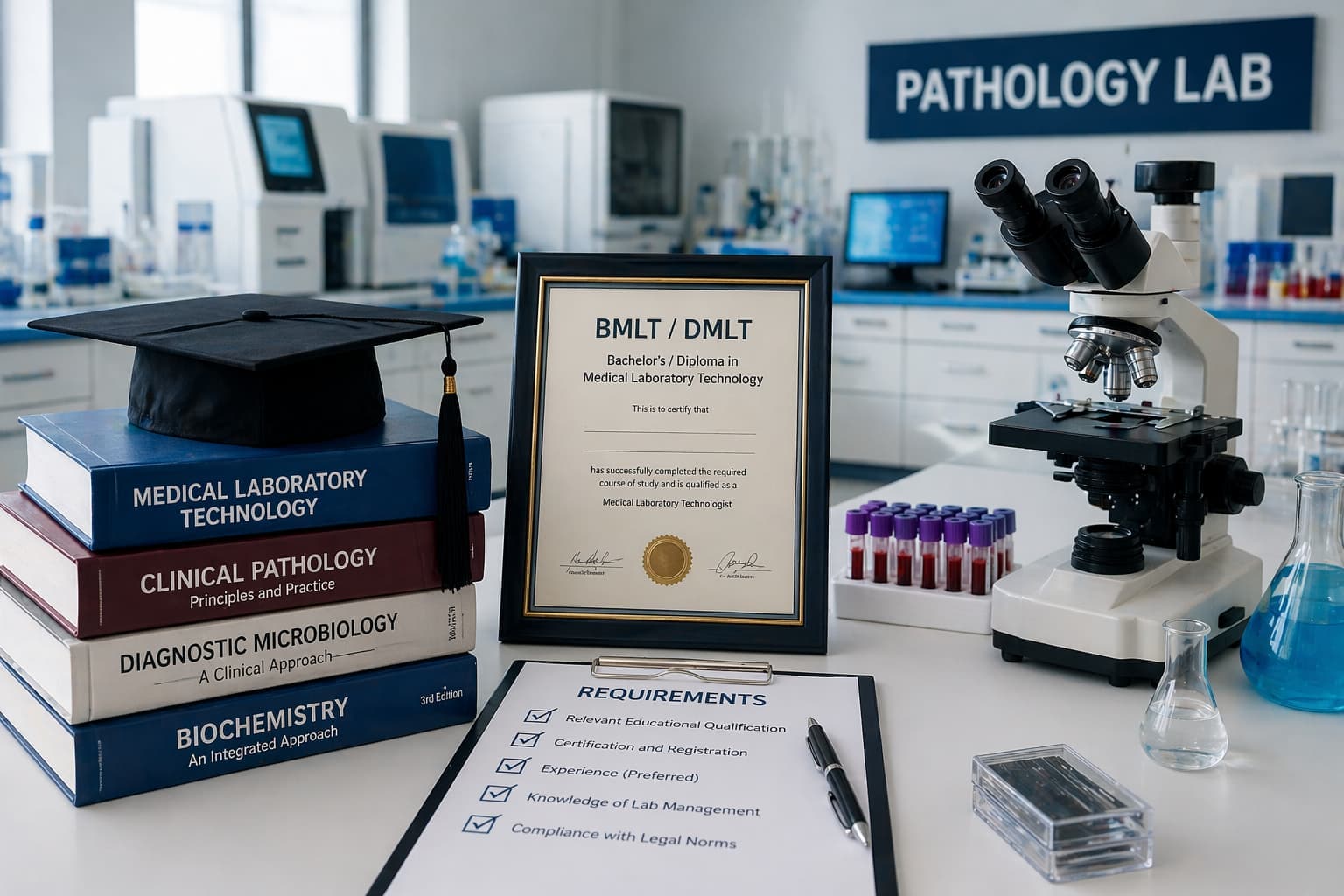
| BSc/DMLT (Diploma in Medical Lab Technology) | No (independently) | Can work as a technician under a qualified pathologist |
| Pharmacist | No | Cannot own or operate a diagnostic lab |
The Key Point: If you hold an MBBS + MD in Pathology or a DCP, you're in the clearest position to open and operate a full-service lab. If you're wondering whether someone with a DMLT can open a pathology lab independently, the answer is no. A DMLT qualifies you as a skilled lab technician, not as a diagnostic reporting authority.
All degrees must be recognised by the Medical Council of India (MCI), now functioning under the National Medical Commission (NMC) framework. An unrecognised degree disqualifies you, regardless of your experience or infrastructure.
The Supervision Rule Nobody Talks About Enough
Even if you're not a pathologist yourself, you can still be involved in owning or managing a lab. But all diagnostic reporting must be supervised and signed off by a qualified pathologist, i.e., MD Pathology or DCP holder.
It is a mandatory legal requirement. So if you're a DMLT professional or an MBBS doctor without a postgraduate pathology degree, you either need to obtain that qualification or bring a qualified pathologist on board before you start issuing reports.
Many labs in India operate in a grey zone here. Don't be one of them. Regulatory scrutiny is increasing. Operating without proper qualified supervision puts you at real legal risk, including penalties, forced closure, and potential criminal liability.
Licenses Required for a Pathology Lab in India
Educational qualifications get you through the door. Licenses keep you in business. You need both. You need to get them in order before you start operations.
1. Registration under the Clinical Establishments Act, 2010
Most states have adopted this central legislation (or have their own equivalent). You must register your lab under the act with your state government.
2. State Government Lab License
Separate from clinical establishment registration, several states issue specific diagnostic lab licenses. Check your state's health department for exact requirements.
3. Medical Council Recognition
Your qualifications must be in order with the NMC/MCI, and your lab's reporting pathologist should be on record.
4. NABL Accreditation
Technically voluntary, but practically essential. If you want hospital tie-ups, corporate clients, or government empanelment, it is mandatory. NABL accreditation indicates quality and opens doors. Many procurement policies also now mandate it.
5. NOCs You Cannot Skip
Before you open, you need No Objection Certificates from the Fire Department, the Municipal Authority or local body, and the State Pollution Control Board (especially for biomedical waste).
Biomedical waste management is mandatory. Labs generate hazardous waste daily. Non-compliance with SPCB norms is a common violation that lands labs in trouble.
Who Can and Who Cannot Start a Diagnostic Lab
You can start a diagnostic lab in India if you are,
- An MD Pathologist.
- A DCP holder.
- An MBBS doctor (for basic labs, as per recent regulatory amendments).
- An MSc Pathology holder (basic lab, limited scope).
You cannot independently start and operate a diagnostic reporting lab if you are,
- A pharmacist.
- A DMLT technician (without a qualified pathologist supervising).
- Someone with a degree unrecognised by MCI/NMC.
The distinction between “ownership” and “operation” matters here. A non-clinical person can technically co-own a lab as a business entity. But the scientific and diagnostic operations must be headed by a qualified professional.
If you're a DMLT professional asking whether a DMLT can open a pathology lab, revisit this section.
Infrastructure Standards
- A clean, hygienic, well-lit space: Poor infrastructure is the easiest way to fail an inspection.
- Department-Wise Sections: Haematology, biochemistry, microbiology, histopathology, etc.
- Proper sanitation, waste disposal systems, and accessibility for differently-abled patients.
- A reception/sample collection area distinct from the processing area.
- Adequate cold storage for reagents and samples.
- Standard Operating Procedures (SOPs) must be displayed and followed.
Space requirements vary by state regulation, but a minimum of 200–500 sq ft is common for a basic setup. A full-service lab with imaging will need significantly more.
Staffing: Who You Need on the Ground
- Pathologist (mandatory for reporting: MD/DCP qualified).
- Lab Technicians (DMLT/BSc MLT certified).
- Phlebotomist (for blood draws).
- Radiologist (if imaging services like X-ray or ultrasound are included).
- Administrative staff (reception, billing, data entry).
Staffing is one of the bigger operational challenges in Tier 2 and rural areas. The shortage of qualified lab technicians is real, and retaining talent requires more than just a salary. You should invest in structured growth, training, and tie-ups with nearby medical colleges for internships.
Equipment, Software, and Running Costs
Once your qualifications and licenses are in place, the next layer is setting up the actual operational engine.
Lab Equipment: Haematology analysers, biochemistry analysers, microscopes, centrifuges, incubators, refrigerators, and (if applicable) imaging machines.
Lab Software: A Lab Information System (LIS) isn't optional anymore. It handles test orders, result entry, report generation, patient records, and billing, all in one place.
Reagents and Consumables: These are recurring costs. Efficient reagent management directly impacts your profitability. Negotiate vendor contracts early, track usage patterns, and minimise wastage through proper inventory protocols.
Financial Planning: Begin it from day one. Not after you've already signed equipment leases. It saves you from the cash flow problems that derail many new labs in the first year.
Quality Assurance
Internal Quality Control (IQC): Daily checks to ensure equipment and reagents are performing within acceptable limits.
External Quality Assessment (EQA): Participation in national or international proficiency testing programs.
Adherence to NABL guidelines: If you're pursuing accreditation (and you should).
Documentation: SOPs, maintenance logs, corrective action records, all must be current and auditable.
Legal Risks of Getting It Wrong
- Heavy monetary penalties.
- Immediate lab closure by state health authorities.
- FIRs or criminal proceedings (especially in cases of diagnostic harm).
- Permanent disqualification from operating clinical establishments
State health departments are increasingly conducting inspections, especially post-COVID. Don't rely on an outdated compliance checklist or assume that "everyone does it this way." The regulations are tightening.
Staying Compliant
- Track license renewal dates (Clinical Establishment registration, NABL, NOCs, all have validity periods).
- Keep up with amendments to the Clinical Establishments Act and state-specific rules.
- Train your staff regularly.
- Stay current with new diagnostic technologies entering the market
Continuing Medical Education (CME) credits, industry association memberships, and NABL-mandated training are practical ways to stay updated without letting compliance become overwhelming.
Before You Start
The qualifications to open a pathology lab in India are not bureaucratic checkboxes. They exist because diagnostic errors have real consequences for real patients. Getting credentialed properly, licensed fully, and staffed correctly protects your patients, your team, and your business.
If you hold an MD in Pathology or a DCP, you have the foundational qualification required to open a pathology lab in India. If you're not there yet, know exactly what you need to get there, or who you need to partner with.
Get Started at ₹1!
Try Flabs for a full month for just ₹1.
Follow us on