Kidneys have an important role in maintaining internal balance. They regulate fluid and electrolyte levels, remove metabolic waste, control acid–base status, and contribute to endocrine functions such as erythropoietin production and vitamin D activation. Globally, chronic kidney disease (CKD) is rising due to diabetes, hypertension, ageing populations, and lifestyle changes.
In India, the burden of kidney disorders is steadily increasing, placing pressure on clinicians and pathology services to ensure early and accurate detection.
The good news is that laboratory assessment opens a clear window into renal function. Through a renal profile test, subtle biochemical alterations can be identified long before clinical symptoms become severe.
For pathologists and healthcare professionals, understanding the components, interpretation, and reporting standards of renal function panels is critical to delivering high-quality tests.
Renal Profile Test: What It Evaluates
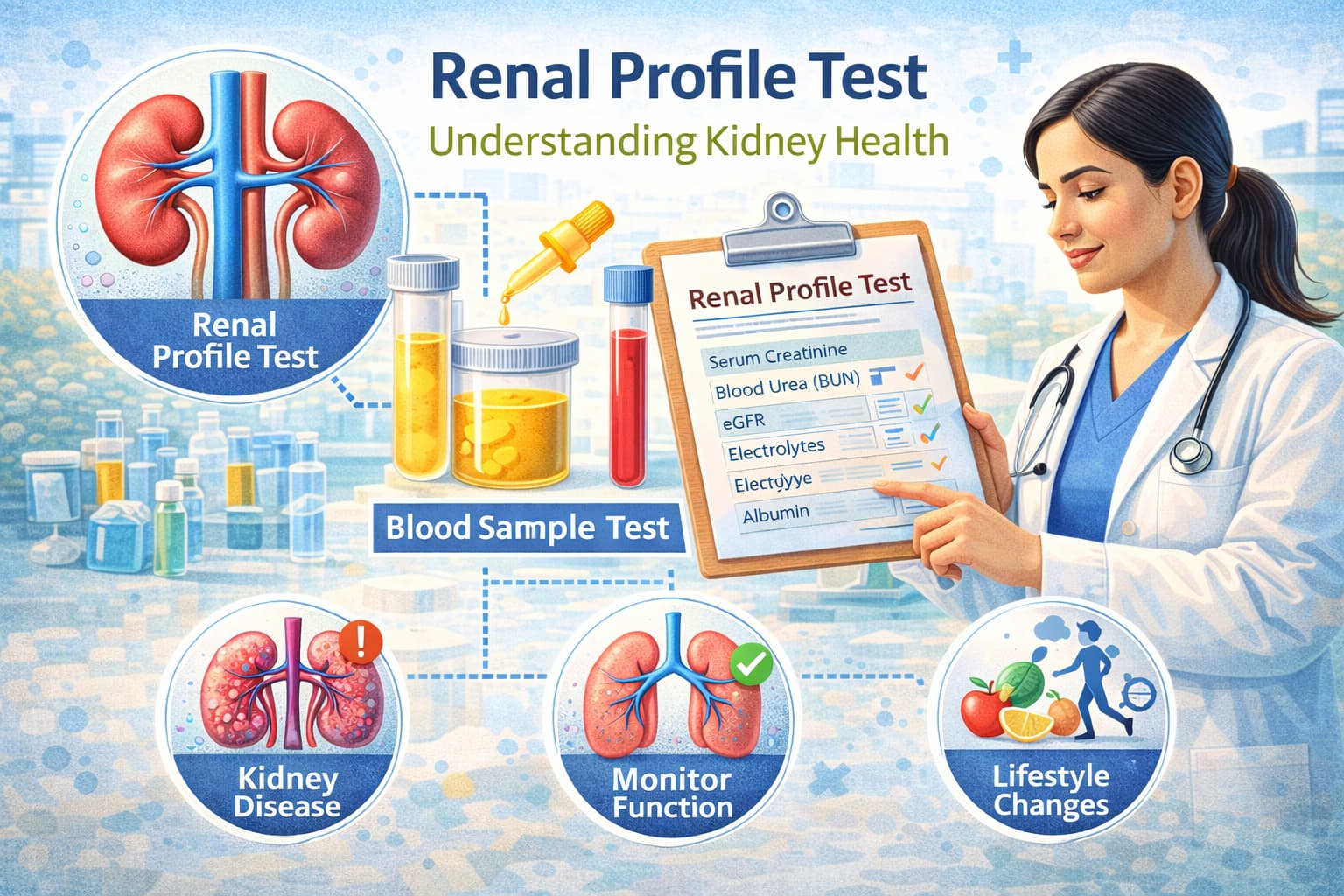
A renal profile test is a comprehensive biochemical panel designed to assess kidney function, electrolyte balance, and metabolic waste clearance. It enables screening, diagnosis, monitoring, and therapeutic decision-making in patients at risk of renal impairment.
A complete renal profile test includes the following primary parameters.
| Parameter | Clinical Significance | Common Clinical Associations |
|---|---|---|
| Serum Creatinine | Marker of glomerular filtration | CKD, acute kidney injury (AKI), dehydration |
| Blood Urea/BUN | Protein metabolism byproduct | Renal dysfunction, high-protein diet |
| eGFR | Estimated filtration capacity | CKD staging |
| Uric Acid | Purine metabolism | Gout, renal stones |
| Sodium | Fluid balance | Dehydration, SIADH |
| Potassium | Cardiac and neuromuscular function | Hyperkalemia in renal failure |
| Chloride | Acid-base balance | Metabolic acidosis/alkalosis |
| Bicarbonate | Metabolic status | Acidosis in CKD |
| Calcium | Bone-mineral metabolism | CKD-MBD |
| Phosphorus | Renal excretion marker | Advanced renal disease |
Indications for Ordering the Renal Panel
- Diabetes mellitus
- Hypertension
- Suspected acute kidney injury
- Chronic kidney disease monitoring
- Nephrotoxin exposure
- Electrolyte imbalance
- Preoperative assessment
- Cardiovascular disease evaluation
In tertiary pathology labs in India, the renal profile test is part of routine health checkups as well as disease-specific panels.
Reference Values and Interpretation
Proper interpretation of the test results depends on standardised reference intervals. Laboratories must maintain internal quality controls and calibration aligned with IDMS-traceable creatinine methods.
Below is a commonly accepted renal profile test normal range values.
| Test | Normal Range (Adults) |
|---|---|
| Serum Creatinine | 0.6-1.3 mg/dL |
| Blood Urea | 15-45 mg/dL |
| eGFR | >90 mL/min/1.73m² |
| Sodium | 135-145 mEq/L |
| Potassium | 3.5-5.0 mEq/L |
| Chloride | 98-107 mEq/L |
| Bicarbonate | 22-28 mEq/L |
| Calcium | 8.6-10.2 mg/dL |
| Phosphorus | 2.5-4.5 mg/dL |
Interpretation should account for age, sex, muscle mass, hydration status, and comorbidities.
| CKD Stage | eGFR (mL/min/1.73m²) | Interpretation |
|---|---|---|
| G1 | ≥90 | Normal with kidney damage markers |
| G2 | 60–89 | Mild decrease |
| G3a | 45–59 | Mild to moderate decrease |
| G3b | 30–44 | Moderate to severe decrease |
| G4 | 15–29 | Severe decrease |
| G5 | <15 | Kidney failure |
Pre-Analytical Considerations
While it is not mandatory, fasting for the renal profile test is commonly recommended when the panel is combined with metabolic or lipid assessments. Fasting reduces variability in urea and electrolyte values influenced by recent dietary intake.
However, in emergency settings, testing proceeds without delay.
The renal profile test procedure follows standardised laboratory workflow.
- Patient registration.
- Venous blood collection procedure.
- Serum separation.
- Biochemical analysis on automated analysers.
- Internal QC validation.
- Result verification and release.
The renal profile test without urine refers to a serum-based assessment only. In some cases, urine analysis and albumin-to-creatinine ratio are ordered separately for comprehensive evaluation.
Pre-analytical errors can falsely elevate potassium, e.g., hemolysis. Delayed processing may affect bicarbonate readings. Laboratory teams must ensure strict sample handling protocols.
Clinical Correlation and Interpretation
Elevated Creatinine
- Acute kidney injury
- Chronic kidney disease
- Drug-induced nephrotoxicity
- Rhabdomyolysis
Reduced eGFR
- Progressive CKD
- Diabetic nephropathy
- Hypertensive nephrosclerosis
Hyperkalemia
- Advanced renal failure
- ACE inhibitor therapy
- Metabolic acidosis
Hypokalemia
- Diuretic therapy
- Gastrointestinal losses
Interpreting renal profile test results requires integration with clinical findings, imaging studies, and patient history.
Pathologists must also consider pseudo-elevations in creatinine due to analytical interference or high muscle mass in athletic individuals.
Laboratory Workflow and Reporting
High-volume laboratories require streamlined processes to maintain accuracy and compliance. Standardised pathology report format enhances clarity and reduces interpretation ambiguity.
An effective renal report should include the following.
- Test name and method.
- Patient demographics.
- Reference intervals.
- Flagged abnormal values.
- eGFR calculation formula.
- Clinical interpretation note.
Turnaround time (TAT) is a critical metric in renal testing. For routine samples, most laboratories aim for a TAT of 2–6 hours.
In large pathology labs in India, automation and LIS integration significantly improve reporting efficiency.
The Role of Technology in Renal Diagnostics
Digital transformation has reshaped renal diagnostics. Advanced Laboratory Information Systems (LIS) integrate automation, quality control, and interpretation tools.
Flabs LIS, an AI-powered LIS software platform trusted by NABL labs, streamlines renal panel workflows through:
- AI Smart Report generation
- AI Flagger for abnormal parameter alerts
- AI Interpretation aligned with lab standards
- Real-time TAT Management
- Automated Quality Control checks
- Bulk registration and report sharing
- Dynamic QR-coded reports
- Barcode-based sample tracking
- Multi-doctor digital signature integration
AI-driven flagging supports faster review of critical potassium elevations or declining eGFR values. Integrated finance management and referral tracking strengthen operational efficiency in multi-centre laboratories.
Extended Panels and Special Considerations
An extended renal profile test may be recommended in cases of:
- Chronic kidney disease progression
- Suspected mineral bone disorder
- Electrolyte imbalance resistant to therapy
- ICU management
These panels may incorporate Serum albumin, Total protein, Magnesium, and Parathyroid hormone (separate assay).
Quality Control and Analytical Accuracy
Renal biomarkers require stringent internal and external quality assessment. Variability in creatinine measurement can significantly alter eGFR calculation and CKD staging.
Laboratories must ensure:
- Daily QC validation
- Proficiency testing participation
- Method harmonization
- Calibration traceability
- Automated delta checks
AI-driven quality checks embedded in modern lab software enhance reliability prior to report release.
Turnaround Time and Operational Efficiency
Timely renal assessment influences clinical decision-making, especially in emergency departments and critical care units.
Efficient turnaround time depends on:
- Automated analysers
- Sample tracking systems
- LIS integration
- Digital verification workflows
Real-time tracking of renal panels reduces reporting delays and enhances clinician satisfaction.
Communicating Results to Clinicians
Clear reporting remains central to patient safety. A well-structured renal profile test report must highlight:
- Abnormal values
- Stage of kidney dysfunction
- Critical alerts
- Clinical advisory notes
Standardised pathology report format with embedded interpretation ensures consistent communication.
Digital report sharing via QR code access enhances transparency and tamper-proof documentation.
Conclusion
Kidney health assessment relies heavily on biochemical evaluation. The renal profile test provides comprehensive insight into filtration capacity, electrolyte balance, and metabolic waste clearance.
For pathologists and healthcare professionals, precision in interpretation, adherence to quality standards, and optimised laboratory workflow are essential components of renal diagnostics. As the burden of kidney disease rises across India, reliable laboratory infrastructure supported by AI-powered LIS systems strengthens diagnostic confidence and operations.
Accurate testing, efficient reporting, and standardised workflows ensure that every renal panel contributes to improved patient outcomes and stronger healthcare delivery systems.
Ready to automate your lab operations with Flabs LIS?
Also check -
Lung Function Test: Procedure and Benefits
Renal Function Test List: Tests for Kidney Health
Get Started at ₹1!
Try Flabs for a full month for just ₹1.
Follow us on