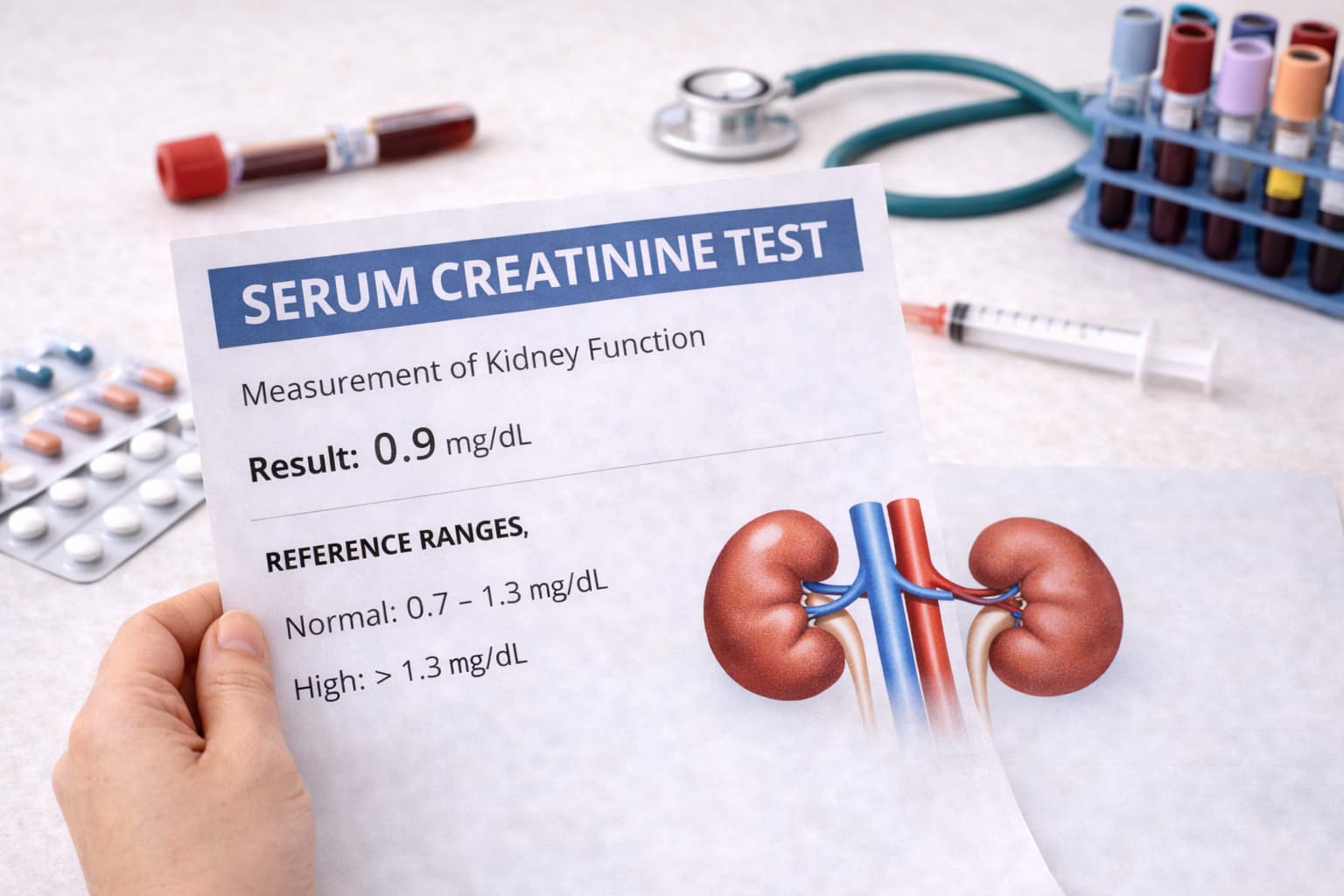
The serum creatinine test is one of the most widely used tools for evaluating kidney filtration capacity. It measures the amount of creatinine circulating in the bloodstream, a waste product released during muscle metabolism. Since healthy kidneys remove creatinine efficiently, rising concentrations may signal impaired renal function.
For pathologists and healthcare professionals, serum creatinine trends support diagnostic reasoning, therapy decisions, and risk assessment for a range of scenarios.
Serum Creatinine Test
A serum creatinine test measures the amount of creatinine in the blood. Creatinine is a waste product produced during normal muscle activity and removed from the bloodstream mainly through the kidneys.
A high serum creatinine result may indicate that the kidneys are filtering less effectively, but one result cannot diagnose kidney disease by itself. Creatinine also varies with age, sex, muscle mass, recent exercise, diet, hydration, medicines and laboratory method.
- The result should be interpreted with:
- The laboratory’s reference interval
- Previous creatinine results
- Estimated glomerular filtration rate, or eGFR
- Urine albumin-to-creatinine ratio, or UACR
- Symptoms, medicines and medical history
Current kidney guidelines recommend assessing people at risk of chronic kidney disease using both glomerular filtration and urine albumin measurements rather than relying on serum creatinine alone.
What Does Serum Creatinine Measure?
Creatinine is formed during the normal use and breakdown of creatine in skeletal muscle. It enters the bloodstream and is filtered by the kidneys before being excreted in urine.
When kidney filtration decreases, creatinine may accumulate in the blood. However, the amount of creatinine a person produces also depends on muscle mass. A muscular adult may naturally have a higher baseline result, while an older or frail person may have a result within the laboratory range despite reduced kidney function.
For this reason, serum creatinine is commonly used to calculate eGFR, which provides a more useful estimate of kidney filtration than the creatinine number alone.
Serum Creatinine Test Procedure and Preparation
A serum creatinine test requires a blood sample collected from a vein. The blood draw generally takes only a few minutes.
Fasting is not always required for a standalone serum creatinine test. However:
- A provider may advise avoiding meat for approximately 24 hours because cooked meat can temporarily increase creatinine.
- Fasting may be required when creatinine is included in a basic or comprehensive metabolic panel.
- Medicines and supplements can affect the result.
- Creatine supplements and recent intense exercise should be disclosed.
- Patients should not stop prescribed medicines unless instructed by their healthcare provider.
Preparation instructions can vary according to the reason for testing and the other tests ordered at the same time.
Serum Creatinine Normal Range
Serum creatinine reference intervals differ according to age, sex, muscle mass, assay method and the laboratory performing the test.
The following are example reference intervals published by Mayo Clinic Laboratories. They should not replace the range printed on an individual laboratory report.
| Age or Group | Example Serum Creatinine Range |
|---|---|
| Infants, 0–11 months | 0.17–0.42 mg/dL |
| Children, 1–5 years | 0.19–0.49 mg/dL |
| Children, 6–10 years | 0.26–0.61 mg/dL |
| Children, 11–14 years | 0.35–0.86 mg/dL |
| Males aged 15 years and above | 0.74–1.35 mg/dL |
| Females aged 16 years and above | 0.59–1.04 mg/dL |
These ranges are examples from one laboratory system. Another laboratory may use a slightly different method or reference population and therefore print a different interval.
Important interpretation points
- Do not compare a child’s creatinine result with an adult reference interval.
- Adult men often have higher values than adult women because average muscle mass differs.
- Older adults may produce less creatinine because of lower muscle mass.
- A result within range does not always rule out early kidney disease.
- A mildly elevated result does not automatically mean kidney failure.
- Trends over time are often more informative than one isolated result.
What Do Creatinine Results Such as 0.9, 1.2 or 1.4 Mean?
A creatinine result cannot be classified accurately without knowing the person’s age, sex, muscle mass, laboratory range, eGFR and previous results.
| Serum Creatinine Result | General Interpretation |
|---|---|
| 0.9 mg/dL | Falls within many commonly used adult reference intervals, but kidney function should still be interpreted with eGFR and clinical context. |
| 1.2 mg/dL | May fall within some adult male ranges but may be above the upper limit used for some adult women. |
| 1.4 mg/dL | Above many commonly used adult reference intervals and may require review, particularly when new or increasing. |
| 2.0 mg/dL | Above common adult reference intervals and generally warrants timely clinical assessment, eGFR calculation, and evaluation of the cause. |
These examples are not diagnostic thresholds. A change from 0.7 to 1.2 may be more clinically important for one person than a stable result of 1.3 is for another.
MedlinePlus notes that normal results depend on muscle mass, diet, age and activity, and that a single abnormal creatinine result normally requires repeat or complementary testing.
High Serum Creatinine: Possible Causes
A high serum creatinine result may occur when kidney filtration decreases, but it can also rise temporarily for reasons unrelated to permanent kidney damage.
Possible causes include:
- Acute kidney injury
- Chronic kidney disease
- Reduced blood flow to the kidneys
- Dehydration
- Urinary obstruction
- Kidney infection
- Heart failure
- Diabetes-related kidney damage
- Severe muscle injury or rhabdomyolysis
- Recent intense exercise
- A large cooked-meat meal
- Creatine supplements
- Certain medicines
- Some pregnancy-related complications
A high result should be compared with the person’s baseline, eGFR, urine findings, symptoms and medication history. One elevated result does not identify the cause.
Low Serum Creatinine: Possible Causes
Low serum creatinine is less common and is usually related to reduced creatinine production rather than increased kidney filtration.
Possible causes include:
- Low muscle mass
- Age-related muscle loss
- Malnutrition
- Prolonged illness
- Neuromuscular conditions
- Significant weight loss
- Severe liver disease
- Pregnancy-related increases in kidney filtration
A low creatinine result may make creatinine-based eGFR less reliable in people with very low muscle mass. A clinician may consider cystatin C or another method when a more accurate filtration estimate is needed.
Serum Creatinine, eGFR and UACR
Serum creatinine is most useful when interpreted with eGFR and UACR.
eGFR
eGFR estimates how effectively the kidneys filter blood. In adults, laboratories commonly calculate it from serum creatinine together with demographic information using a validated equation.
| eGFR Category | Value (mL/min/1.73 m²) | General Description |
|---|---|---|
| G1 | 90 or above | Normal or high filtration |
| G2 | 60–89 | Mildly decreased filtration |
| G3a | 45–59 | Mildly to moderately decreased |
| G3b | 30–44 | Moderately to severely decreased |
| G4 | 15–29 | Severely decreased |
| G5 | Below 15 | Kidney failure range |
G1 or G2 alone does not confirm chronic kidney disease unless another marker of kidney damage is present. A single low eGFR also does not prove that the condition is chronic. KDIGO recommends confirming chronicity over at least three months through previous or repeated results and other clinical evidence.
UACR
UACR compares albumin and creatinine in a urine sample. It helps detect albumin leakage, which can be an early marker of kidney damage even when serum creatinine appears normal.
A UACR above 30 mg/g may indicate albuminuria and usually requires confirmation and clinical assessment. Kidney evaluation is more complete when eGFR and UACR are considered together.
Check - Urine albumin-to-creatinine ratio test
Integrating eGFR, Creatinine Clearance, and UACR
Kidney assessment becomes more reliable when serum creatinine interacts with other markers:
- eGFR incorporates age, sex, height, and weight. A value below 60 may indicate chronic kidney disease.
- Creatinine clearance, drawn from a 24-hour urine collection, provides a direct measurement of filtration.
- UACR evaluates early glomerular injury through albumin leakage.
Because creatinine fluctuates with physical activity, diet, or muscle mass, decisions anchored solely on a serum creatinine test report can miss early or mild impairment. Combining metrics usually aligns better with clinical outcomes.
How to Read a Serum Creatinine Report
A serum creatinine report should be reviewed in this order:
- Confirm the patient name and collection date.
- Locate the serum creatinine result.Check whether the unit is mg/dL or µmol/L.
- Compare the result with the laboratory’s printed reference interval.
- Check whether the report includes eGFR.
- Compare the value with previous results.
- Review abnormal-result flags and laboratory comments.
- Consider medicines, supplements, hydration, exercise and recent meat intake.
- Discuss an unexpected or changing result with the treating clinician.
Serum Creatinine Test Uses in Clinical Practice
Renal monitoring has broad applications across specialities. Clinicians request serum creatinine testing to gauge kidney status, diagnose acute or chronic kidney diseases, examine therapy response in CKD, or detect drug-related renal injury.
Testing becomes relevant in patients with oedema, nausea, fatigue, cognitive issues, altered urination, appetite changes, or unexplained shortness of breath. It also supports risk screening for individuals with diabetes, hypertension, cardiovascular disease, obesity, smoking history, family-linked kidney disease, prior renal abnormalities, or organ transplant status.
Interpreting the Test Report
A “normal” number does not assure optimal filtration. Early kidney disease might still display standard creatinine levels due to compensation by remaining nephrons. Likewise, an elevated value must be compared with baseline results, hydration status, dietary intake, and medication exposure.
Patients with persistent abnormalities may require imaging, repeat testing, or referral.
Serum Creatinine Test Before a CT Scan
A recent serum creatinine or eGFR result may be requested before a CT examination involving iodinated contrast, especially for people with known kidney disease or relevant risk factors.
The purpose is to help the radiology team assess kidney function and plan the safest imaging approach. The assessment should use eGFR and the overall clinical context rather than one creatinine number alone.
Current radiology guidance distinguishes between contrast-associated acute kidney injury—kidney injury occurring after contrast administration—and contrast-induced acute kidney injury, where contrast is considered the cause. The need for testing, contrast modification or preventive measures should be decided by the treating and radiology teams.
When Should an Abnormal Result Be Reviewed?
Contact a healthcare professional when:
- Creatinine remains above the laboratory range
- The value is increasing compared with previous tests
- eGFR is reduced
- Urine albumin or blood is present
- There is swelling of the feet, legs, hands or eyelids
- Urine becomes unusually foamy or bloody
- Urination increases or decreases significantly
- There is persistent fatigue, nausea, itching or loss of appetite
- A person with kidney disease develops shortness of breath or confusion
- The result changed suddenly after an illness, dehydration, medicine or procedure
- Early chronic kidney disease may not cause noticeable symptoms. People with diabetes, high blood pressure, heart disease or a family history of kidney disease may need testing even when they feel well.
When Will You Get Results
Many pathology labs in India report serum creatinine test time within a few hours, depending on sample load, analyser throughput, and workflow efficiency. A faster turnaround time supports emergency care and hospital decision cycles.
Labs with automated accessioning, integrated analysers, and structured digital reporting demonstrate shorter waiting periods. These operational advantages also reduce pre-analytical delays and transcription errors.
Serum Creatinine Test Price in India
The serum creatinine test price varies across regions, lab types, and technology platforms. In India, it ranges from around ₹140 to ₹329. High-volume diagnostic centres may have lower pricing due to automated workflows and centralised analysers. Smaller labs that rely on manual processes incur higher per-sample costs due to reagent expenses and labour demands.
Modernising Lab Operations
As renal testing volumes expand, laboratories require reliable pathology lab equipment plus a digital backbone that supports accuracy, compliance, and high throughput. Automated interfacing between analysers and software platforms reduces manual interventions and lowers error rates. Standardised formatting ensures clean serum creatinine test reports that clinicians can interpret without delays.
This is where an intelligent LIS Software becomes a strategic investment.
How Flabs Pathology Software Elevates Serum Creatinine Testing
Flabs LIS Software integrates operational, analytical, and patient-facing modules designed for pathology labs of all sizes. By embedding AI-driven workflow automation, the platform streamlines tasks that ordinarily consume staff time.
Streamlined Lab Operations
Flabs enables smooth patient registration, automated data capture from analysers, and production of QR-coded reports for secure sharing. Since the system integrates with WhatsApp, labs maintain consistent communication without manual follow-ups.
Each step, from sample receipt to verification, flows with fewer bottlenecks, allowing labs to raise productivity without increasing headcount.
Patient Experience
Patients can access reports instantly through a phone-number login. The portal encourages timely clinical decisions, where serum creatinine trends influence ongoing care.
User-Friendly Interface
The interface favours intuitive navigation, so technicians, pathologists, and administrators adapt quickly. Consequently, less time is spent on software handling.
Affordable and Scalable
Flabs supports single-site labs or multi-centre operations. As volumes grow, labs can add collection centres, maintain consistent reporting standards, and store data securely with compliant backups and disaster-recovery protocols.
Final Thoughts
The serum creatinine test is an important starting point for evaluating kidney filtration, but it should not be interpreted as a stand-alone diagnosis.
The most useful assessment combines the laboratory’s reference interval, previous creatinine results, eGFR, urine albumin testing, medicines, symptoms and medical history. A normal result does not always exclude early kidney disease, and one high result does not automatically confirm chronic kidney disease.
Unexpected, persistent or rapidly changing results should be discussed with a qualified healthcare professional.
Related read-
Get Started at ₹1!
Try Flabs for a full month for just ₹1.
Follow us on