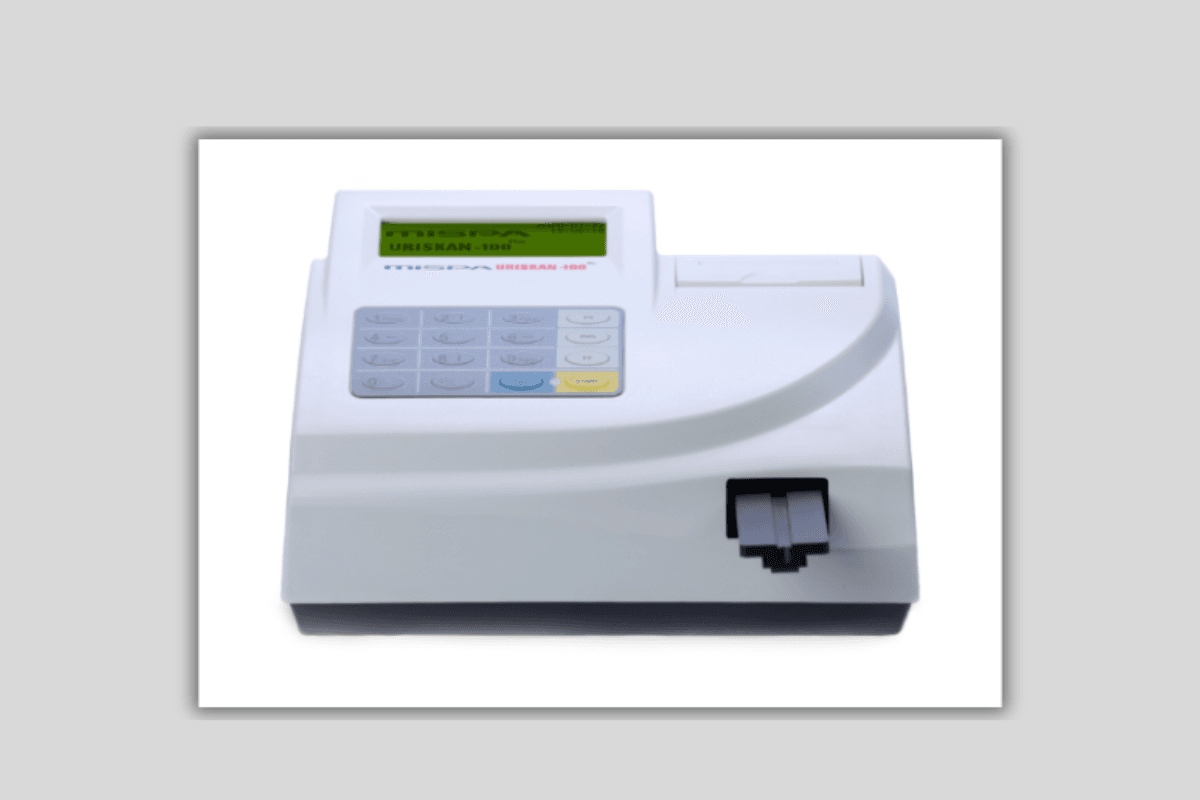
A urine analyser is a sophisticated laboratory device designed to automate the chemical analysis of urine samples. It is sometimes known as a urine analyser machine. The urine analyser systematically examines urine components, aiding healthcare professionals in detecting conditions related to the urinary tract, liver, diabetes, pancreatitis, and more. Pathologists and healthcare professionals rely on these analysers to deliver accurate, timely, and reliable results.
Urine Analyser Working Principle
The urine analyser's working principle involves the use of test strips impregnated with specific chemical reagents. The analyser, usually controlled by a microcomputer, uses optical sensors to detect colour changes on these reagent strips once they react with urine components.
Reagent pads on each strip independently react with different urine substances e.g., glucose, protein, ketones, pH levels, blood, and leukocytes. After dipping the strip into a urine sample, the machine places it within a colourimetric chamber.
The reagent pads are illuminated by dual-wavelength reflected light, which is received and interpreted by an optical sensor or spherical integrator. This sophisticated system precisely measures the colour intensity variations, directly correlating to the concentrations of various substances in urine.
Additionally, a compensation pad is included to counterbalance errors caused by urine colour variations. Such rigorous calibration ensures minimises false readings. Modern urine analysers also employ spectrophotometry for quantitative analysis. They enable real-time monitoring of optical signals during analysis.
Urine Analysis: Definition and Applications
Urine analysis is a standard laboratory test involving the evaluation of urine components to detect diseases and monitor overall health. Traditionally, medical practitioners assessed urine visually, analysing colour, smell, and consistency. But urine analysers nwoadays can automate these processes, providing precise and reproducible results.
Types of Urine Analysers
| Type of Analyser | Description |
|---|---|
| Fully Automatic Analyzers | Automate the entire testing process with high throughput and minimal manual intervention. |
| Semi-Automatic Analyzers | Combine automated functions with some manual steps, requiring technician involvement. |
| Point-of-Care (PoC) Analyzers | Portable devices are designed for immediate, on-site testing in clinical or emergency settings. |
| Benchtop Analysers | Compact instruments for small laboratories or research environments. |
Urine Analyser Uses
Urine analysers deliver rapid and detailed reports, substantially reducing turnaround times in laboratories. Many of the urine analyser uses include:
- Screening for urinary tract infections by detecting leukocytes and nitrites.
- Monitoring glucose levels for diabetic patients.
- Assessing kidney health through protein and blood analysis.
- Identifying liver diseases via bilirubin and urobilinogen detection.
- Detecting metabolic abnormalities by analysing ketones and pH levels.
Advanced urine analysers can also perform sediment examination, which identifies and counts microscopic elements like red blood cells, white blood cells, epithelial cells, casts, crystals, and microorganisms. It utilises centrifugation for particle sedimentation.
These analysers often incorporate high-power microscopy with image analysis software for automated counting and classification of sediment components based on morphology.
Urine Analyser Test Procedure
- Collect a fresh urine sample in a sterile container.
- Immerse the reagent strip briefly in the urine sample.
- Insert the reagent strip into the analyser’s reading slot or tray.
- The machine automatically reads and interprets the chemical reactions, providing results within minutes.
Urine Test Machine Price and Considerations
The cost of a urine test machine in India varies based on its features, level of automation, and analytical capabilities. Entry-level semi-automated analysers and compact models for smaller labs can start as low as ₹27,000 to ₹35,000. These are suitable for clinics or laboratories with lower sample volumes and basic testing needs.
Mid-range models like advanced semi-automated and some fully automated urinalysis systems analysers fall within the ₹45,000 to ₹1,00,000 range.
For laboratories handling large sample volumes or requiring integrated microscopy, high-throughput automation, or connectivity with Laboratory Information Management Systems (LIMS), fully automated urine analysers may range from ₹1,00,000 to over ₹3,50,000. Some premium models can exceed ₹16,00,000.
Maintaining and Calibrating a Urine Analyser
Proper maintenance of urine analysers is vital for dependable performance. Regular cleaning of the colourimetric chamber, optical components, and sample handling areas prevents contamination and improves longevity. Scheduled calibration using known control standards maintains analytical accuracy and compliance with clinical laboratory standards.
Labs must ensure daily, weekly, and monthly maintenance protocols as recommended by the manufacturer. Regular software updates keep the system current with the latest analytical methodologies and security features.
For laboratories with high sample volumes, establishing a preventive maintenance contract with the supplier can minimise downtime substantially.
Selecting the Right Urine Analyser
Choosing the right urine analyser involves assessing lab-specific requirements:
- Evaluate workload volume to decide between semi-automated or fully automated systems.
- Review the accuracy standards required by your laboratory.
- Compare urine analyser prices and ongoing reagent costs.
- Confirm warranty coverage and availability of after-sales support.
When selecting a urine analyser, also consider its data integration capabilities with existing laboratory systems. Modern analysers should enable connectivity with Laboratory Information Management Systems (LIMS) for efficient data management and reporting.
Evaluate the security measures implemented to protect patient information. Also, assess the analyser's compatibility with other laboratory instruments in your laboratory ecosystem.
Suggested - Elisa Reader
Flabs LIMS
Flabs Pathology Software achieves the necessary integration with urine analysers effortlessly. It offers automated report generation, WhatsApp integration, and QR-coded sharing, streamlining lab operations. Its user-friendly design, patient portal, and scalable features make it suitable for labs of all sizes.
Start your 5-day free trial of Flabs now and experience smoother lab management from day one.
Also check - Cryostat for Histology: Main Benefits and Considerations
Get Started at ₹1!
Try Flabs for a full month for just ₹1.
Follow us on